
Homework Answers
 hey
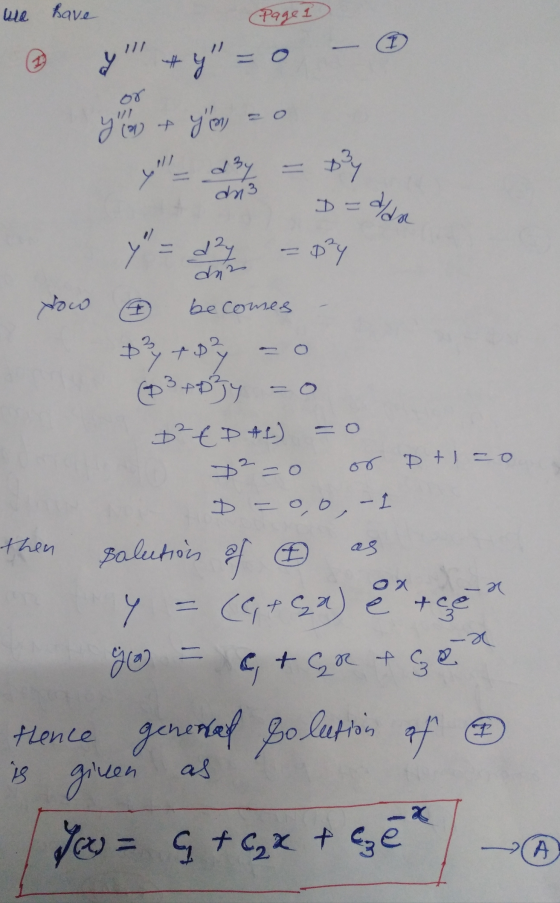
dear! This is your complete solution in detail. Plz like it ???I
did hard work for you.
hey
dear! This is your complete solution in detail. Plz like it ???I
did hard work for you.
Add Answer to:
2. Solve (i) Find the general solution of y" + y' = 0. Here, don't have...
Solve the initial value problem: y''-2y'+y=0, y(0)=2, y'(0)=1 . A) Write its characteristic equation. B) Write...
Solve the initial value problem: y''-2y'+y=0, y(0)=2, y'(0)=1 . A) Write its characteristic equation. B) Write a fundamental set of solutions of the homogenous equation. C) Prove that your solutions from B) are independent. D) Find the solution satisfying initial conditions.
(1 point) The general solution of the homogeneous differential equation can be written as 2 where...
 (1 point) The general solution of the homogeneous differential equation can be written as 2 where a, b are arbitrary constants and is a particular solution of the nonhomogeneous equation By superposition, the general solution of the equation 2y 5ryy 18z+1 isyp so yax-1+bx-5+1+3x NOTE: you must use a, b for the arbitrary constants. Find the solution satisfying the initial conditions y(1) 3, y'(1) 8 The fundamental theorem for linear IVPs shows that this solution is the unique solution to...
6. [0/2 points) DETAILS PREVIOUS ANSWERS Find the general (real) solution of the differential equation: y"-...
 6. [0/2 points) DETAILS PREVIOUS ANSWERS Find the general (real) solution of the differential equation: y"- 2y'- 15y=-51 sin(3 x) -3x | Ae 5x + Be 34 y(x) = 8.5 + -cos(3x) * 17 51 14 sin(3x) - - Find the unique solution that satisfies the initial conditions: Y(0) = 2.5 and y'(o)=37 y(x) = 7. [-12 Points) DETAILS Find the general (real) solution of the differential equation: y" + 4y' + 4y=64 cos(2x) y(x) = Find the unique solution...
4. Consider the following initial value problem: y(0) = e. (a) Solve the IVP using the...
 4. Consider the following initial value problem: y(0) = e. (a) Solve the IVP using the integrating factor method. (b) What is the largest interval on which its solution is guaranteed to uniquely exist? (c) The equation is also separable. Solve it again as a separable equation. Find the particular solution of this IVP. Does your answer agree with that of part (a)? 5 Find the general solution of the differential equation. Do not solve explicitly for y. 6,/Solve explicitly...
(c) (i) Find the general solution of the following partial differential equation y, = 2y sin...
 (c) (i) Find the general solution of the following partial differential equation y, = 2y sin x + e-x Whatische solution when the initial conditions are v(0,y)--y, and (ii) y(x, 0) = cos x ? (10 Marks)
Q5) Find a general solution. Check your answer by substitution. 4y" – 25y = 0 y"...
 Q5) Find a general solution. Check your answer by substitution. 4y" – 25y = 0 y" + 36y = 0 y" + 6y' + 8.96y = 0) y" + 2k%y' + k4y = 0 Q6) Solve the IVP. Check that your answer satisfies the ODE as well as the initial conditions. Show the details of your work. y" + 25y = 0, y(0) = 4.6, y'(0) = -1.2 4y" – 4y' – 3y = 0, y(-2) = e, y'(-2) =...
y' = f(y, t), y(t0) = y0. (i) what conditions guaranteeing a unique solution to the...
y' = f(y, t), y(t0) = y0. (i) what conditions guaranteeing a unique solution to the nonlinear initial value problem (ii) After checking the conditions, state what the theorem predicts for the initial value problem y' = (-x2 )/y , y(1) = 0. (iii) Solve the above initial value problem and find two distinct solutions (iv) Explain if results in (iii) and in (ii) contradict each other
4. Given that {cos x, sin 2, 1) is a fundamental set of solutions for y"...
 4. Given that {cos x, sin 2, 1) is a fundamental set of solutions for y" + y = 0, solve the initial value problem with conditions y(0) = 3, y'(0) = 5, "(0) = -4. 4. Given that {coso, sin x 1} is a fundamental set of solutions for y'" + y = 0, solve the initial value problem with conditions y(0) - 3, V'(0) -- 5. "(0) -4
(17 points) (a) Find the general solution of the differential equation y" (t) + 4y(t) =...
 (17 points) (a) Find the general solution of the differential equation y" (t) + 4y(t) = 0. general solution = (Use the letters A and B for any constants you have in your solution.) (b) For each of the following initial conditions, find a particular solution. (i) y(0) = 0, y'(0) = 1: y = (ii) y(0) = 1, y'(0) = 0:y= (iii) y(0) = 1, y(1) = 0:y= (iv) y(0) = 0, y(1) = 1: y = (On a...
Two solutions to y' + 6y + 25 = 0 are y1 = = e 3t...
 Two solutions to y' + 6y + 25 = 0 are y1 = = e 3t sin(4t), y2 = e cos( 4t). a) Find the Wronskian. W b) Find the solution satisfying the initial conditions y(0) = - 4, y'(0) = 0 y =
 (1 point) The general solution of the homogeneous differential equation can be written as 2 where a, b are arbitrary constants and is a particular solution of the nonhomogeneous equation By superposition, the general solution of the equation 2y 5ryy 18z+1 isyp so yax-1+bx-5+1+3x NOTE: you must use a, b for the arbitrary constants. Find the solution satisfying the initial conditions y(1) 3, y'(1) 8 The fundamental theorem for linear IVPs shows that this solution is the unique solution to...
 6. [0/2 points) DETAILS PREVIOUS ANSWERS Find the general (real) solution of the differential equation: y"- 2y'- 15y=-51 sin(3 x) -3x | Ae 5x + Be 34 y(x) = 8.5 + -cos(3x) * 17 51 14 sin(3x) - - Find the unique solution that satisfies the initial conditions: Y(0) = 2.5 and y'(o)=37 y(x) = 7. [-12 Points) DETAILS Find the general (real) solution of the differential equation: y" + 4y' + 4y=64 cos(2x) y(x) = Find the unique solution...
 4. Consider the following initial value problem: y(0) = e. (a) Solve the IVP using the integrating factor method. (b) What is the largest interval on which its solution is guaranteed to uniquely exist? (c) The equation is also separable. Solve it again as a separable equation. Find the particular solution of this IVP. Does your answer agree with that of part (a)? 5 Find the general solution of the differential equation. Do not solve explicitly for y. 6,/Solve explicitly...
 (c) (i) Find the general solution of the following partial differential equation y, = 2y sin x + e-x Whatische solution when the initial conditions are v(0,y)--y, and (ii) y(x, 0) = cos x ? (10 Marks)
 Q5) Find a general solution. Check your answer by substitution. 4y" – 25y = 0 y" + 36y = 0 y" + 6y' + 8.96y = 0) y" + 2k%y' + k4y = 0 Q6) Solve the IVP. Check that your answer satisfies the ODE as well as the initial conditions. Show the details of your work. y" + 25y = 0, y(0) = 4.6, y'(0) = -1.2 4y" – 4y' – 3y = 0, y(-2) = e, y'(-2) =...
 4. Given that {cos x, sin 2, 1) is a fundamental set of solutions for y" + y = 0, solve the initial value problem with conditions y(0) = 3, y'(0) = 5, "(0) = -4. 4. Given that {coso, sin x 1} is a fundamental set of solutions for y'" + y = 0, solve the initial value problem with conditions y(0) - 3, V'(0) -- 5. "(0) -4
 (17 points) (a) Find the general solution of the differential equation y" (t) + 4y(t) = 0. general solution = (Use the letters A and B for any constants you have in your solution.) (b) For each of the following initial conditions, find a particular solution. (i) y(0) = 0, y'(0) = 1: y = (ii) y(0) = 1, y'(0) = 0:y= (iii) y(0) = 1, y(1) = 0:y= (iv) y(0) = 0, y(1) = 1: y = (On a...
 Two solutions to y' + 6y + 25 = 0 are y1 = = e 3t sin(4t), y2 = e cos( 4t). a) Find the Wronskian. W b) Find the solution satisfying the initial conditions y(0) = - 4, y'(0) = 0 y =
Most questions answered within 3 hours.
-
Where is the error in this code sequence?
String s1 = "Hello";
String s2 = "ello";...
asked 11 months ago -
Financial data for Joel de Paris, Inc., for last year
follow:
Joel de Paris, Inc.
Balance...
asked 11 months ago -
Consider this reaction:
Al2(SO4)3 (aq)+ BaCl3
(aq) Al2Cl6 (aq)- +
3BaSO4(s) . What is the...
asked 11 months ago -
Suppose that Savneet is considering increasing her
recent random sample from 20 car rentals to 40...
asked 11 months ago -
Trucks arrive at an unloading terminal at an average rate of 120
per hour.
Trucks arrive...
asked 11 months ago -
Why are methanol and ethanol completely soluble in water while
octanol is not very little soluble....
asked 11 months ago -
A facilities manager at a university reads in a research report
that the mean amount of...
asked 11 months ago -
When the CuSO4 is rehydrated by adding water to the anhydrous
compound, is this an endothermic...
asked 11 months ago -
A ray of sunlight is passing from diamond into crown glass; the
angle of incidence is...
asked 11 months ago -
A block of mass 0.249 kg is placed on top of a light, vertical
spring of...
asked 11 months ago -
how do the kidneys compensate in the presences of acidosis
a) trigger hyperventilate
b) reserve acid...
asked 11 months ago -
Question 501 pts
The rental rate of capital to the firm increases. Which of the
following...
asked 11 months ago