
Homework Answers
Add Answer to:
PRORO332 Evaluation of the Gas Law Coestant 69 Dahida Ch Date Pre-Laboratory Assi nt gnme 1....
PROP0332: Evaluation of the Gas Law Constant Name Section Date Pre-Laboratory Assignment 1. A student following...
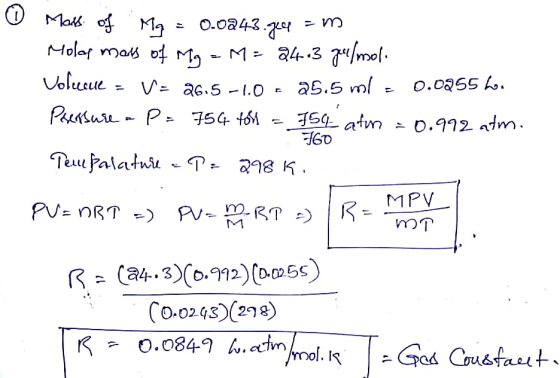
 PROP0332: Evaluation of the Gas Law Constant Name Section Date Pre-Laboratory Assignment 1. A student following the procedure described in this module collected the following data: 20 mass Mg 8 initial syringe volume, mL final syringe volume, mL barometric pressure, torr temperature, K Calculate the gas law constant. 0.0243 1.0 26.5 754 298 answer 2. What would be the volume of hydrogen gas produced by the reaction of 0.243 g of magnesium metal and collected at 750 torr and 298...
Can you help answer all questions? I dont know how to answer any of the question...
 Can you help answer all questions?
I
dont know how to answer any of the question i dont know what kind
of math to use
PROP033: En of the Gul Pre-Laboratory Assignment 1. A student following the procedure described in this module collectes procedure described in this module collected the following data 0.0243 10 mass Mg 8 initial syringe volume, mL final syringe volume, ml barometric pressure, torr temperature, K Calculate the gas law constant. 26.5 754 298 answer 2....
Can you help answer all questions?
I
dont know how to answer any of the question i dont know what kind
of math to use
PROP033: En of the Gul Pre-Laboratory Assignment 1. A student following the procedure described in this module collectes procedure described in this module collected the following data 0.0243 10 mass Mg 8 initial syringe volume, mL final syringe volume, ml barometric pressure, torr temperature, K Calculate the gas law constant. 26.5 754 298 answer 2....
(Use the spaces provided for the answe 1. An evaluation of R was performed, following the...
 (Use the spaces provided for the answe 1. An evaluation of R was performed, following the procedure described in this module. The barometric pressure was 736 torr, the temperature was 295 K, and the volume of hydrogen gas collected was 35.6 mL. The calculated value of R was 82.1 mL atm K-1 mol-1 How many grams of magnesium metal was (1) used? answer (2) If the vapor pressure of water had not been taken into account, what would have been...
Using the equation: Mg(s) + 2HCl(aq)——> H2(g) + MgCl2(aq) complete the prelab. Prelab Questions 1. A...
 Using the equation: Mg(s) + 2HCl(aq)——> H2(g) + MgCl2(aq)
complete the prelab.
Prelab Questions 1. A student following the procedures in this b i collected the following data mass Mg. 0.0243 initial syringe volume, ml 0.8 final syringe volume, ml barometric pressure, torr temperature, 293.5 Calculate the value of the universal gas constant, R. 26.3 748 2. What would be the volume of hydrogen pas produced by the reaction of 0.100 g of magnesium metal, collected at 750 torr and...
Using the equation: Mg(s) + 2HCl(aq)——> H2(g) + MgCl2(aq)
complete the prelab.
Prelab Questions 1. A student following the procedures in this b i collected the following data mass Mg. 0.0243 initial syringe volume, ml 0.8 final syringe volume, ml barometric pressure, torr temperature, 293.5 Calculate the value of the universal gas constant, R. 26.3 748 2. What would be the volume of hydrogen pas produced by the reaction of 0.100 g of magnesium metal, collected at 750 torr and...
Using the equation: Mg(s) + 2HCl(aq) ———> H2(g) + MgCl2(aq), complete the worksheet. Prelab Questions ....
 Using the equation: Mg(s) + 2HCl(aq) ———> H2(g) + MgCl2(aq),
complete the worksheet.
Prelab Questions . A student following the procedures in this lab exercise collected the following data: mass Mg, g 0.0243 initial syringe volume, mi 0.8 final syringe volume, ml 26.3 barometric pressure, tor 748 temperature, K 293.5 Calculate the value of the universal gas constant, R. 2. What would be the volume of hydrogen gas produced by the reaction of 0.100 g of magnesium metal, collected at...
Using the equation: Mg(s) + 2HCl(aq) ———> H2(g) + MgCl2(aq),
complete the worksheet.
Prelab Questions . A student following the procedures in this lab exercise collected the following data: mass Mg, g 0.0243 initial syringe volume, mi 0.8 final syringe volume, ml 26.3 barometric pressure, tor 748 temperature, K 293.5 Calculate the value of the universal gas constant, R. 2. What would be the volume of hydrogen gas produced by the reaction of 0.100 g of magnesium metal, collected at...
1. An evaluation of R was performed using the procedures outlined in this exercise. The barometric...
1. An evaluation of R was performed using the procedures outlined in this exercise. The barometric pressure was 735 torr and the temperature was 21.5 degree Celsius. The volume of H2(g) was collected was 32.7 mL. The calculated value of R was 0.0817 L*atm/mol*K. a) How many grams of Mg metal were used in this determination? b) If the correction for the vapor pressure of water had not been performed, what would be the calculated value of R? c) If...
Pre-Lab Questions 1. What volume of hydrogen, measured at 25 oC and 1.00 atm, can be...
 Pre-Lab Questions 1. What volume of hydrogen, measured at 25 oC and 1.00 atm, can be produced by dissolving 5.0 g of magnesium in hydrochloric acid? (Write and balance the equation for the reaction first.) A sample of iroa reacted with hydrodhlovie acid. The libernwed hydrogen of the collection of gas pressure to find the pressure of the hydrogen gas.) 40.1 mL when collected of 750 torT. What is the mass of the sample of iron? (Because over water, the...
PRE- LAB QUESTIONS NAME: 1. Write a balanced chemical equation for the reaction of aluminum metal...
 PRE- LAB QUESTIONS NAME: 1. Write a balanced chemical equation for the reaction of aluminum metal with hydrochloric acid. UAL TI3 3H2 ZAltaHCI od bw 2. Use the equation above to calculate the mass of aluminum that is needed to prepare between mL of hydrogen gas. The laboratory temperature is 22.0°C and the barometric pressure is 760.0 tor. 966 04m570 =0.0227 Pu K AT D.032 24S K 3. Calculate the minimum volume of 6.0 M HCI that you will need...
Pre-Laboratory Questions for Lab 10 1. The ideal gas law is an equation used for examining...
 Pre-Laboratory Questions for Lab 10 1. The ideal gas law is an equation used for examining ideal gases. The four tenets of kinetic molecular theory define what an ideal gas is. However, no ideal gases exist in nature, only real gases do. Van der Waals' equation attempts to make corrections to real gases that do not exhibit ideal behavior. Two gases are given below that do not exhibit ideal behavior. Explain for each one why it doesn't exhibit ideal behavior....
*SHOW YOUR WORK* (Boyle's Law): 1. What is the final volume (in mL) or argon gas...
*SHOW YOUR WORK* (Boyle's Law): 1. What is the final volume (in mL) or argon gas is 50.0 mL at 705 torr is compressed to a pressure of 2.75 atm, at constant temperature? (Lewis Dot Structures): 2. Draw Lewis structures for the following molecules. Include partial charges, AXE designation, (example: AX2 E2), Electron-pair geometry and geometric-molecular shapes. Is it Polar or Non-Polar? CH2Cl2 SO2 3. Which of the following explains why the pressure of a gas increases when the temperature...
 PROP0332: Evaluation of the Gas Law Constant Name Section Date Pre-Laboratory Assignment 1. A student following the procedure described in this module collected the following data: 20 mass Mg 8 initial syringe volume, mL final syringe volume, mL barometric pressure, torr temperature, K Calculate the gas law constant. 0.0243 1.0 26.5 754 298 answer 2. What would be the volume of hydrogen gas produced by the reaction of 0.243 g of magnesium metal and collected at 750 torr and 298...
 Can you help answer all questions?
I
dont know how to answer any of the question i dont know what kind
of math to use
PROP033: En of the Gul Pre-Laboratory Assignment 1. A student following the procedure described in this module collectes procedure described in this module collected the following data 0.0243 10 mass Mg 8 initial syringe volume, mL final syringe volume, ml barometric pressure, torr temperature, K Calculate the gas law constant. 26.5 754 298 answer 2....
Can you help answer all questions?
I
dont know how to answer any of the question i dont know what kind
of math to use
PROP033: En of the Gul Pre-Laboratory Assignment 1. A student following the procedure described in this module collectes procedure described in this module collected the following data 0.0243 10 mass Mg 8 initial syringe volume, mL final syringe volume, ml barometric pressure, torr temperature, K Calculate the gas law constant. 26.5 754 298 answer 2....
 (Use the spaces provided for the answe 1. An evaluation of R was performed, following the procedure described in this module. The barometric pressure was 736 torr, the temperature was 295 K, and the volume of hydrogen gas collected was 35.6 mL. The calculated value of R was 82.1 mL atm K-1 mol-1 How many grams of magnesium metal was (1) used? answer (2) If the vapor pressure of water had not been taken into account, what would have been...
 Using the equation: Mg(s) + 2HCl(aq)——> H2(g) + MgCl2(aq)
complete the prelab.
Prelab Questions 1. A student following the procedures in this b i collected the following data mass Mg. 0.0243 initial syringe volume, ml 0.8 final syringe volume, ml barometric pressure, torr temperature, 293.5 Calculate the value of the universal gas constant, R. 26.3 748 2. What would be the volume of hydrogen pas produced by the reaction of 0.100 g of magnesium metal, collected at 750 torr and...
Using the equation: Mg(s) + 2HCl(aq)——> H2(g) + MgCl2(aq)
complete the prelab.
Prelab Questions 1. A student following the procedures in this b i collected the following data mass Mg. 0.0243 initial syringe volume, ml 0.8 final syringe volume, ml barometric pressure, torr temperature, 293.5 Calculate the value of the universal gas constant, R. 26.3 748 2. What would be the volume of hydrogen pas produced by the reaction of 0.100 g of magnesium metal, collected at 750 torr and...
 Using the equation: Mg(s) + 2HCl(aq) ———> H2(g) + MgCl2(aq),
complete the worksheet.
Prelab Questions . A student following the procedures in this lab exercise collected the following data: mass Mg, g 0.0243 initial syringe volume, mi 0.8 final syringe volume, ml 26.3 barometric pressure, tor 748 temperature, K 293.5 Calculate the value of the universal gas constant, R. 2. What would be the volume of hydrogen gas produced by the reaction of 0.100 g of magnesium metal, collected at...
Using the equation: Mg(s) + 2HCl(aq) ———> H2(g) + MgCl2(aq),
complete the worksheet.
Prelab Questions . A student following the procedures in this lab exercise collected the following data: mass Mg, g 0.0243 initial syringe volume, mi 0.8 final syringe volume, ml 26.3 barometric pressure, tor 748 temperature, K 293.5 Calculate the value of the universal gas constant, R. 2. What would be the volume of hydrogen gas produced by the reaction of 0.100 g of magnesium metal, collected at...
 Pre-Lab Questions 1. What volume of hydrogen, measured at 25 oC and 1.00 atm, can be produced by dissolving 5.0 g of magnesium in hydrochloric acid? (Write and balance the equation for the reaction first.) A sample of iroa reacted with hydrodhlovie acid. The libernwed hydrogen of the collection of gas pressure to find the pressure of the hydrogen gas.) 40.1 mL when collected of 750 torT. What is the mass of the sample of iron? (Because over water, the...
 PRE- LAB QUESTIONS NAME: 1. Write a balanced chemical equation for the reaction of aluminum metal with hydrochloric acid. UAL TI3 3H2 ZAltaHCI od bw 2. Use the equation above to calculate the mass of aluminum that is needed to prepare between mL of hydrogen gas. The laboratory temperature is 22.0°C and the barometric pressure is 760.0 tor. 966 04m570 =0.0227 Pu K AT D.032 24S K 3. Calculate the minimum volume of 6.0 M HCI that you will need...
 Pre-Laboratory Questions for Lab 10 1. The ideal gas law is an equation used for examining ideal gases. The four tenets of kinetic molecular theory define what an ideal gas is. However, no ideal gases exist in nature, only real gases do. Van der Waals' equation attempts to make corrections to real gases that do not exhibit ideal behavior. Two gases are given below that do not exhibit ideal behavior. Explain for each one why it doesn't exhibit ideal behavior....
Most questions answered within 3 hours.
-
Where is the error in this code sequence?
String s1 = "Hello";
String s2 = "ello";...
asked 11 months ago -
Financial data for Joel de Paris, Inc., for last year
follow:
Joel de Paris, Inc.
Balance...
asked 11 months ago -
Consider this reaction:
Al2(SO4)3 (aq)+ BaCl3
(aq) Al2Cl6 (aq)- +
3BaSO4(s) . What is the...
asked 11 months ago -
Suppose that Savneet is considering increasing her
recent random sample from 20 car rentals to 40...
asked 11 months ago -
Trucks arrive at an unloading terminal at an average rate of 120
per hour.
Trucks arrive...
asked 11 months ago -
Why are methanol and ethanol completely soluble in water while
octanol is not very little soluble....
asked 11 months ago -
A facilities manager at a university reads in a research report
that the mean amount of...
asked 11 months ago -
When the CuSO4 is rehydrated by adding water to the anhydrous
compound, is this an endothermic...
asked 11 months ago -
A ray of sunlight is passing from diamond into crown glass; the
angle of incidence is...
asked 11 months ago -
A block of mass 0.249 kg is placed on top of a light, vertical
spring of...
asked 11 months ago -
how do the kidneys compensate in the presences of acidosis
a) trigger hyperventilate
b) reserve acid...
asked 11 months ago -
Question 501 pts
The rental rate of capital to the firm increases. Which of the
following...
asked 11 months ago