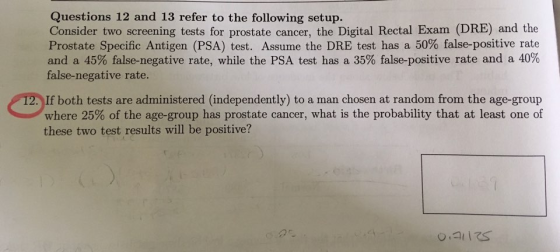
How to solve to get answer 0.71125?
Homework Answers
P(at least one of the test will be positive)
=1-P(none of the test is postive)
=1-(P(have disease and tested negative by both tests)+P(not have disease and tested negative by both tests))
=1-(0.25*0.45*0.4+0.75*(1-0.5)*(1-0.35))=0.71125
Add Answer to:
How to solve to get answer 0.71125?
Questions 12 and 13 refer to the following setup....
Prostate-specific antigen (PSA) test is a common screening test used for detecting prostate cancer. From Harvard Medical School “Prostate Knowledge” webpage. Is PSA reliable? Although PSA testing ca...
Prostate-specific antigen (PSA) test is a common screening test used for detecting prostate cancer. From Harvard Medical School “Prostate Knowledge” webpage. Is PSA reliable? Although PSA testing can help catch prostate cancer at an early stage, having an elevated PSA (generally considered more than 4 ng/ml) doesn’t necessarily mean that a man has cancer. Noncancerous conditions, including benign prostatic hyperplasia (BPH), or an enlarged prostate, and prostatitis, can raise PSA levels. In fact, studies have shown that about 75% of...
According to a 2018 article in Esquire magazine, approximately 70% of males over age...
According to a 2018 article in Esquire magazine, approximately 70% of males over age 70 will develop cancerous cells in their prostate, Prostate cancer is second only to skin cancer as the most common form of cancer for males in the United States. One of the most common tests for the detection of prostate cancer is the prostate-specific antigen (PSA) test. However, this test is known to have a high false positive rate (tests that come back positive...
Getting Started Suggested Web Slice Galery S chedule Care Welcome to DOCLV. Heather Academy Honda Wees...
 Getting Started Suggested Web Slice Galery S chedule Care Welcome to DOCLV. Heather Academy Honda Wees Time Remaining: 1:27:54 Hide/Show Time Remang Part 1 of 1 Question 8 of 16 1.0 Points A large company institutes a new wellness program aimed at improving the health of its 50,000 employees. As a part of the program, all employees are given physical examinations and screening tests. One of the tests given to male employees is the prostate specific antigen (PSA) test with...
Consider the following domain: . a % of men at age fifty who participate in the...
 Consider the following domain: . a % of men at age fifty who participate in the routine screen have prostate cancer. .b% of men with prostate cancer will get positive prostate-specific antigen test. • % of men without prostate cancer will also get positive prostate-specific antigen test. 1. Please describe the domain knowledge in terms of probabilities in which C is used to denote prostate cancer and P is used to denote positive prostate-specific antigen test. 2. Please follow Bayesian...
Hello I would like to ask for some help on this two-part practice question that I...
 Hello I would like to ask for some help on this two-part
practice question that I have, mainly with the second part as I
don't really get it.
Consider the following domain:
a% of men at age fifty who participate in the routine screen
have prostate cancer.
b% of men with prostate cancer will get a positive
prostate-specific antigen test.
c% of men without prostate cancer will also get positive
prostate-specific antigen test.
Please describe the domain knowledge in terms...
Hello I would like to ask for some help on this two-part
practice question that I have, mainly with the second part as I
don't really get it.
Consider the following domain:
a% of men at age fifty who participate in the routine screen
have prostate cancer.
b% of men with prostate cancer will get a positive
prostate-specific antigen test.
c% of men without prostate cancer will also get positive
prostate-specific antigen test.
Please describe the domain knowledge in terms...
validity of a test HELP answer ALL you can !! ... imagine you are a physician...
 validity of a test
HELP
answer ALL you can !!
... imagine you are a physician discussing the results of a screening test with a patient. AC 1) If the test was positive, how likely is it that he really has the disease? [How worried should he be?] 2) If the test was negative, how likely is it that he really does NOT have it? (How reassured should he be?] 1) What does 1) represent? 0 1 Represents that the...
validity of a test
HELP
answer ALL you can !!
... imagine you are a physician discussing the results of a screening test with a patient. AC 1) If the test was positive, how likely is it that he really has the disease? [How worried should he be?] 2) If the test was negative, how likely is it that he really does NOT have it? (How reassured should he be?] 1) What does 1) represent? 0 1 Represents that the...
pls answer all 5:12 .. LED < Back 465 practice 2-1.docx 17 imagine you are a...
 pls answer all
5:12 .. LED < Back 465 practice 2-1.docx 17 imagine you are a physician discussing the results of a screening test with a patient. 1) If the test was positive how likely is it that he really has the disease? (How worried should he be? 2) If the test was negative how likely is it that he really does NOT have it? How reassured should he be? 1) What does 1) represent? a) Express this measure mathematically...
pls answer all
5:12 .. LED < Back 465 practice 2-1.docx 17 imagine you are a physician discussing the results of a screening test with a patient. 1) If the test was positive how likely is it that he really has the disease? (How worried should he be? 2) If the test was negative how likely is it that he really does NOT have it? How reassured should he be? 1) What does 1) represent? a) Express this measure mathematically...
2.94 points QUESTION 11 This measure shows how the observed mortality in a population compares...
2.94 points QUESTION 11 This measure shows how the observed mortality in a population compares to expectations: age-specific rate cause-specific rate proportional mortality ratio standardized mortality ratio 2.94 points QUESTION 12 33% of deaths among 44-65 years olds were due to drug overdose is an example of a: age-specific rate cause-specific rate proportional mortality ratio standardized mortality ratio 2.94 points QUESTION 13 In 2017, there were 300 deaths per 100,000 people aged 25-34 years in Rhode Island....
I would like help, I am unsure how to solve the following questions from my study...
I would like help, I am unsure how to solve the following questions from my study guide. I am no confused because I have to use an excel sheet upon solving them 1. The current cost function for a lab that evaluates blood tests is C=400,000 + 20Q, where Q is the number of tests performed annually. If the lab expects to perform 50,000 tests annually, what are the average costs per evaluation? 2. A clinic finds that it can...
What is the professiona code and cpt icd-10-cm codes for this case? Reason for Visit: General...
What is the professiona code and cpt icd-10-cm codes for this case? Reason for Visit: General history and physical, yearly exam, seen a year ago by me. HPI: Harry is here today for a general history and physical. He reports that he is currently feeling well and has no major concerns today. Chronic Medical Problems: Positive history of hypertension. Currently takes hydrochlorothiazide 25 mg 1 by mouth daily for this. He reports no headache, no visual changes, no chest pain,...
 Getting Started Suggested Web Slice Galery S chedule Care Welcome to DOCLV. Heather Academy Honda Wees Time Remaining: 1:27:54 Hide/Show Time Remang Part 1 of 1 Question 8 of 16 1.0 Points A large company institutes a new wellness program aimed at improving the health of its 50,000 employees. As a part of the program, all employees are given physical examinations and screening tests. One of the tests given to male employees is the prostate specific antigen (PSA) test with...
 Consider the following domain: . a % of men at age fifty who participate in the routine screen have prostate cancer. .b% of men with prostate cancer will get positive prostate-specific antigen test. • % of men without prostate cancer will also get positive prostate-specific antigen test. 1. Please describe the domain knowledge in terms of probabilities in which C is used to denote prostate cancer and P is used to denote positive prostate-specific antigen test. 2. Please follow Bayesian...
 Hello I would like to ask for some help on this two-part
practice question that I have, mainly with the second part as I
don't really get it.
Consider the following domain:
a% of men at age fifty who participate in the routine screen
have prostate cancer.
b% of men with prostate cancer will get a positive
prostate-specific antigen test.
c% of men without prostate cancer will also get positive
prostate-specific antigen test.
Please describe the domain knowledge in terms...
Hello I would like to ask for some help on this two-part
practice question that I have, mainly with the second part as I
don't really get it.
Consider the following domain:
a% of men at age fifty who participate in the routine screen
have prostate cancer.
b% of men with prostate cancer will get a positive
prostate-specific antigen test.
c% of men without prostate cancer will also get positive
prostate-specific antigen test.
Please describe the domain knowledge in terms...
 validity of a test
HELP
answer ALL you can !!
... imagine you are a physician discussing the results of a screening test with a patient. AC 1) If the test was positive, how likely is it that he really has the disease? [How worried should he be?] 2) If the test was negative, how likely is it that he really does NOT have it? (How reassured should he be?] 1) What does 1) represent? 0 1 Represents that the...
validity of a test
HELP
answer ALL you can !!
... imagine you are a physician discussing the results of a screening test with a patient. AC 1) If the test was positive, how likely is it that he really has the disease? [How worried should he be?] 2) If the test was negative, how likely is it that he really does NOT have it? (How reassured should he be?] 1) What does 1) represent? 0 1 Represents that the...
 pls answer all
5:12 .. LED < Back 465 practice 2-1.docx 17 imagine you are a physician discussing the results of a screening test with a patient. 1) If the test was positive how likely is it that he really has the disease? (How worried should he be? 2) If the test was negative how likely is it that he really does NOT have it? How reassured should he be? 1) What does 1) represent? a) Express this measure mathematically...
pls answer all
5:12 .. LED < Back 465 practice 2-1.docx 17 imagine you are a physician discussing the results of a screening test with a patient. 1) If the test was positive how likely is it that he really has the disease? (How worried should he be? 2) If the test was negative how likely is it that he really does NOT have it? How reassured should he be? 1) What does 1) represent? a) Express this measure mathematically...
Most questions answered within 3 hours.
-
Where is the error in this code sequence?
String s1 = "Hello";
String s2 = "ello";...
asked 10 months ago -
Financial data for Joel de Paris, Inc., for last year
follow:
Joel de Paris, Inc.
Balance...
asked 10 months ago -
Consider this reaction:
Al2(SO4)3 (aq)+ BaCl3
(aq) Al2Cl6 (aq)- +
3BaSO4(s) . What is the...
asked 10 months ago -
Suppose that Savneet is considering increasing her
recent random sample from 20 car rentals to 40...
asked 10 months ago -
Trucks arrive at an unloading terminal at an average rate of 120
per hour.
Trucks arrive...
asked 10 months ago -
Why are methanol and ethanol completely soluble in water while
octanol is not very little soluble....
asked 10 months ago -
A facilities manager at a university reads in a research report
that the mean amount of...
asked 10 months ago -
When the CuSO4 is rehydrated by adding water to the anhydrous
compound, is this an endothermic...
asked 10 months ago -
A ray of sunlight is passing from diamond into crown glass; the
angle of incidence is...
asked 10 months ago -
A block of mass 0.249 kg is placed on top of a light, vertical
spring of...
asked 10 months ago -
how do the kidneys compensate in the presences of acidosis
a) trigger hyperventilate
b) reserve acid...
asked 10 months ago -
Question 501 pts
The rental rate of capital to the firm increases. Which of the
following...
asked 10 months ago