
Homework Answers
Add Answer to:
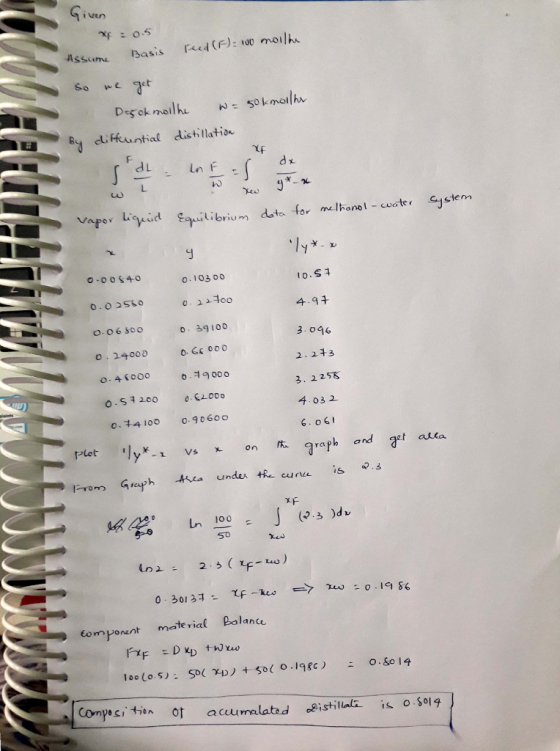
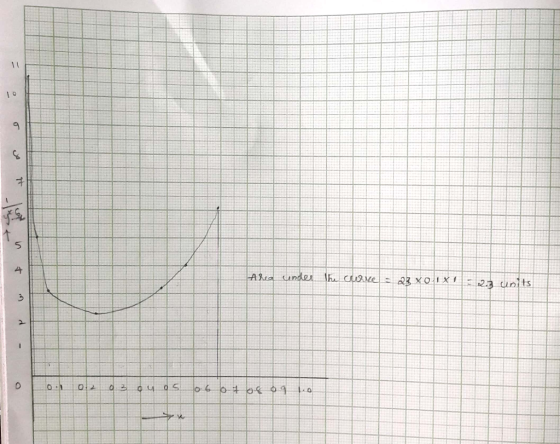
Problem #1 A batch still is to be used to separate methanol from an aqueous solution....
A distillation column is separating a feed that is 40 mol% methanol and 60% water. The...
 A distillation column is separating a feed that is 40 mol%
methanol and 60% water. The two phase feed is 60% liquid.
Distillate product should be 92% methanol and bottoms 4 mol%. A
total reboiler and a total condenser are used and reflux is
saturated. Operation is at atmospheric pressure with a reflux ratio
of 0.9. Under these conditions, HG = 1.3 ft and HL = 0.8ft in both
the stripping and enriching sections. Determine the required
packing height in...
A distillation column is separating a feed that is 40 mol%
methanol and 60% water. The two phase feed is 60% liquid.
Distillate product should be 92% methanol and bottoms 4 mol%. A
total reboiler and a total condenser are used and reflux is
saturated. Operation is at atmospheric pressure with a reflux ratio
of 0.9. Under these conditions, HG = 1.3 ft and HL = 0.8ft in both
the stripping and enriching sections. Determine the required
packing height in...
3. Given the equilibrium data for acetone from ethanol at 1 atm below, 0.262 0.15 0.348...
 3. Given the equilibrium data for acetone from ethanol at 1 atm below, 0.262 0.15 0.348 0.417 0.25 0.478 0.524 0.35 0.566 0.605 0.674 0.739 0.802 0.865 0.929 0.1 0.3 0.6 0.7 0.9 Answer the following: A distillation column with a total condenser is separating acetone from ethanol. A distillate concentration of 90 mo1% acetone is desired. Since CMO is valid, LN is constant at 0.80, find the composition of the liquid leaving the 5th stage below the condenser a....
The vapor-liquid equilibrium for n-pentane and n-hexane at 1 ATM is well approximated using a constant...
The vapor-liquid equilibrium for n-pentane and n-hexane at 1 ATM is well approximated using a constant relative volatility of 2.95. CMO is valid. For all the problems, the feed stream is flowing at 80 mol/s and contains 45 mol% n-pentane, the feed is a saturated liquid (q = 1) at the column pressure, the distillate is 95 mol% n-pentane, and the bottoms is 10 mol% n-pentane. In this problem, you should analyze the column graphically using the McCabe-Thiele Method a....
separation processes
The goal is to separate methanol from water using distillation. We have a 50-50 feed input as a two-phase mixture with 50% vaporized coming in at 500 kmol/hr. The column is well insulated and has a total condenser. A reflux is set to 2 and returned as saturated liquid. The composition in the distillate and bottoms are to be 0.95 and 0.05 mole fractions, respectively. The column is at 1 atm. If 100 kmol/hr were taken off as saturated liquid...
The distillation column shown at the right is used to separate compound A from compound B...
 The distillation column shown at the right is used to separate compound A from compound B in an adiabatic fashion. A liquid mixture of A and B is fed at a specified temperature into a distillation column (stream 1). At the top of the column, a vapor stream that is A-rich (stream 2) passes through a condenser that completely condenses the mixture. Half of this liquid leaves the condenser as the overhead product (stream 4), and half of the liquid...
1. Procedure A. Lithium 2,6-dimethylphenoxide. In a 300-ml. flask, equipped with a magnetic stirrer and a...
 1. Procedure A. Lithium 2,6-dimethylphenoxide. In a 300-ml. flask, equipped with a magnetic stirrer and a reflux condenser and flushed with nitrogen, are placed 150 ml. of toluene (freshly distilled from sodium), 1.40 g. (0.202 mole) of lithium metal (Note 1) and 25.0 g. (0.205 mole) of resublimed 2,6-dimethylphenol. The mixture is heated under reflux with stirring for 36 hours; a nitrogen atmosphere is maintained for the reflux period (Note 2). The condenser is replaced by a distillation head with...
Working on the questions at the end of this lab report (see above). I need help answering questio...
 Working on the questions at the end of this lab report
(see above). I need help answering questions 2, 3, and 4 completely
and thoroughly. Thank you!
s, until the I hexano 1 clean disti CYCLOHEXENE from CYCLOHEXANOL be dehydrated with solfuric acid to yield cyclohexene and waterf Add a 0°C (record ct and cal H,SO + H20 ainer. s in purification of any crude product are (a) the preliminary separation of the product from the reaction mixture by distillation...
Working on the questions at the end of this lab report
(see above). I need help answering questions 2, 3, and 4 completely
and thoroughly. Thank you!
s, until the I hexano 1 clean disti CYCLOHEXENE from CYCLOHEXANOL be dehydrated with solfuric acid to yield cyclohexene and waterf Add a 0°C (record ct and cal H,SO + H20 ainer. s in purification of any crude product are (a) the preliminary separation of the product from the reaction mixture by distillation...
please help with how the flow chart will look like? thank you! Synthesis of n-Butyl Bromide...
 please help with how the flow chart will look like? thank
you!
Synthesis of n-Butyl Bromide Purpose of the Experiment: In this week's experiment you will be synthesizing n-butylbromide (IUPAC 1-bromobutane from 1-butanol and a concentrated acid via a nucleophilie substitution reaction. It is important to know that alcohols dehydrate to form alkenes in the presence of strong inorganic acids, so care must be taken in this experiment not to heat the reaction too vigorously else an elimination reaction may...
please help with how the flow chart will look like? thank
you!
Synthesis of n-Butyl Bromide Purpose of the Experiment: In this week's experiment you will be synthesizing n-butylbromide (IUPAC 1-bromobutane from 1-butanol and a concentrated acid via a nucleophilie substitution reaction. It is important to know that alcohols dehydrate to form alkenes in the presence of strong inorganic acids, so care must be taken in this experiment not to heat the reaction too vigorously else an elimination reaction may...
 A distillation column is separating a feed that is 40 mol%
methanol and 60% water. The two phase feed is 60% liquid.
Distillate product should be 92% methanol and bottoms 4 mol%. A
total reboiler and a total condenser are used and reflux is
saturated. Operation is at atmospheric pressure with a reflux ratio
of 0.9. Under these conditions, HG = 1.3 ft and HL = 0.8ft in both
the stripping and enriching sections. Determine the required
packing height in...
A distillation column is separating a feed that is 40 mol%
methanol and 60% water. The two phase feed is 60% liquid.
Distillate product should be 92% methanol and bottoms 4 mol%. A
total reboiler and a total condenser are used and reflux is
saturated. Operation is at atmospheric pressure with a reflux ratio
of 0.9. Under these conditions, HG = 1.3 ft and HL = 0.8ft in both
the stripping and enriching sections. Determine the required
packing height in...
 3. Given the equilibrium data for acetone from ethanol at 1 atm below, 0.262 0.15 0.348 0.417 0.25 0.478 0.524 0.35 0.566 0.605 0.674 0.739 0.802 0.865 0.929 0.1 0.3 0.6 0.7 0.9 Answer the following: A distillation column with a total condenser is separating acetone from ethanol. A distillate concentration of 90 mo1% acetone is desired. Since CMO is valid, LN is constant at 0.80, find the composition of the liquid leaving the 5th stage below the condenser a....
 The distillation column shown at the right is used to separate compound A from compound B in an adiabatic fashion. A liquid mixture of A and B is fed at a specified temperature into a distillation column (stream 1). At the top of the column, a vapor stream that is A-rich (stream 2) passes through a condenser that completely condenses the mixture. Half of this liquid leaves the condenser as the overhead product (stream 4), and half of the liquid...
 1. Procedure A. Lithium 2,6-dimethylphenoxide. In a 300-ml. flask, equipped with a magnetic stirrer and a reflux condenser and flushed with nitrogen, are placed 150 ml. of toluene (freshly distilled from sodium), 1.40 g. (0.202 mole) of lithium metal (Note 1) and 25.0 g. (0.205 mole) of resublimed 2,6-dimethylphenol. The mixture is heated under reflux with stirring for 36 hours; a nitrogen atmosphere is maintained for the reflux period (Note 2). The condenser is replaced by a distillation head with...
 Working on the questions at the end of this lab report
(see above). I need help answering questions 2, 3, and 4 completely
and thoroughly. Thank you!
s, until the I hexano 1 clean disti CYCLOHEXENE from CYCLOHEXANOL be dehydrated with solfuric acid to yield cyclohexene and waterf Add a 0°C (record ct and cal H,SO + H20 ainer. s in purification of any crude product are (a) the preliminary separation of the product from the reaction mixture by distillation...
Working on the questions at the end of this lab report
(see above). I need help answering questions 2, 3, and 4 completely
and thoroughly. Thank you!
s, until the I hexano 1 clean disti CYCLOHEXENE from CYCLOHEXANOL be dehydrated with solfuric acid to yield cyclohexene and waterf Add a 0°C (record ct and cal H,SO + H20 ainer. s in purification of any crude product are (a) the preliminary separation of the product from the reaction mixture by distillation...
 please help with how the flow chart will look like? thank
you!
Synthesis of n-Butyl Bromide Purpose of the Experiment: In this week's experiment you will be synthesizing n-butylbromide (IUPAC 1-bromobutane from 1-butanol and a concentrated acid via a nucleophilie substitution reaction. It is important to know that alcohols dehydrate to form alkenes in the presence of strong inorganic acids, so care must be taken in this experiment not to heat the reaction too vigorously else an elimination reaction may...
please help with how the flow chart will look like? thank
you!
Synthesis of n-Butyl Bromide Purpose of the Experiment: In this week's experiment you will be synthesizing n-butylbromide (IUPAC 1-bromobutane from 1-butanol and a concentrated acid via a nucleophilie substitution reaction. It is important to know that alcohols dehydrate to form alkenes in the presence of strong inorganic acids, so care must be taken in this experiment not to heat the reaction too vigorously else an elimination reaction may...
Most questions answered within 3 hours.
-
Where is the error in this code sequence?
String s1 = "Hello";
String s2 = "ello";...
asked 10 months ago -
Financial data for Joel de Paris, Inc., for last year
follow:
Joel de Paris, Inc.
Balance...
asked 10 months ago -
Consider this reaction:
Al2(SO4)3 (aq)+ BaCl3
(aq) Al2Cl6 (aq)- +
3BaSO4(s) . What is the...
asked 10 months ago -
Suppose that Savneet is considering increasing her
recent random sample from 20 car rentals to 40...
asked 10 months ago -
Trucks arrive at an unloading terminal at an average rate of 120
per hour.
Trucks arrive...
asked 10 months ago -
Why are methanol and ethanol completely soluble in water while
octanol is not very little soluble....
asked 10 months ago -
A facilities manager at a university reads in a research report
that the mean amount of...
asked 10 months ago -
When the CuSO4 is rehydrated by adding water to the anhydrous
compound, is this an endothermic...
asked 10 months ago -
A ray of sunlight is passing from diamond into crown glass; the
angle of incidence is...
asked 10 months ago -
A block of mass 0.249 kg is placed on top of a light, vertical
spring of...
asked 10 months ago -
how do the kidneys compensate in the presences of acidosis
a) trigger hyperventilate
b) reserve acid...
asked 10 months ago -
Question 501 pts
The rental rate of capital to the firm increases. Which of the
following...
asked 10 months ago