
Homework Answers
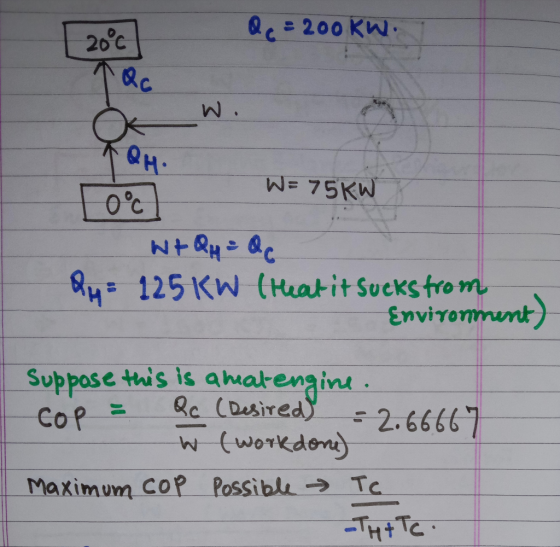
 please see that cyclic device
doesn't say that if this is refrigerator and heat engine , for a
specific system only the desired output changes.
please see that cyclic device
doesn't say that if this is refrigerator and heat engine , for a
specific system only the desired output changes.
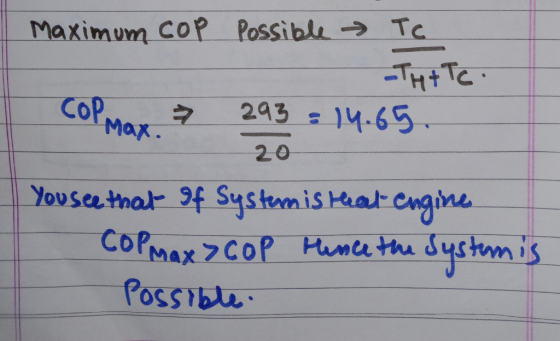
Also see maximum cop formula means that system is for reversible system where irreversibility is 0 means that system is ideal and the system that inventor suggests is irreversibile in nature
If the maximum cop was less that cop of the inventor system becomes impossible as this would mean that system is more ideal that theoretical system but in reality no body can make a ideal system there will always be some irreversibility means system is more practical
But here system is possible as cop is less than maximum cop hence INVENTOR CLAIM IS VALID
THANK YOU
PLEASE LET ME if you need anything else from me
Upvote if helpful
Have a great day
Add Answer to:
3. An inventor claims to have developed a cyclic device that produces 200 kW of heat....
3. An inventor claims to have developed a heat pump that supplies 100 kW of heat...
 3. An inventor claims to have developed a heat pump that supplies 100 kW of heat to a room and maintain 25°C while extracting 80 kW of energy (power) from the outside air at 0°C. Is this claim true? Show your calculation. If you write yes/no without calculation, you will not get any credit (10 points)
(45 pes) An inventor claims to have developed a steady flow device that operates on an electrical power input of 250 kW, has one inlet and two outlets. A stream of ammonia e device at 100 kPa and 20P...
 (45 pes) An inventor claims to have developed a steady flow device that operates on an electrical power input of 250 kW, has one inlet and two outlets. A stream of ammonia e device at 100 kPa and 20PC at a rate of 1 kg/s. The two exiting streams ow rate, one is at 200 kPa, 20°C and the other is a saturated liquid at 10 aims that heat transfer occurs with an uniform surface temperature sume that kinetic and...
The answer is NO but why? An inventor claims to have developed a heat engine that...
 The answer is NO but
why?
An inventor claims to have developed a heat engine that receives 700 kJ of heat from a source at 500 K and produces 300 kJ of net work while rejecting the waste heat to a sink at 290 K. Is this a reasonable claim? Yes or No Yes No
The answer is NO but
why?
An inventor claims to have developed a heat engine that receives 700 kJ of heat from a source at 500 K and produces 300 kJ of net work while rejecting the waste heat to a sink at 290 K. Is this a reasonable claim? Yes or No Yes No
An inventor claims to have devised a closed cyclic engine which exchanges heat with cold and...
An inventor claims to have devised a closed cyclic engine which exchanges heat with cold and hot reservoirs at 25 and 350 ◦C, respectively, and produces 0.45 kJ of work for every kJ of heat extracted from the hot reservoir. Is this claim believable?
An inventor claims to have perfected a heat engine that receives energy by means of heat...
An inventor claims to have perfected a heat engine that receives energy by means of heat transfer from a fuel at 300°C and rejects energy to the surroundings at 15°C while achieving a thermal efficiency of 60 percent. How would you evaluate the inventor's claims?
question 2 EGN 3343-Thermodynamics t Dr. Boutsen a) An inventor claims to have developed a food...
 question 2
EGN 3343-Thermodynamics t Dr. Boutsen a) An inventor claims to have developed a food freezer that keeps the freezer cor temperature of-3°C while the kitchen temperature is 20°C and also has a coet performance of 14. Is his claim valid? Explain (10 points b) A power oyele operates between a lake's surface water at a temperature of 30 water at a depth whose temperature is 285 K. At steady state the cycle develops output of 10 kW while...
question 2
EGN 3343-Thermodynamics t Dr. Boutsen a) An inventor claims to have developed a food freezer that keeps the freezer cor temperature of-3°C while the kitchen temperature is 20°C and also has a coet performance of 14. Is his claim valid? Explain (10 points b) A power oyele operates between a lake's surface water at a temperature of 30 water at a depth whose temperature is 285 K. At steady state the cycle develops output of 10 kW while...
Thermodynamics An inventor claims that an engine produces 130 kW with a fuel consumption of 20...
 Thermodynamics An inventor claims that an engine produces 130 kW with a fuel consumption of 20 kg/h. The fuel has a chemical energy of 40,000 kJ/kg. The energy is received at a mean temperature of 500 degrees Celsius and is rejected at a mean temperature of 50 degrees Celsius. Which laws of thermodynamics are violated? A. First law only B. Second law only C. Both first and second laws D. Neither first nor second laws
An inventor claims he has developed a heat engine that receives energy from a source and...
 An inventor claims he has developed a heat engine that receives energy from a source and can completely transform this energy to work without any heat rejection. A. Inventors claim violates both Kelvin-Planck and First law of thermodynamics B. Inventors claim violates first law of thermodynamics C. The inventors claim violates kelvin-Planck statement D. Inventors claim violates Clausius statement
An inventor claims he has developed a heat engine that receives energy from a source and...
 An inventor claims he has developed a heat engine that receives energy from a source and can completely transform this energy to work without any heat rejection. O A. The inventors claim violates kelvin-Planck statement B. Inventors claim violates Clausius statement C. Inventors claim violates both Kelvin-Planck and First law of thermodynamics D. Inventors claim violates first law of thermodynamics
Problem 2 (28%) An inventor has proposed to build a device to continuously create hot and...
 Problem 2 (28%) An inventor has proposed to build a device to continuously create hot and cold air from a high pressure air stream at room temperature, shown in Figure 1. She claims that she can feed air at 25°C and 10 bar into this device and obtain cold air (0°C and 1 bar) and hot air (40°C and 1 bar). The device has no energy input, no moving parts, and loses no heat to the surroundings. Assume a constant...
 3. An inventor claims to have developed a heat pump that supplies 100 kW of heat to a room and maintain 25°C while extracting 80 kW of energy (power) from the outside air at 0°C. Is this claim true? Show your calculation. If you write yes/no without calculation, you will not get any credit (10 points)
 (45 pes) An inventor claims to have developed a steady flow device that operates on an electrical power input of 250 kW, has one inlet and two outlets. A stream of ammonia e device at 100 kPa and 20PC at a rate of 1 kg/s. The two exiting streams ow rate, one is at 200 kPa, 20°C and the other is a saturated liquid at 10 aims that heat transfer occurs with an uniform surface temperature sume that kinetic and...
 The answer is NO but
why?
An inventor claims to have developed a heat engine that receives 700 kJ of heat from a source at 500 K and produces 300 kJ of net work while rejecting the waste heat to a sink at 290 K. Is this a reasonable claim? Yes or No Yes No
The answer is NO but
why?
An inventor claims to have developed a heat engine that receives 700 kJ of heat from a source at 500 K and produces 300 kJ of net work while rejecting the waste heat to a sink at 290 K. Is this a reasonable claim? Yes or No Yes No
 question 2
EGN 3343-Thermodynamics t Dr. Boutsen a) An inventor claims to have developed a food freezer that keeps the freezer cor temperature of-3°C while the kitchen temperature is 20°C and also has a coet performance of 14. Is his claim valid? Explain (10 points b) A power oyele operates between a lake's surface water at a temperature of 30 water at a depth whose temperature is 285 K. At steady state the cycle develops output of 10 kW while...
question 2
EGN 3343-Thermodynamics t Dr. Boutsen a) An inventor claims to have developed a food freezer that keeps the freezer cor temperature of-3°C while the kitchen temperature is 20°C and also has a coet performance of 14. Is his claim valid? Explain (10 points b) A power oyele operates between a lake's surface water at a temperature of 30 water at a depth whose temperature is 285 K. At steady state the cycle develops output of 10 kW while...
 Thermodynamics An inventor claims that an engine produces 130 kW with a fuel consumption of 20 kg/h. The fuel has a chemical energy of 40,000 kJ/kg. The energy is received at a mean temperature of 500 degrees Celsius and is rejected at a mean temperature of 50 degrees Celsius. Which laws of thermodynamics are violated? A. First law only B. Second law only C. Both first and second laws D. Neither first nor second laws
 An inventor claims he has developed a heat engine that receives energy from a source and can completely transform this energy to work without any heat rejection. A. Inventors claim violates both Kelvin-Planck and First law of thermodynamics B. Inventors claim violates first law of thermodynamics C. The inventors claim violates kelvin-Planck statement D. Inventors claim violates Clausius statement
 An inventor claims he has developed a heat engine that receives energy from a source and can completely transform this energy to work without any heat rejection. O A. The inventors claim violates kelvin-Planck statement B. Inventors claim violates Clausius statement C. Inventors claim violates both Kelvin-Planck and First law of thermodynamics D. Inventors claim violates first law of thermodynamics
 Problem 2 (28%) An inventor has proposed to build a device to continuously create hot and cold air from a high pressure air stream at room temperature, shown in Figure 1. She claims that she can feed air at 25°C and 10 bar into this device and obtain cold air (0°C and 1 bar) and hot air (40°C and 1 bar). The device has no energy input, no moving parts, and loses no heat to the surroundings. Assume a constant...
Most questions answered within 3 hours.
-
Where is the error in this code sequence?
String s1 = "Hello";
String s2 = "ello";...
asked 11 months ago -
Financial data for Joel de Paris, Inc., for last year
follow:
Joel de Paris, Inc.
Balance...
asked 11 months ago -
Consider this reaction:
Al2(SO4)3 (aq)+ BaCl3
(aq) Al2Cl6 (aq)- +
3BaSO4(s) . What is the...
asked 11 months ago -
Suppose that Savneet is considering increasing her
recent random sample from 20 car rentals to 40...
asked 11 months ago -
Trucks arrive at an unloading terminal at an average rate of 120
per hour.
Trucks arrive...
asked 11 months ago -
Why are methanol and ethanol completely soluble in water while
octanol is not very little soluble....
asked 11 months ago -
A facilities manager at a university reads in a research report
that the mean amount of...
asked 11 months ago -
When the CuSO4 is rehydrated by adding water to the anhydrous
compound, is this an endothermic...
asked 11 months ago -
A ray of sunlight is passing from diamond into crown glass; the
angle of incidence is...
asked 11 months ago -
A block of mass 0.249 kg is placed on top of a light, vertical
spring of...
asked 11 months ago -
how do the kidneys compensate in the presences of acidosis
a) trigger hyperventilate
b) reserve acid...
asked 11 months ago -
Question 501 pts
The rental rate of capital to the firm increases. Which of the
following...
asked 11 months ago