Show that the B-field outside of a long straight wire carrying a current I is derivable...
Show that the B-field outside of a long straight wire carrying a
current I is derivable from the scalar potential  in cylindrical coordinates and that
  satisfies Laplace's equation. Why is this
not one of the cylindrical harmonics (as would be the case for the
electrostatic potential of a line charge)?
satisfies Laplace's equation. Why is this
not one of the cylindrical harmonics (as would be the case for the
electrostatic potential of a line charge)?
Please answer fully and show all steps. Thanks!
Homework Answers
the gradient of f, namely

which mean
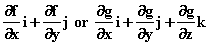
Suppose however, we are given f as a function of r and  , that is, in
polar coordinates, (or g in spherical coordinates, as a function of
, that is, in
polar coordinates, (or g in spherical coordinates, as a function of
 , , and
 ).
).
For example, suppose 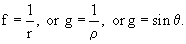
How do we find the gradient of f or g?
One way to find the gradient of such a function
is to convert r or  or
or
 into
rectangular coordinates using the appropriate formulae for
them, and perform the partial differentiation on the
resulting expressions.
into
rectangular coordinates using the appropriate formulae for
them, and perform the partial differentiation on the
resulting expressions.
Thus we can write
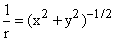
and find, by ordinary partial differentiating
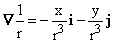
It is a bit more convenient sometimes, to be able to express the gradient directly in polar coordinates or spherical coordinates, like it is expressed in rectangular coordinates as above.
We want here an expression involving partial derivatives with
respect to r and multiplied by vectors pointing
respectively in the r direction, and
direction.
So we want to know: what vectors should these partial derivatives be multiplied by in order to form the gradient?
When we find the answer, the actual partial derivative with respect to each polar variable will be the dot product of a unit vector in a polar direction with the gradient.
We therefore digress to discuss what thes unit vectors are so that you can recognize them.
The r direction is the direction tilted by an angle
counterclockwise from the x axis. A unit vector in that direction,
call it ur, can be written in any of
the three following forms

The unit vector in the direction
lies in the direction 90o beyond the r direction,
counterclockwisely, and is therefore given by


The presence of a magnetic moment m creates a magnetic field which is the gradient of some scalar field. To gain a better intuitive feel about the relationship between scalar fields and their gradient vector fields, see Appendix A.3.6. Because the divergence of the magnetic field is zero, by definition, the divergence of the gradient of the scalar field is also zero, or ?2?m = 0. The operator ?2 is called the Laplacian and ?2?m = 0 is Laplace
Add Answer to:
Show that the B-field outside of a long straight wire carrying a
current I is derivable...
4. (a) A long straight wire carrying a current is placed near a current-carrying rectangular loop...
 4. (a) A long straight wire carrying a current is placed near
a current-carrying rectangular loop. Describe how, and why, the
loop would move as a result of the magnetic forces from the long
wire. The current in the loop is counterclockwise.
(b) Suppose that you were to put in a different
loop below the long wire (and still in the plane of the page).
Draw the shape of a loop that would...
...experience a total magnetic force of zero...
4. (a) A long straight wire carrying a current is placed near
a current-carrying rectangular loop. Describe how, and why, the
loop would move as a result of the magnetic forces from the long
wire. The current in the loop is counterclockwise.
(b) Suppose that you were to put in a different
loop below the long wire (and still in the plane of the page).
Draw the shape of a loop that would...
...experience a total magnetic force of zero...
If the magnetic field due to a long, straight current-carrying wire has a magnitude B at...
If the magnetic field due to a long, straight current-carrying wire has a magnitude B at a distance R from the wire’s center, how far away must you be (in terms of R) for the magnetic field to decrease to B/3?
The magnetic field 38.0 cm away from a long, straight wire carrying current 9.00 A is...
The magnetic field 38.0 cm away from a long, straight wire carrying current 9.00 A is 4740 nT. (a) At what distance is it 474 nT? (b) At one instant, the two conductors in a long household extension cord carry equal 9.00-A currents in opposite directions. The two wires are 3.00 mm apart. Find the magnetic field 38.0 cm away from the middle of the straight cord, in the plane of the two wires. (c) At what distance is it...
The magnetic field 37.0 cm away from a long, straight wire carrying current 9.00 A is...
The magnetic field 37.0 cm away from a long, straight wire carrying current 9.00 A is 4860 µT. (a) At what distance is it 486 µT? cm (b) At one instant, the two conductors in a long household extension cord carry equal 9.00-A currents in opposite directions. The two wires are 3.00 mm apart. Find the magnetic field 37.0 cm away from the middle of the straight cord, in the plane of the two wires. How far is the...
a straight wire w0 cm long, carrying current of 4A, is in uniform magnetic field of...
a straight wire w0 cm long, carrying current of 4A, is in uniform magnetic field of 0.6 T. what is the force on the wire when it is at an angle of 30 with respect to the field (its not 0.2 N) 20 cm long * 20 cm long
The magnetic field 43.0 cm away from a long, straight wire carrying current 9.00 A is...
 The magnetic field 43.0 cm away from a long, straight wire carrying current 9.00 A is 4190 UT. (a) At what distance is it 419 HT? cm (b) At one instant, the two conductors in a long household extension cord carry equal 9.00-A currents in opposite directions. The two wires are 3.00 mm apart. Find the magnetic field 43.0 cm away from the middle of the straight cord, in the plane of the two wires. nt (c) At what distance...
The magnetic field 37.0 cm away from a long, straight wire carrying current 7.00 A is...
 The magnetic field 37.0 cm away from a long, straight wire carrying current 7.00 A is 3780 nT. (a) At what distance is it 378 nt? cm (b) At one instant, the two conductors in a long household extension cord carry equal 7.00-A currents in opposite directions. The two wires are 3.00 mm apart. Find the magnetic field 37.0 cm away from the middle of the straight cord, in the plane of the two wires. ni (c) At what distance...
The magnetic field 39.0 cm away from a long, straight wire carrying current 4.00 A is...
The magnetic field 39.0 cm away from a long, straight wire carrying current 4.00 A is 2050 nT. (a) At what distance is it 205 nT? cm (b) At one instant, the two conductors in a long household extension cord carry equal 4.00-A currents in opposite directions. The two wires are 3.00 mm apart. Find the magnetic field 39.0 cm away from the middle of the straight cord, in the plane of the two wires. nT (c) At what distance...
The magnetic field 41.0 cm away from a long, straight wire carrying current 4.00 A is...
The magnetic field 41.0 cm away from a long, straight wire carrying current 4.00 A is 1950 nT. (a) At what distance is it 195 nT? _____ cm (b) At one instant, the two conductors in a long household extension cord carry equal 4.00-A currents in opposite directions. The two wires are 3.00 mm apart. Find the magnetic field 41.0 cm away from the middle of the straight cord, in the plane of the two wires. __________ nT (c) At...
How does the magnetic field due to a long straight wire carrying current vary with distance...
 How does the magnetic field due to a long straight wire carrying current vary with distance from the wire, ?
 4. (a) A long straight wire carrying a current is placed near
a current-carrying rectangular loop. Describe how, and why, the
loop would move as a result of the magnetic forces from the long
wire. The current in the loop is counterclockwise.
(b) Suppose that you were to put in a different
loop below the long wire (and still in the plane of the page).
Draw the shape of a loop that would...
...experience a total magnetic force of zero...
4. (a) A long straight wire carrying a current is placed near
a current-carrying rectangular loop. Describe how, and why, the
loop would move as a result of the magnetic forces from the long
wire. The current in the loop is counterclockwise.
(b) Suppose that you were to put in a different
loop below the long wire (and still in the plane of the page).
Draw the shape of a loop that would...
...experience a total magnetic force of zero...
 The magnetic field 43.0 cm away from a long, straight wire carrying current 9.00 A is 4190 UT. (a) At what distance is it 419 HT? cm (b) At one instant, the two conductors in a long household extension cord carry equal 9.00-A currents in opposite directions. The two wires are 3.00 mm apart. Find the magnetic field 43.0 cm away from the middle of the straight cord, in the plane of the two wires. nt (c) At what distance...
 The magnetic field 37.0 cm away from a long, straight wire carrying current 7.00 A is 3780 nT. (a) At what distance is it 378 nt? cm (b) At one instant, the two conductors in a long household extension cord carry equal 7.00-A currents in opposite directions. The two wires are 3.00 mm apart. Find the magnetic field 37.0 cm away from the middle of the straight cord, in the plane of the two wires. ni (c) At what distance...
 How does the magnetic field due to a long straight wire carrying current vary with distance from the wire, ?
Most questions answered within 3 hours.
-
Where is the error in this code sequence?
String s1 = "Hello";
String s2 = "ello";...
asked 11 months ago -
Financial data for Joel de Paris, Inc., for last year
follow:
Joel de Paris, Inc.
Balance...
asked 11 months ago -
Consider this reaction:
Al2(SO4)3 (aq)+ BaCl3
(aq) Al2Cl6 (aq)- +
3BaSO4(s) . What is the...
asked 11 months ago -
Suppose that Savneet is considering increasing her
recent random sample from 20 car rentals to 40...
asked 11 months ago -
Trucks arrive at an unloading terminal at an average rate of 120
per hour.
Trucks arrive...
asked 11 months ago -
Why are methanol and ethanol completely soluble in water while
octanol is not very little soluble....
asked 11 months ago -
A facilities manager at a university reads in a research report
that the mean amount of...
asked 11 months ago -
When the CuSO4 is rehydrated by adding water to the anhydrous
compound, is this an endothermic...
asked 11 months ago -
A ray of sunlight is passing from diamond into crown glass; the
angle of incidence is...
asked 11 months ago -
A block of mass 0.249 kg is placed on top of a light, vertical
spring of...
asked 11 months ago -
how do the kidneys compensate in the presences of acidosis
a) trigger hyperventilate
b) reserve acid...
asked 11 months ago -
Question 501 pts
The rental rate of capital to the firm increases. Which of the
following...
asked 11 months ago