Calculate the fraction of atoms in a sample of argon gas at 384K that have an...
Calculate the fraction of atoms in a sample of argon gas at 384K that have an energy of 10.7kJ or greater.
Homework Answers
Apply Arrhenius equation here:
k = Ae^(-Ea/RT)
here we only want to look at the e^(-Ea/RT) part.
I don't know if you have learned this but what the Arrhenius
equation really means is:
k = pfZ where
p = fraction of collisions that occur with reactant molecules
properly oriented
f = fraction of collisions having energy greater than the
activation energy
Z = frequency of collisions
Now in the Arrhenius equation, p and Z have been combined to form
A, and f is the part that says e^(-Ea/RT)
f = e^(-10.7 x 10^3 J/mol/(8.31 J/mol-K x 384 K))
f = 0.035
So the answer is 0.035 or 3.5%.
Add Answer to:
Calculate the fraction of atoms in a sample of argon gas at 384K
that have an...
A gas of argon atoms and a gas of helium atoms have the same rms speed....
 A gas of argon atoms and a gas of helium atoms have the same rms speed. Which gas is hotter? Explain your answer. (Note: the mass of an argon atom is greater than the mass of a helium atom)
9. Give the fraction of atoms in a sample of argon gas at 400 that has...
 9. Give the fraction of atoms in a sample of argon gas at 400 that has an energy of 10 ior grea 1. 10. The reaction CHelg) +b(g) CHg)+ Hilg) has K,- 2.26x10 at 630K. At this temperature, i the initial partial pressures are 4.6 torr of CH and 3.98 torr of , calculate the equilibrium partial pressure of CHa, 1, CHl, and HI. 115 pt) 11. Consider the reaction 2S029g) + O2(g)2SO (g), AH<0. Will equilibrium shift forward, backward,...
A sample of argon gas (39.948 u) contains 2.41×10²² atoms of argon. The gas is initially...
A sample of argon gas (39.948 u) contains 2.41×10²² atoms of argon. The gas is initially at a pressure of 0.950 atm and a temperature of 298 K but then expands isobarically by 475 cm3 . (a) How many moles of argon gas are present? (b) What is the initial volume of the gas (in L)? (c) Calculate the work (in Joules) done by the gas during this process. (d) What is the final temperature (K) of the gas (after...
A sample of argon gas and a sample of xenon gas at low temperature do not...
A sample of argon gas and a sample of xenon gas at low temperature do not exhibit ideal gas behavior. Which gas deviates more from ideal gas behavior, and what is the major cause of the deviation? Greater Deviation Cause of Deviation (A) Argon Attractive forces between atoms (B) Argon Volume of the atoms (C) Argon Mass of the atoms (D) Xenon Attractive forces between atoms (E) Xenon Mass of the atoms
Consider the following plot that shows the fraction of a sample of gas molecules that have a given speed at the sa...
 Consider the following plot that shows the fraction of a sample of gas molecules that have a given speed at the same temperature. The gases plotted are H, N2, H70., He. Fraction de molecules Molecular speed (m/s) Which of the following gases in each pair of compounds, Pairs I-III, would show the greater deviation from ideal behavior when both gases are under the same set of conditions? Pair II: water vapor or neon Pair III: hydrogen fluoride and Pair I:...
The mole fraction of argon gas in the atmosphere of Titan, Saturn’s largest moon was estimated...
The mole fraction of argon gas in the atmosphere of Titan, Saturn’s largest moon was estimated by the scientists to be 0.120. The total pressure on the surface of Titan is 1220 torr. a.)partial pressure in atm of argon gas in Titan’s atmosphere b.)mass (in grams) of argon gas in 295 L of the atmosphere of Titan at 275 K
Some incandescent light bulbs are filled with argon gas. What is Vrms for argon atoms near...
 Some incandescent light bulbs are filled with argon gas. What is Vrms for argon atoms near the filament, assuming their temperature is 2950 K? The atomic mass of argon is 39.948 u. 1578.9 X The number of grams per mole is numerically the same as the value measured in atomic mass units. How is the root mean square speed related to the temperature of a gas? m/s
(a) You have 2.30 moles of argon. How many argon atoms are present? (b) How many...
(a) You have 2.30 moles of argon. How many argon atoms are present? (b) How many moles of neon are needed to have 4.32x10^24 neon atoms? (c) You have 37.0 grams of CO2. How many moles is that? (d) You have 2.53 moles of CCl4. How many grams is that? (e) How many H2O molecules are present in a sample of water with a mass of 3.64 grams?
2. You have a sample of argon gas at a certain pressure, volume, and temperature. You...
 2. You have a sample of argon gas at a certain pressure, volume, and temperature. You double the volume, double the number of moles of argon, and double the temperature (in Kelvin). How does the final pressure (P:) compare to the original pressure (P.)?
Some incandescent light bulbs are filled with argon gas. What is rms velocity for argon atoms...
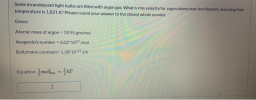 Some incandescent light bulbs are filled with argon gas. What is rms velocity for argon atoms near the filament, assuming their temperature is 1,821 K? Please round your answer to the closest whole number. Given: Atomic mass of argon = 39.95 gm/mol Avogardo's number = 6.02 1023 /mol Boltzmann constant= 1.38 10 23 J/K Equation: mwans - KT I
 A gas of argon atoms and a gas of helium atoms have the same rms speed. Which gas is hotter? Explain your answer. (Note: the mass of an argon atom is greater than the mass of a helium atom)
 9. Give the fraction of atoms in a sample of argon gas at 400 that has an energy of 10 ior grea 1. 10. The reaction CHelg) +b(g) CHg)+ Hilg) has K,- 2.26x10 at 630K. At this temperature, i the initial partial pressures are 4.6 torr of CH and 3.98 torr of , calculate the equilibrium partial pressure of CHa, 1, CHl, and HI. 115 pt) 11. Consider the reaction 2S029g) + O2(g)2SO (g), AH<0. Will equilibrium shift forward, backward,...
 Consider the following plot that shows the fraction of a sample of gas molecules that have a given speed at the same temperature. The gases plotted are H, N2, H70., He. Fraction de molecules Molecular speed (m/s) Which of the following gases in each pair of compounds, Pairs I-III, would show the greater deviation from ideal behavior when both gases are under the same set of conditions? Pair II: water vapor or neon Pair III: hydrogen fluoride and Pair I:...
 Some incandescent light bulbs are filled with argon gas. What is Vrms for argon atoms near the filament, assuming their temperature is 2950 K? The atomic mass of argon is 39.948 u. 1578.9 X The number of grams per mole is numerically the same as the value measured in atomic mass units. How is the root mean square speed related to the temperature of a gas? m/s
 2. You have a sample of argon gas at a certain pressure, volume, and temperature. You double the volume, double the number of moles of argon, and double the temperature (in Kelvin). How does the final pressure (P:) compare to the original pressure (P.)?
 Some incandescent light bulbs are filled with argon gas. What is rms velocity for argon atoms near the filament, assuming their temperature is 1,821 K? Please round your answer to the closest whole number. Given: Atomic mass of argon = 39.95 gm/mol Avogardo's number = 6.02 1023 /mol Boltzmann constant= 1.38 10 23 J/K Equation: mwans - KT I
Most questions answered within 3 hours.
-
Where is the error in this code sequence?
String s1 = "Hello";
String s2 = "ello";...
asked 11 months ago -
Financial data for Joel de Paris, Inc., for last year
follow:
Joel de Paris, Inc.
Balance...
asked 11 months ago -
Consider this reaction:
Al2(SO4)3 (aq)+ BaCl3
(aq) Al2Cl6 (aq)- +
3BaSO4(s) . What is the...
asked 11 months ago -
Suppose that Savneet is considering increasing her
recent random sample from 20 car rentals to 40...
asked 11 months ago -
Trucks arrive at an unloading terminal at an average rate of 120
per hour.
Trucks arrive...
asked 11 months ago -
Why are methanol and ethanol completely soluble in water while
octanol is not very little soluble....
asked 11 months ago -
A facilities manager at a university reads in a research report
that the mean amount of...
asked 11 months ago -
When the CuSO4 is rehydrated by adding water to the anhydrous
compound, is this an endothermic...
asked 11 months ago -
A ray of sunlight is passing from diamond into crown glass; the
angle of incidence is...
asked 11 months ago -
A block of mass 0.249 kg is placed on top of a light, vertical
spring of...
asked 11 months ago -
how do the kidneys compensate in the presences of acidosis
a) trigger hyperventilate
b) reserve acid...
asked 11 months ago -
Question 501 pts
The rental rate of capital to the firm increases. Which of the
following...
asked 11 months ago