


Homework Answers
Add Answer to:
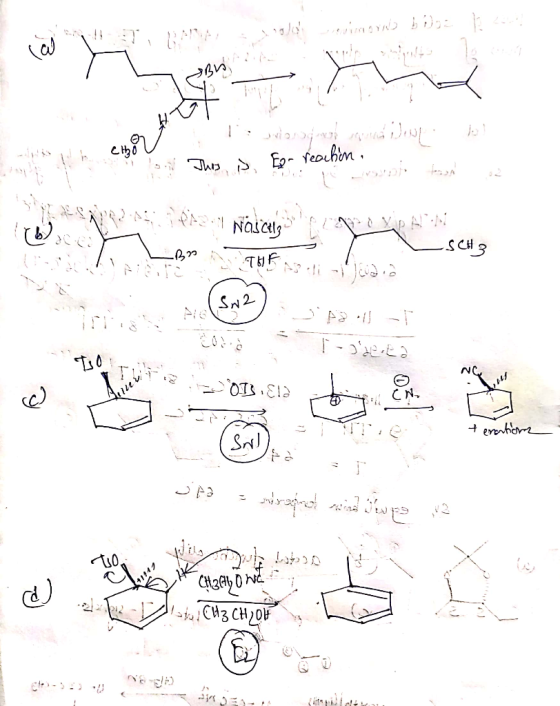
(a)
(b)
(c)
(d)
Predict the product(s) for the following reactions. Indicate the pathway (E1, E2,...
3. Predict the major product (only one product) in each of the following reactions and indicate...
 3. Predict the major product (only one product) in each of the
following reactions and indicate the type of mechanism.
3. Predict the major product (only one product) in each of the following reactions and indicate the type of mechanism. (3 pts; no partial point) Mechanism Sn2 Sn1 HO HBr moy ng heo 0°C, H2O E2 E1 Mechanism Sn2 Sn1 H2SO4 E2 E1 Mechanism HBr SN2 Sn1 rt, H20 E2 E1 OH
3. Predict the major product (only one product) in each of the
following reactions and indicate the type of mechanism.
3. Predict the major product (only one product) in each of the following reactions and indicate the type of mechanism. (3 pts; no partial point) Mechanism Sn2 Sn1 HO HBr moy ng heo 0°C, H2O E2 E1 Mechanism Sn2 Sn1 H2SO4 E2 E1 Mechanism HBr SN2 Sn1 rt, H20 E2 E1 OH
For the following reaction, (a) predict the reaction pathway (SN2, E2, SN1/E1) based on our predictive...
 For the following reaction, (a) predict the reaction pathway (SN2, E2, SN1/E1) based on our predictive model and (b) draw the product(s). ONa
1. Predict whether the following reactions are likely to proceed by an E1 or E2 mechanism....
 1. Predict whether the following reactions are likely to proceed
by an E1 or E2 mechanism. PLEASE show the mechanism and product of
the reaction!!!!
2. Explain each prediction.
Predicting mechanisms: E1 or E2? 1. Predict whether the following reactions are likely to proceed by an El or E2 mechanism. 2. Explain each prediction. Br co KOH H2O Br CH,CH,OH Br CH2CH OH CH,0/CH,OH Br
1. Predict whether the following reactions are likely to proceed
by an E1 or E2 mechanism. PLEASE show the mechanism and product of
the reaction!!!!
2. Explain each prediction.
Predicting mechanisms: E1 or E2? 1. Predict whether the following reactions are likely to proceed by an El or E2 mechanism. 2. Explain each prediction. Br co KOH H2O Br CH,CH,OH Br CH2CH OH CH,0/CH,OH Br
1. Determine whether the following reactions will go through SN1, SN2, E1, or E2 mechanism a....
 1. Determine whether the following reactions will go through SN1, SN2, E1, or E2 mechanism a. 1-bromobutane + sodium hydroxide b. 2-chloro-2-methylpentane + sodium hydroxide + heat C. 2,3-dimethyl-3-bromopentane + water d. 2-bromobutane + methanol 2. Draw the major product for the following reactions (draw both products if racemic): NaSH DMSO TsO CHA Nal CH, acetone CH,CH,ONa+ ethanol CH,OH/H-0 Solite Nal (1 equiv.) acetone F CH2CH OH 25°C
Predict the product of each reaction below and indicate if the mechanism is likely to be...
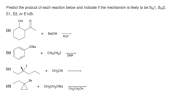 Predict the product of each reaction below and indicate if the mechanism is likely to be SN1, SN2, E1, E2, or E1cB. OH 0 a) T T + NaOH H2O ONa + CH3CH2I DME (d) X + CH3CH2ONA CH3CH2OH
4. Predict the products of the following reactions & indicate whether they are most likely to...
 4. Predict the products of the following reactions & indicate whether they are most likely to go through an SN2, SN1, E1, or E2 mechanism. NaCN DMSO NaOH CH3OH heat Only one product is formed in the following E2 elimination reaction. Draw an arrow-pushing mechanism for the reaction and provide the correct product structure. Include a 3-D drawing (chair conformation) displaying proper stereochemistry of the transition state to explain formation of only the major product. CH3 •Br NaOCH3 ~"'CHS
3. Predict the major product (only one product) in each of the following reactions and indicate...
 3. Predict the major product (only one product) in each of the following reactions and indicate the type of mechanism. (3 pts; no partial point) Mechanism SN2 Sn1 HO HBr 0°C, H20 E2 E1 Mechanism Sn2 Sn1 H2SO4 E2 E1 Mechanism HBr Sn2 Sn1 rt, H20 E2 E1
Draw the major product and label as SN2, SN1, E2, or E1 7. Draw the major...
 Draw the major product and
label as SN2, SN1, E2, or E1
7. Draw the major products of the following reactions, and label the reaction as SN2, SN1, E2 E1. (Darkly shaded bonds are wedged) Br NaOMe NaCN H2SO4 OTs NaSH OTs H20 NaOMe Br KOtBu OH HBr HBr OH
Draw the major product and
label as SN2, SN1, E2, or E1
7. Draw the major products of the following reactions, and label the reaction as SN2, SN1, E2 E1. (Darkly shaded bonds are wedged) Br NaOMe NaCN H2SO4 OTs NaSH OTs H20 NaOMe Br KOtBu OH HBr HBr OH
Q1) provide the product for the following reactions, identify as Sn1,Sn2, E1 or E2. Also provide...
 Q1) provide the product for the following reactions, identify as Sn1,Sn2, E1 or E2. Also provide the mechanism of the reaction H20 Br NaCN DMSO b). Csi Меон сін C)- KOH ci H d)_ this reaction was run at 100°C and 0.1 M KOH concentration 2) Rank the members of the following groups in order of basicity, nucleophilicity, and leaving group ability. Expain your answers a) H20, OH, CH,CO2- b) Br", ".Fr 3) Predict the effect of the changes given...
please indicate stereochemistry (20 marks) 1. Identify each of the following reactions as SN1, SN2, E1,...
 please indicate stereochemistry
(20 marks) 1. Identify each of the following reactions as SN1, SN2, E1, or E2 and give the products formed in each case, and indicate the stereochemistry of the product if appropriate (mechanisms are not required). If no reaction would occur, indicate this with N.R. forno reaction" and give the reason for which you don't expect a product. a) E HEC-CH2-C...Br (CH3),C07 (CH3),COH CHE 70°C CH3 SN2 Morand SN2 H H₃C-CH2-c...Br. CN/DMSO in CH 25°C d) Br...
please indicate stereochemistry
(20 marks) 1. Identify each of the following reactions as SN1, SN2, E1, or E2 and give the products formed in each case, and indicate the stereochemistry of the product if appropriate (mechanisms are not required). If no reaction would occur, indicate this with N.R. forno reaction" and give the reason for which you don't expect a product. a) E HEC-CH2-C...Br (CH3),C07 (CH3),COH CHE 70°C CH3 SN2 Morand SN2 H H₃C-CH2-c...Br. CN/DMSO in CH 25°C d) Br...
 3. Predict the major product (only one product) in each of the
following reactions and indicate the type of mechanism.
3. Predict the major product (only one product) in each of the following reactions and indicate the type of mechanism. (3 pts; no partial point) Mechanism Sn2 Sn1 HO HBr moy ng heo 0°C, H2O E2 E1 Mechanism Sn2 Sn1 H2SO4 E2 E1 Mechanism HBr SN2 Sn1 rt, H20 E2 E1 OH
3. Predict the major product (only one product) in each of the
following reactions and indicate the type of mechanism.
3. Predict the major product (only one product) in each of the following reactions and indicate the type of mechanism. (3 pts; no partial point) Mechanism Sn2 Sn1 HO HBr moy ng heo 0°C, H2O E2 E1 Mechanism Sn2 Sn1 H2SO4 E2 E1 Mechanism HBr SN2 Sn1 rt, H20 E2 E1 OH
 For the following reaction, (a) predict the reaction pathway (SN2, E2, SN1/E1) based on our predictive model and (b) draw the product(s). ONa
 1. Predict whether the following reactions are likely to proceed
by an E1 or E2 mechanism. PLEASE show the mechanism and product of
the reaction!!!!
2. Explain each prediction.
Predicting mechanisms: E1 or E2? 1. Predict whether the following reactions are likely to proceed by an El or E2 mechanism. 2. Explain each prediction. Br co KOH H2O Br CH,CH,OH Br CH2CH OH CH,0/CH,OH Br
1. Predict whether the following reactions are likely to proceed
by an E1 or E2 mechanism. PLEASE show the mechanism and product of
the reaction!!!!
2. Explain each prediction.
Predicting mechanisms: E1 or E2? 1. Predict whether the following reactions are likely to proceed by an El or E2 mechanism. 2. Explain each prediction. Br co KOH H2O Br CH,CH,OH Br CH2CH OH CH,0/CH,OH Br
 1. Determine whether the following reactions will go through SN1, SN2, E1, or E2 mechanism a. 1-bromobutane + sodium hydroxide b. 2-chloro-2-methylpentane + sodium hydroxide + heat C. 2,3-dimethyl-3-bromopentane + water d. 2-bromobutane + methanol 2. Draw the major product for the following reactions (draw both products if racemic): NaSH DMSO TsO CHA Nal CH, acetone CH,CH,ONa+ ethanol CH,OH/H-0 Solite Nal (1 equiv.) acetone F CH2CH OH 25°C
 Predict the product of each reaction below and indicate if the mechanism is likely to be SN1, SN2, E1, E2, or E1cB. OH 0 a) T T + NaOH H2O ONa + CH3CH2I DME (d) X + CH3CH2ONA CH3CH2OH
 4. Predict the products of the following reactions & indicate whether they are most likely to go through an SN2, SN1, E1, or E2 mechanism. NaCN DMSO NaOH CH3OH heat Only one product is formed in the following E2 elimination reaction. Draw an arrow-pushing mechanism for the reaction and provide the correct product structure. Include a 3-D drawing (chair conformation) displaying proper stereochemistry of the transition state to explain formation of only the major product. CH3 •Br NaOCH3 ~"'CHS
 3. Predict the major product (only one product) in each of the following reactions and indicate the type of mechanism. (3 pts; no partial point) Mechanism SN2 Sn1 HO HBr 0°C, H20 E2 E1 Mechanism Sn2 Sn1 H2SO4 E2 E1 Mechanism HBr Sn2 Sn1 rt, H20 E2 E1
 Draw the major product and
label as SN2, SN1, E2, or E1
7. Draw the major products of the following reactions, and label the reaction as SN2, SN1, E2 E1. (Darkly shaded bonds are wedged) Br NaOMe NaCN H2SO4 OTs NaSH OTs H20 NaOMe Br KOtBu OH HBr HBr OH
Draw the major product and
label as SN2, SN1, E2, or E1
7. Draw the major products of the following reactions, and label the reaction as SN2, SN1, E2 E1. (Darkly shaded bonds are wedged) Br NaOMe NaCN H2SO4 OTs NaSH OTs H20 NaOMe Br KOtBu OH HBr HBr OH
 Q1) provide the product for the following reactions, identify as Sn1,Sn2, E1 or E2. Also provide the mechanism of the reaction H20 Br NaCN DMSO b). Csi Меон сін C)- KOH ci H d)_ this reaction was run at 100°C and 0.1 M KOH concentration 2) Rank the members of the following groups in order of basicity, nucleophilicity, and leaving group ability. Expain your answers a) H20, OH, CH,CO2- b) Br", ".Fr 3) Predict the effect of the changes given...
 please indicate stereochemistry
(20 marks) 1. Identify each of the following reactions as SN1, SN2, E1, or E2 and give the products formed in each case, and indicate the stereochemistry of the product if appropriate (mechanisms are not required). If no reaction would occur, indicate this with N.R. forno reaction" and give the reason for which you don't expect a product. a) E HEC-CH2-C...Br (CH3),C07 (CH3),COH CHE 70°C CH3 SN2 Morand SN2 H H₃C-CH2-c...Br. CN/DMSO in CH 25°C d) Br...
please indicate stereochemistry
(20 marks) 1. Identify each of the following reactions as SN1, SN2, E1, or E2 and give the products formed in each case, and indicate the stereochemistry of the product if appropriate (mechanisms are not required). If no reaction would occur, indicate this with N.R. forno reaction" and give the reason for which you don't expect a product. a) E HEC-CH2-C...Br (CH3),C07 (CH3),COH CHE 70°C CH3 SN2 Morand SN2 H H₃C-CH2-c...Br. CN/DMSO in CH 25°C d) Br...
Most questions answered within 3 hours.
-
Where is the error in this code sequence?
String s1 = "Hello";
String s2 = "ello";...
asked 10 months ago -
Financial data for Joel de Paris, Inc., for last year
follow:
Joel de Paris, Inc.
Balance...
asked 10 months ago -
Consider this reaction:
Al2(SO4)3 (aq)+ BaCl3
(aq) Al2Cl6 (aq)- +
3BaSO4(s) . What is the...
asked 10 months ago -
Suppose that Savneet is considering increasing her
recent random sample from 20 car rentals to 40...
asked 10 months ago -
Trucks arrive at an unloading terminal at an average rate of 120
per hour.
Trucks arrive...
asked 10 months ago -
Why are methanol and ethanol completely soluble in water while
octanol is not very little soluble....
asked 10 months ago -
A facilities manager at a university reads in a research report
that the mean amount of...
asked 10 months ago -
When the CuSO4 is rehydrated by adding water to the anhydrous
compound, is this an endothermic...
asked 10 months ago -
A ray of sunlight is passing from diamond into crown glass; the
angle of incidence is...
asked 10 months ago -
A block of mass 0.249 kg is placed on top of a light, vertical
spring of...
asked 10 months ago -
how do the kidneys compensate in the presences of acidosis
a) trigger hyperventilate
b) reserve acid...
asked 10 months ago -
Question 501 pts
The rental rate of capital to the firm increases. Which of the
following...
asked 10 months ago