A one-year savings certificate that pays 15% is purchased for $10,000. If the purchaser pays taxes...
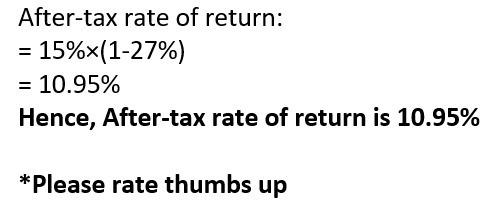
A one-year savings certificate that pays 15% is purchased for $10,000. If the purchaser pays taxes at the 27% incremental income tax rate, the after tax rate of return on this investment is?
Homework Answers
Add Answer to:
A one-year savings certificate that pays 15% is purchased for
$10,000. If the purchaser pays taxes...
11. A two-year certificate of deposit pays an annual effective rate of 9%. The purchaser is...
 11. A two-year certificate of deposit pays an annual effective rate of 9%. The purchaser is offered two options for prepayment penalties in the event of early withdrawal: A - a reduction in the rate of interest to 7%. B loss of three months interest In order to assist the purchaser in deciding which option to select, compute the ratio of the proceeds under Option A to those under Option B if the certificate of deposit is surrendered: a. At...
Tom Shilling expects to have $10,000 of taxable income to commit to his retirement savings each...
Tom Shilling expects to have $10,000 of taxable income to commit to his retirement savings each year for the next 30 years. His investments will be made at the end of the year. His tax rate is 30% and his investments will earn 8% annually. If Tom invests in a taxable account, his annual investment is reduced by his income taxes, and his annual return on investments will also be reduced by 30%. If tom invests in a traditional IRA,...
(14-81) A small research device can be purchased for $10,000 and depreciated by 5-year MACRS depreciation....
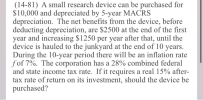 (14-81) A small research device can be purchased for $10,000 and depreciated by 5-year MACRS depreciation. The net benefits from the device, before deducting depreciation, are $2500 at the end of the first year and increasing $1250 per year after that, until the device is hauled to the junkyard at the end of 10 years During the 10-year period there will be an inflation rate fof 7%. The corporation has a 28% combined federal and state income tax rate. If...
Katie pays $10,000 in tax-deductible property taxes. Katie’s marginal tax rate is 32%, average tax rate...
Katie pays $10,000 in tax-deductible property taxes. Katie’s marginal tax rate is 32%, average tax rate is 28%, and effective tax rate is 25%. Katie's tax savings from paying the property tax is: $1,600 $2,500 $2,800 $3,200 $10,000
Question 1 10 pts A 10-year, 11.00%, $2,000 bond that pays dividends quarterly can be purchased...
 Question 1 10 pts A 10-year, 11.00%, $2,000 bond that pays dividends quarterly can be purchased for $1,869. This means that $1,869 is spent on the bond now. Every quarter, $55.00 is provided to the purchaser as the dividend. After 10 years, $2,000 is given to the purchaser. If the bond is purchased and pays as scheduled, which of the following ranges of effective rate of return will the purchaser receive? 0 11.50% - 11.85% 0 11.00% - 11.50% 0...
You decide to put $10,000 in a money market fund that pays interest at the annual...
You decide to put $10,000 in a money market fund that pays interest at the annual rate of 7.2%, compounding it monthly. You plan to take the money out after one year and pay the income tax on the interest earned. You are in the 25% tax bracket. Find the total amount available to you after taxes.
A newly issued bond pays its coupons once a year. Its coupon rate is 5%, its...
 A newly issued bond pays its coupons once a year. Its coupon rate is 5%, its maturity is 20 years, and its yield to maturity is 8% a Find the holding period return for a one-year investment period if the bond is selling at a yeld to maturity of 7% by the end of the year. (Do not round intermediate calculations. Round your answer to 2 decimal places.) Holding-period return nces b. If you sell the bond after one year...
A U.S. company purchases a 90-day certificate of deposit from a Singapore bank on May 15,...
A U.S. company purchases a 90-day certificate of deposit from a Singapore bank on May 15, when the spot rate is $0.72/S$. The certificate has a face value of S$100,000 and pays interest at an annual rate of 2 percent. On August 13, the certificate of deposit matures, and the company receives principal and interest of S$100,500 and records interest revenue on the investment. The spot rate on August 13 is $0.75/S$. The average spot rate for the period May...
Kenneth pays taxes at the 12% federal income tax bracket level. His state also has a...
Kenneth pays taxes at the 12% federal income tax bracket level. His state also has a 6% tax on investment income, including interest earned. If Kenneth were to cash in a U.S. savings bond for $250, which he originally purchased for $50, how much will he pay in federal and state taxes? (Round answer to 2 decimal place, e.g. 52.20.) Group of answer choices $42.00. $24.00. $63.00. $45.00.
A newly issued bond pays its coupons once a year. Its coupon rate is 5.2%, its...
A newly issued bond pays its coupons once a year. Its coupon rate is 5.2%, its maturity is 10 years, and its yield to maturity is 8.2%. a. Find the holding-period return for a one-year investment period if the bond is selling at a yield to maturity of 7.2% by the end of the year. (Do not round intermediate calculations. Round your answer to 2 decimal places.) Holding-period return 15.28 % b. If you sell the bond after one year...
 11. A two-year certificate of deposit pays an annual effective rate of 9%. The purchaser is offered two options for prepayment penalties in the event of early withdrawal: A - a reduction in the rate of interest to 7%. B loss of three months interest In order to assist the purchaser in deciding which option to select, compute the ratio of the proceeds under Option A to those under Option B if the certificate of deposit is surrendered: a. At...
 (14-81) A small research device can be purchased for $10,000 and depreciated by 5-year MACRS depreciation. The net benefits from the device, before deducting depreciation, are $2500 at the end of the first year and increasing $1250 per year after that, until the device is hauled to the junkyard at the end of 10 years During the 10-year period there will be an inflation rate fof 7%. The corporation has a 28% combined federal and state income tax rate. If...
 Question 1 10 pts A 10-year, 11.00%, $2,000 bond that pays dividends quarterly can be purchased for $1,869. This means that $1,869 is spent on the bond now. Every quarter, $55.00 is provided to the purchaser as the dividend. After 10 years, $2,000 is given to the purchaser. If the bond is purchased and pays as scheduled, which of the following ranges of effective rate of return will the purchaser receive? 0 11.50% - 11.85% 0 11.00% - 11.50% 0...
 A newly issued bond pays its coupons once a year. Its coupon rate is 5%, its maturity is 20 years, and its yield to maturity is 8% a Find the holding period return for a one-year investment period if the bond is selling at a yeld to maturity of 7% by the end of the year. (Do not round intermediate calculations. Round your answer to 2 decimal places.) Holding-period return nces b. If you sell the bond after one year...
Most questions answered within 3 hours.
-
Where is the error in this code sequence?
String s1 = "Hello";
String s2 = "ello";...
asked 11 months ago -
Financial data for Joel de Paris, Inc., for last year
follow:
Joel de Paris, Inc.
Balance...
asked 11 months ago -
Consider this reaction:
Al2(SO4)3 (aq)+ BaCl3
(aq) Al2Cl6 (aq)- +
3BaSO4(s) . What is the...
asked 11 months ago -
Suppose that Savneet is considering increasing her
recent random sample from 20 car rentals to 40...
asked 11 months ago -
Trucks arrive at an unloading terminal at an average rate of 120
per hour.
Trucks arrive...
asked 11 months ago -
Why are methanol and ethanol completely soluble in water while
octanol is not very little soluble....
asked 11 months ago -
A facilities manager at a university reads in a research report
that the mean amount of...
asked 11 months ago -
When the CuSO4 is rehydrated by adding water to the anhydrous
compound, is this an endothermic...
asked 11 months ago -
A ray of sunlight is passing from diamond into crown glass; the
angle of incidence is...
asked 11 months ago -
A block of mass 0.249 kg is placed on top of a light, vertical
spring of...
asked 11 months ago -
how do the kidneys compensate in the presences of acidosis
a) trigger hyperventilate
b) reserve acid...
asked 11 months ago -
Question 501 pts
The rental rate of capital to the firm increases. Which of the
following...
asked 11 months ago