A uniform solid disc, whose moment of inertia is unknown, is rotating at an angular velocity...
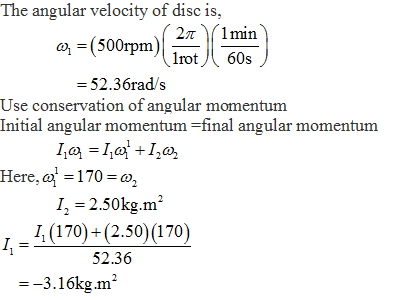
A uniform solid disc, whose moment of inertia is unknown, is rotating at an angular velocity of 500 rpm. Later it falls on another solid disc that is at rest and that its moment of inertia is of 2.50 kg * m2. The final speed with which both rotate is 170 rpm. Determine the moment of inertia of the disc.
Homework Answers
Add Answer to:
A uniform solid disc, whose moment of inertia is unknown, is
rotating at an angular velocity...
A disc of moment of inertia 3.00 kgm2 is rotating with angular velocity 2.00 rad/s about...
A disc of moment of inertia 3.00 kgm2 is rotating with angular velocity 2.00 rad/s about an axis perpendicular to its plane and passing through its centre. Another disk (which is not rotating) of moment of inertia 5.00 kgm2 is gently placed over it. Finally, the two discs rotate with the same angular velocity around the common rotational axis. The new angular velocity of the combined disc (in rad/s) is ?
A flat horizontal disc of moment of inertia 2.2 kg m2 is rotating at 4.5 rad...
A flat horizontal disc of moment of inertia 2.2 kg m2 is rotating at 4.5 rad s-1 about a vertical axis through its centre. A 0.13 kg mass is dropped onto the disc, landing without slipping 1.4 m from the centre. Calculate the new angular velocity of the disc, in rad s-1 , to 2d.p.
9. A disc is rotating about a axis through the center at a constant angular velocity...
 9. A disc is rotating about a axis through the center at a constant angular velocity oo. Two ants of equal mass suddenly drop onto the edge the disc and gets stuck to the rotating disc. Does the Moment of Inertia of the system increase or decrease? Explain a. b. Does the angular velocity increase or decrease? Explain 01 c. Now suppose the two ants start moving toward the center at a constant speed. i.Does the moment of inertia increase...
In the diagram, disk 1 has a moment of inertia of 3.2 kg · m2 and...
In the diagram, disk 1 has a moment of inertia of 3.2 kg · m2 and is rotating in the counterclockwise direction with an angular velocity of 7.3 rad/s about a frictionless rod passing through its center. A second disk rotating clockwise with an angular velocity of 8.9 rad/s falls from above onto disk 1. The two then rotate as one in the clockwise direction with an angular velocity of 1.8 rad/s. Determine the moment of inertia, in kg ·...
In the diagram, Disk 1 has a moment of inertia of 4.20 kg · m2 and...
In the diagram, Disk 1 has a moment of inertia of 4.20 kg · m2 and is rotating in the counterclockwise direction with an angular speed of 6.90 rad/s about a frictionless rod passing through its center. A second disk rotating clockwise with an angular speed of 8.50 rad/s falls from above onto Disk 1. The two then rotate as one in the clockwise direction with an angular speed of 2.80 rad/s. Determine the moment of inertia of Disk 2.
A wheel with moment of inertia equal to 0.20 kg m^2 is rotating at 900 rpm....
 A wheel with moment of inertia equal to 0.20 kg m^2 is rotating at 900 rpm. A second wheel, initially at rest and having moment of inertia equal to 0.70 kg m^2 is suddenly connected to the first wheel. a) What is the final angular speed of the two wheels after this completely inelastic collision? Answer in rpm b) Calculate the energy- convened to heat, sound, etc. in the collision. omega must not be in rpm for this calculation.
A disc (thin cylinder) of mass 0.1 kg and radius 0.41 m is rotating on a...
A disc (thin cylinder) of mass 0.1 kg and radius 0.41 m is rotating on a frictionless axle at a constant rate of 74 RPM. What a the angular velocity and angular momentum of the disc? A second disc of 0.05 kg and 0.18 m is dropped down the axle on top. The two then rotate together. What is the final angular velocity and RPM of the system of discs?
A counterclockwise torque is suddenly applied to a rotating shaft with a moment of inertia of...
A counterclockwise torque is suddenly applied to a rotating shaft with a moment of inertia of 5 kg•m2 . The shaft was initially at rest (zero speed). If the applied torque causes the shaft to rotate at a constant angular acceleration of 1.5 rad/s2 , considering zero viscous damping: a) Calculate the applied torque. b) Calculate the angular speed of the shaft after 5 seconds in radians per second. c) Express the speed in revolutions per minute.
Two disks are rotating about the same axis. Disk A has a moment of inertia of...
Two disks are rotating about the same axis. Disk A has a moment of inertia of 3.3 kg · m2 and an angular velocity of +7.4 rad/s. Disk B is rotating with an angular velocity of -9.3 rad/s. The two disks are then linked together without the aid of any external torques, so that they rotate as a single unit with an angular velocity of -2.5 rad/s. The axis of rotation for this unit is the same as that for...
Two disks are rotating about the same axis. Disk A has a moment of inertia of...
Two disks are rotating about the same axis. Disk A has a moment of inertia of 3.4 kg · m2 and an angular velocity of +7.2 rad/s. Disk B is rotating with an angular velocity of –9.8 rad/s. The two disks are then linked together without the aid of any external torques, so that they rotate as a single unit with an angular velocity of –2.4 rad/s. The axis of rotation for this unit is the same as that for...
 9. A disc is rotating about a axis through the center at a constant angular velocity oo. Two ants of equal mass suddenly drop onto the edge the disc and gets stuck to the rotating disc. Does the Moment of Inertia of the system increase or decrease? Explain a. b. Does the angular velocity increase or decrease? Explain 01 c. Now suppose the two ants start moving toward the center at a constant speed. i.Does the moment of inertia increase...
 A wheel with moment of inertia equal to 0.20 kg m^2 is rotating at 900 rpm. A second wheel, initially at rest and having moment of inertia equal to 0.70 kg m^2 is suddenly connected to the first wheel. a) What is the final angular speed of the two wheels after this completely inelastic collision? Answer in rpm b) Calculate the energy- convened to heat, sound, etc. in the collision. omega must not be in rpm for this calculation.
Most questions answered within 3 hours.
-
Where is the error in this code sequence?
String s1 = "Hello";
String s2 = "ello";...
asked 10 months ago -
Financial data for Joel de Paris, Inc., for last year
follow:
Joel de Paris, Inc.
Balance...
asked 10 months ago -
Consider this reaction:
Al2(SO4)3 (aq)+ BaCl3
(aq) Al2Cl6 (aq)- +
3BaSO4(s) . What is the...
asked 10 months ago -
Suppose that Savneet is considering increasing her
recent random sample from 20 car rentals to 40...
asked 10 months ago -
Trucks arrive at an unloading terminal at an average rate of 120
per hour.
Trucks arrive...
asked 10 months ago -
Why are methanol and ethanol completely soluble in water while
octanol is not very little soluble....
asked 10 months ago -
A facilities manager at a university reads in a research report
that the mean amount of...
asked 10 months ago -
When the CuSO4 is rehydrated by adding water to the anhydrous
compound, is this an endothermic...
asked 10 months ago -
A ray of sunlight is passing from diamond into crown glass; the
angle of incidence is...
asked 10 months ago -
A block of mass 0.249 kg is placed on top of a light, vertical
spring of...
asked 10 months ago -
how do the kidneys compensate in the presences of acidosis
a) trigger hyperventilate
b) reserve acid...
asked 10 months ago -
Question 501 pts
The rental rate of capital to the firm increases. Which of the
following...
asked 10 months ago