1. We can observe the wavelengths emitted from Hydrogen. When Hydrogen electrons transition between states, they...
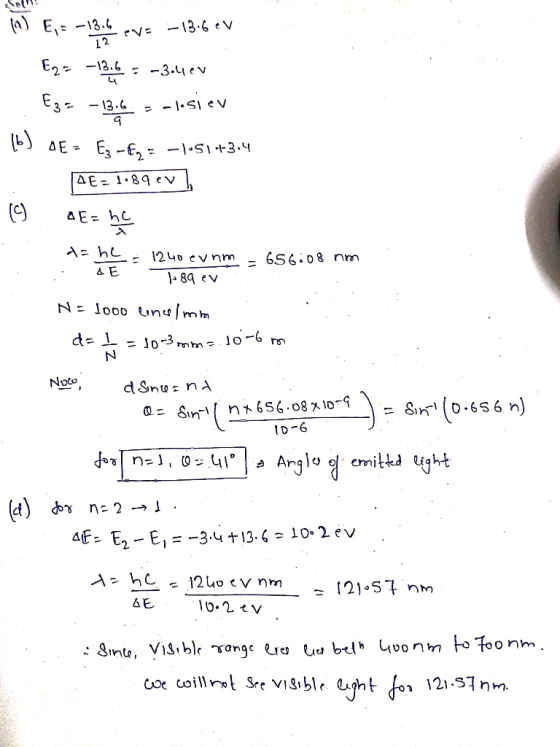
1. We can observe the wavelengths emitted from Hydrogen. When Hydrogen electrons transition between states, they absorb or emit a particle of light called a photon with energy E=hf. Here f is the frequency of light and h is a constant.
a. How much energy does an electron in the n=1 (lowest-energy) state of Hydrogen have? Repeat for n=2 and n=3.
b. How much energy is emitted if an electron in the n=3 state transitions to the n=2 state?
c. Common diffraction gratings have 500 lines/mm and 1000 lines/mm. For the 1000 1 lines/mm grating, what are the angles of emitted light (relative to the central maximum) when an n=3 to n=2 electron transition occurs in Hydrogen?
d. Why don’t we see visible light emitted when hydrogen transitions between the n=2 state and the ground state? Please show all work including how you planned for the problem, did the problem, and a potential way to check your answer!
Homework Answers
Add Answer to:
1. We can observe the wavelengths emitted from Hydrogen. When
Hydrogen electrons transition between states, they...
a. How much energy does an electron in the n=1 (lowest-energy) state of Hydrogen have? Repeat...
a. How much energy does an electron in the n=1 (lowest-energy) state of Hydrogen have? Repeat for n=2 and n=3. b. How much energy is emitted if an electron in the n=3 state transitions to the n=2 state? c. We used diffraction gratings in class that had 500 lines/mm (white cardboard surrounding grating) and 1000 lines/mm (rainbow cardboard surrounding grating). For the 1000 lines/mm grating, what are the angles of emitted light (relative to the central maximum) when an n=3...
The two most prominent wavelengths in the light emitted by a hydrogen discharge lamp are 656...
The two most prominent wavelengths in the light emitted by a hydrogen discharge lamp are 656 nm (red) and 486 nm (blue). Light from a hydrogen lamp illuminates a diffraction grating with 540 lines/mm , and the light is observed on a screen 1.7 m behind the grating.
The two most prominent wavelengths in the light emitted by a hydrogen discharge lamp are 656...
The two most prominent wavelengths in the light emitted by a hydrogen discharge lamp are 656 nmnm (red) and 486 nmnm (blue). Light from a hydrogen lamp illuminates a diffraction grating with 520 lines/mmlines/mm , and the light is observed on a screen 1.7 mm behind the grating. What is the distance between the first-order red and blue fringes?
The two most prominent wavelengths in the light emitted by a hydrogen discharge lamp are 656...
The two most prominent wavelengths in the light emitted by a hydrogen discharge lamp are 656 nm(red) and 486 nm (blue). Light from a hydrogen lamp illuminates a diffraction grating with 500 lines per mm, and the light is observed on a screen 1.50 m behind the grating. What is the order between the first-ordered red and blue fringes? (Express your answer in centimeters).
The two most prominent wavelengths in the light emitted by a hydrogen discharge lamp are 656 nm (red) and 486 nm (blue)
The two most prominent wavelengths in the light emitted by a hydrogen discharge lamp are 656 nm (red) and 486 nm (blue). Light from a hydrogen lamp illuminates a diffraction grating with 550 lines / mm, and the light is observed on a screen 1.2 m behind the grating.You may want to review (Page 940).For general problem-solving tips and strategies for this topic, you may want to view a Video Tutor Solution of Diffraction grating.Part AWhat is the distance between...
How many different energies of light are emitted from an H atom with the electron in...
How many different energies of light are emitted from an H atom with the electron in the n=4 energy shell? Group of answer choices a. 3 b. 4 c. 5 d. 6 2.. Would a photon of visible light (photons with wavelengths = 400 - 700 nm) have sufficient energy to excite an electron in a hydrogen atom from n = 1 to n = 5? NOTE: You'll need to calculate how much energy is required for the transition from...
4. A photon is emitted when a hydrogen atom undergoes a transition from the n =...
 4. A photon is emitted when a hydrogen atom undergoes a transition from the n = 5 state to the n = 3 state. a. Calculate the wavelength of the emitted photon. b. What is the energy in eV of the emitted photon?
A photon is emitted when a hydrogen atom undergoes a transition from the n = 8...
A photon is emitted when a hydrogen atom undergoes a transition from the n = 8 state to the n = 2 state. Calculate values for the following. (a) the wavelength. nm (b) the frequency. Hz (c) the energy of the emitted photon. eV
The two most prominent wavelengths in the light emitted by a hydrogen discharge lamp are 656...
 The two most prominent wavelengths in the light emitted by a hydrogen discharge lamp are 656 nm (red) and 486 nm (blue) Light from a hydrogen lamp illuminates a diffraction grating with 550 lines/mm, and the light is observed on a screen 1.4 m behind the grating Part A You may want to review (Page 940) For general problem-solving tips and strategies for this topic, you may want to view a Video Tutor Solution of Diffraction grating. What is the...
Hydrogen spectrum tube a. The light emitted in a hydrogen spectrum tube comes from isolated hydrogen...
 Hydrogen spectrum tube a. The light emitted in a hydrogen spectrum tube comes from isolated hydrogen atoms excited by electricity. Is the spectrum of the light emitted by isolated atoms discrete or continuous? b. The spectrum of hydrogen is described by Rydberg's formula: , where R = 1.097 x 10⁷m1 Based on Rydberg's formula, identify the electronic transitions (n + n) that correspond to each of the colored photons that you saw and their expected wavelengths. Compare them to the...
 4. A photon is emitted when a hydrogen atom undergoes a transition from the n = 5 state to the n = 3 state. a. Calculate the wavelength of the emitted photon. b. What is the energy in eV of the emitted photon?
 The two most prominent wavelengths in the light emitted by a hydrogen discharge lamp are 656 nm (red) and 486 nm (blue) Light from a hydrogen lamp illuminates a diffraction grating with 550 lines/mm, and the light is observed on a screen 1.4 m behind the grating Part A You may want to review (Page 940) For general problem-solving tips and strategies for this topic, you may want to view a Video Tutor Solution of Diffraction grating. What is the...
 Hydrogen spectrum tube a. The light emitted in a hydrogen spectrum tube comes from isolated hydrogen atoms excited by electricity. Is the spectrum of the light emitted by isolated atoms discrete or continuous? b. The spectrum of hydrogen is described by Rydberg's formula: , where R = 1.097 x 10⁷m1 Based on Rydberg's formula, identify the electronic transitions (n + n) that correspond to each of the colored photons that you saw and their expected wavelengths. Compare them to the...
Most questions answered within 3 hours.
-
Where is the error in this code sequence?
String s1 = "Hello";
String s2 = "ello";...
asked 10 months ago -
Financial data for Joel de Paris, Inc., for last year
follow:
Joel de Paris, Inc.
Balance...
asked 10 months ago -
Consider this reaction:
Al2(SO4)3 (aq)+ BaCl3
(aq) Al2Cl6 (aq)- +
3BaSO4(s) . What is the...
asked 10 months ago -
Suppose that Savneet is considering increasing her
recent random sample from 20 car rentals to 40...
asked 10 months ago -
Trucks arrive at an unloading terminal at an average rate of 120
per hour.
Trucks arrive...
asked 10 months ago -
Why are methanol and ethanol completely soluble in water while
octanol is not very little soluble....
asked 10 months ago -
A facilities manager at a university reads in a research report
that the mean amount of...
asked 10 months ago -
When the CuSO4 is rehydrated by adding water to the anhydrous
compound, is this an endothermic...
asked 10 months ago -
A ray of sunlight is passing from diamond into crown glass; the
angle of incidence is...
asked 10 months ago -
A block of mass 0.249 kg is placed on top of a light, vertical
spring of...
asked 10 months ago -
how do the kidneys compensate in the presences of acidosis
a) trigger hyperventilate
b) reserve acid...
asked 10 months ago -
Question 501 pts
The rental rate of capital to the firm increases. Which of the
following...
asked 10 months ago