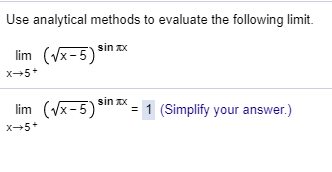
Can someone explain how to do this? In steps, please. No straight
answers.
Homework Answers
Request Answer!
We need at least 10 more requests to produce the answer.
0 / 10 have requested this problem solution
The more requests, the faster the answer.
Add Answer to:
Can someone explain how to do this? In steps, please. No straight
answers.
Use analytical methods...
please explain each of the steps and prove why was it correct for each of the...
 please explain each of the steps and prove why was it correct
for each of the problem and don't use L'Hopital's rule for 2 and 3,
thank you.
The graph below is the function f(x) 4 3 2 1 -1 3 - 4 -5 d Find lim 12 f(2) Find lim 12+ f(x) Find lim f(x) 12 Find f(2) 2? + 10+ 21 Evaluate the limit using an algebraic method: lim 2-3 2 +3 Evaluate the limit 81 - 2...
please explain each of the steps and prove why was it correct
for each of the problem and don't use L'Hopital's rule for 2 and 3,
thank you.
The graph below is the function f(x) 4 3 2 1 -1 3 - 4 -5 d Find lim 12 f(2) Find lim 12+ f(x) Find lim f(x) 12 Find f(2) 2? + 10+ 21 Evaluate the limit using an algebraic method: lim 2-3 2 +3 Evaluate the limit 81 - 2...
can someone please explain their answer, I don't know how to determine when to use sin,...
 can someone please explain
their answer, I don't know how to determine when to use sin, tan,
or cos for the formula
can someone please explain
their answer, I don't know how to determine when to use sin, tan,
or cos for the formula
send help for these 4 questions, please show steps Definition: The AREA A of the region...
 send help for these 4 questions, please show steps
Definition: The AREA A of the region S that lies under the graph of the continuous function f is the limit of the sum of the areas of approximating rectangles A = lim R, = lim [f(x)Ax +f(x2)Ax+...+f(x)Ax] - 00 Consider the function f(x) = x, 13x < 16. Using the above definition, determine which of the following expressions represents the area under the graph off as a limit. A. lim...
send help for these 4 questions, please show steps
Definition: The AREA A of the region S that lies under the graph of the continuous function f is the limit of the sum of the areas of approximating rectangles A = lim R, = lim [f(x)Ax +f(x2)Ax+...+f(x)Ax] - 00 Consider the function f(x) = x, 13x < 16. Using the above definition, determine which of the following expressions represents the area under the graph off as a limit. A. lim...
This is for a calibration lab for analytical chemistry. Can someone please explain how to report...
This is for a calibration lab for analytical chemistry. Can someone please explain how to report the uncertainty of the electronic balance that I used in lab for my lab results. We used a measuring pipette to weigh out 2 ml, 4ml, 6ml, etc. of water into a weigh bottle. Three replicate weights were recorded for each measurement. I was told to do a minimum of 3 weight measurements for the weigh bottle alone to calculate the uncertainty of the...
Do problems 1 and 3 please. Use any entries for the first problem. Thank you. 1....
 Do problems 1 and 3 please. Use any entries for the first
problem. Thank you.
1. (a) Make a table, rounding all entries to four decimal digits, to estimate the instantaneous rate of change of f(x) = x° at x = 1. Round your final answer to three decimal digits (b) Briefly describe how the entries in your table relate to the graph f(x)= x. In addition, briefly explain how your final estimate relates to the graph of f(x) =...
Do problems 1 and 3 please. Use any entries for the first
problem. Thank you.
1. (a) Make a table, rounding all entries to four decimal digits, to estimate the instantaneous rate of change of f(x) = x° at x = 1. Round your final answer to three decimal digits (b) Briefly describe how the entries in your table relate to the graph f(x)= x. In addition, briefly explain how your final estimate relates to the graph of f(x) =...
Please include all steps and methods used to derive the answers to the given questions Find...
 Please include all steps and
methods used to derive the answers to the given questions
Find the power series representation for g centered at 0 by differentiating or integrating the power series for f (perhaps more than once). Give the interval of convergence for the resulting series. х 1 g(x)= using f(x) = (1+3x?)? 1 + 3x g(x)= EN k= 0 The power series g(x) converges on the interval (Simplify your answer. Type your answer in interval notation. Type an...
Please include all steps and
methods used to derive the answers to the given questions
Find the power series representation for g centered at 0 by differentiating or integrating the power series for f (perhaps more than once). Give the interval of convergence for the resulting series. х 1 g(x)= using f(x) = (1+3x?)? 1 + 3x g(x)= EN k= 0 The power series g(x) converges on the interval (Simplify your answer. Type your answer in interval notation. Type an...
We will all rate if correct. Please use methods to prove it. Do not just plug...
 We will all rate if correct. Please use
methods to prove it. Do not just plug 0 s to numerator and
denominator. (Example: With y=mx, or parametric sub etc)
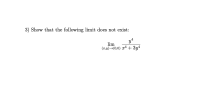
3) Show that the following limit does not exist: lim (x,y)—(0,0) x4 + 3y4
We will all rate if correct. Please use
methods to prove it. Do not just plug 0 s to numerator and
denominator. (Example: With y=mx, or parametric sub etc)
3) Show that the following limit does not exist: lim (x,y)—(0,0) x4 + 3y4
Please provide detailed steps and methods that were used to derive the answers to the given...
 Please provide detailed steps and methods that were used to
derive the answers to the given questions
Use the following information to complete parts a and b below. f(x) = (1 + x)*?; approximate 1.092 a. Find the first four nonzero terms of the Taylor series centered at 0 for the given function. The first term is (Simplify your answer. Use integers or fractions for any numbers in the expression.) The second term is (Use integers or fractions for any...
Please provide detailed steps and methods that were used to
derive the answers to the given questions
Use the following information to complete parts a and b below. f(x) = (1 + x)*?; approximate 1.092 a. Find the first four nonzero terms of the Taylor series centered at 0 for the given function. The first term is (Simplify your answer. Use integers or fractions for any numbers in the expression.) The second term is (Use integers or fractions for any...
How do you do the corridor calculation? And can someone please explain it?
How do you do the corridor calculation? And can someone please explain it?
1 *+-2* (*+2 Vx+5 - 00 (Type an exact answer.) Evaluate the following limit. Use l'Hôpital's...
 1 *+-2* (*+2 Vx+5 - 00 (Type an exact answer.) Evaluate the following limit. Use l'Hôpital's Rule when it is convenient and applicable. x+-2 x+2 Vx+2 What is the most efficient way for this limit to be evaluated? Select the correct choice below and, if necessary O A. Manipulate the given expression algebraically to rewrite the limit aslim x -2 O B. Take the natural logarithm of the expression and then l'Hôpital's Rule to rewrite the limit as X-2 O...
 please explain each of the steps and prove why was it correct
for each of the problem and don't use L'Hopital's rule for 2 and 3,
thank you.
The graph below is the function f(x) 4 3 2 1 -1 3 - 4 -5 d Find lim 12 f(2) Find lim 12+ f(x) Find lim f(x) 12 Find f(2) 2? + 10+ 21 Evaluate the limit using an algebraic method: lim 2-3 2 +3 Evaluate the limit 81 - 2...
please explain each of the steps and prove why was it correct
for each of the problem and don't use L'Hopital's rule for 2 and 3,
thank you.
The graph below is the function f(x) 4 3 2 1 -1 3 - 4 -5 d Find lim 12 f(2) Find lim 12+ f(x) Find lim f(x) 12 Find f(2) 2? + 10+ 21 Evaluate the limit using an algebraic method: lim 2-3 2 +3 Evaluate the limit 81 - 2...
 can someone please explain
their answer, I don't know how to determine when to use sin, tan,
or cos for the formula
can someone please explain
their answer, I don't know how to determine when to use sin, tan,
or cos for the formula
 send help for these 4 questions, please show steps
Definition: The AREA A of the region S that lies under the graph of the continuous function f is the limit of the sum of the areas of approximating rectangles A = lim R, = lim [f(x)Ax +f(x2)Ax+...+f(x)Ax] - 00 Consider the function f(x) = x, 13x < 16. Using the above definition, determine which of the following expressions represents the area under the graph off as a limit. A. lim...
send help for these 4 questions, please show steps
Definition: The AREA A of the region S that lies under the graph of the continuous function f is the limit of the sum of the areas of approximating rectangles A = lim R, = lim [f(x)Ax +f(x2)Ax+...+f(x)Ax] - 00 Consider the function f(x) = x, 13x < 16. Using the above definition, determine which of the following expressions represents the area under the graph off as a limit. A. lim...
 Do problems 1 and 3 please. Use any entries for the first
problem. Thank you.
1. (a) Make a table, rounding all entries to four decimal digits, to estimate the instantaneous rate of change of f(x) = x° at x = 1. Round your final answer to three decimal digits (b) Briefly describe how the entries in your table relate to the graph f(x)= x. In addition, briefly explain how your final estimate relates to the graph of f(x) =...
Do problems 1 and 3 please. Use any entries for the first
problem. Thank you.
1. (a) Make a table, rounding all entries to four decimal digits, to estimate the instantaneous rate of change of f(x) = x° at x = 1. Round your final answer to three decimal digits (b) Briefly describe how the entries in your table relate to the graph f(x)= x. In addition, briefly explain how your final estimate relates to the graph of f(x) =...
 Please include all steps and
methods used to derive the answers to the given questions
Find the power series representation for g centered at 0 by differentiating or integrating the power series for f (perhaps more than once). Give the interval of convergence for the resulting series. х 1 g(x)= using f(x) = (1+3x?)? 1 + 3x g(x)= EN k= 0 The power series g(x) converges on the interval (Simplify your answer. Type your answer in interval notation. Type an...
Please include all steps and
methods used to derive the answers to the given questions
Find the power series representation for g centered at 0 by differentiating or integrating the power series for f (perhaps more than once). Give the interval of convergence for the resulting series. х 1 g(x)= using f(x) = (1+3x?)? 1 + 3x g(x)= EN k= 0 The power series g(x) converges on the interval (Simplify your answer. Type your answer in interval notation. Type an...
 We will all rate if correct. Please use
methods to prove it. Do not just plug 0 s to numerator and
denominator. (Example: With y=mx, or parametric sub etc)
3) Show that the following limit does not exist: lim (x,y)—(0,0) x4 + 3y4
We will all rate if correct. Please use
methods to prove it. Do not just plug 0 s to numerator and
denominator. (Example: With y=mx, or parametric sub etc)
3) Show that the following limit does not exist: lim (x,y)—(0,0) x4 + 3y4
 Please provide detailed steps and methods that were used to
derive the answers to the given questions
Use the following information to complete parts a and b below. f(x) = (1 + x)*?; approximate 1.092 a. Find the first four nonzero terms of the Taylor series centered at 0 for the given function. The first term is (Simplify your answer. Use integers or fractions for any numbers in the expression.) The second term is (Use integers or fractions for any...
Please provide detailed steps and methods that were used to
derive the answers to the given questions
Use the following information to complete parts a and b below. f(x) = (1 + x)*?; approximate 1.092 a. Find the first four nonzero terms of the Taylor series centered at 0 for the given function. The first term is (Simplify your answer. Use integers or fractions for any numbers in the expression.) The second term is (Use integers or fractions for any...
 1 *+-2* (*+2 Vx+5 - 00 (Type an exact answer.) Evaluate the following limit. Use l'Hôpital's Rule when it is convenient and applicable. x+-2 x+2 Vx+2 What is the most efficient way for this limit to be evaluated? Select the correct choice below and, if necessary O A. Manipulate the given expression algebraically to rewrite the limit aslim x -2 O B. Take the natural logarithm of the expression and then l'Hôpital's Rule to rewrite the limit as X-2 O...
Most questions answered within 3 hours.
-
Where is the error in this code sequence?
String s1 = "Hello";
String s2 = "ello";...
asked 10 months ago -
Financial data for Joel de Paris, Inc., for last year
follow:
Joel de Paris, Inc.
Balance...
asked 10 months ago -
Consider this reaction:
Al2(SO4)3 (aq)+ BaCl3
(aq) Al2Cl6 (aq)- +
3BaSO4(s) . What is the...
asked 10 months ago -
Suppose that Savneet is considering increasing her
recent random sample from 20 car rentals to 40...
asked 10 months ago -
Trucks arrive at an unloading terminal at an average rate of 120
per hour.
Trucks arrive...
asked 10 months ago -
Why are methanol and ethanol completely soluble in water while
octanol is not very little soluble....
asked 10 months ago -
A facilities manager at a university reads in a research report
that the mean amount of...
asked 10 months ago -
When the CuSO4 is rehydrated by adding water to the anhydrous
compound, is this an endothermic...
asked 10 months ago -
A ray of sunlight is passing from diamond into crown glass; the
angle of incidence is...
asked 10 months ago -
A block of mass 0.249 kg is placed on top of a light, vertical
spring of...
asked 10 months ago -
how do the kidneys compensate in the presences of acidosis
a) trigger hyperventilate
b) reserve acid...
asked 10 months ago -
Question 501 pts
The rental rate of capital to the firm increases. Which of the
following...
asked 10 months ago