Voltage amplifiers are available with Avoc= 8V/V, Rin = 1.8kOhms, Ro=850 Ohms. With a 12 V...
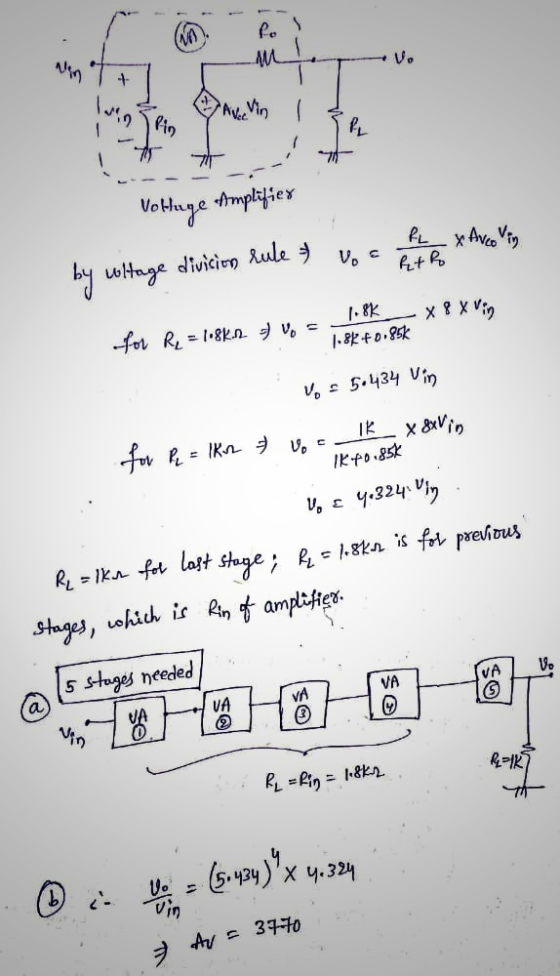
Voltage amplifiers are available with Avoc= 8V/V, Rin = 1.8kOhms, Ro=850 Ohms.
With a 12 V DC power source, each amplifier consumes 1.5 mA average current.
a. How many amplifiers do you need to cascade to get at least a 1000 voltage gain with a load resistance of 1.0 kΩ?
b. What is the voltage gain Av obtained? (Respond with a rounded whole number)
c.For the cascade connection, find the open circuit voltage gain.
d. If you have a 1.5 mV input, how efficient is the equivalent amplifier?
e. Find the transconductance of the entire circuit.
Homework Answers

Please give POSITIVE rating if you understood the answer thank you...
Add Answer to:
Voltage amplifiers are available with Avoc= 8V/V, Rin = 1.8kOhms, Ro=850 Ohms.
With a 12 V...
^ Problema 4. (10 pts) Se tiene disponibles amplificadores de voltaje con Avoc = 8 V/V,...
 ^
Problema 4. (10 pts) Se tiene disponibles amplificadores de voltaje con Avoc = 8 V/V, Rin = 1.8 kg, Ro = 850 2. Con una fuente DC de energía de 12 V, cada amplificador consume 1.5 mA promedio de corriente. a. ¿Cuántos amplificadores se necesita conectar en cascada para obtener por lo menos una ganancia de voltaje de 1000 con una resistencia de carga de 1.0 kN? b. ¿Cuál es la ganancia de voltaje Av obtenida? (Responda con un...
^
Problema 4. (10 pts) Se tiene disponibles amplificadores de voltaje con Avoc = 8 V/V, Rin = 1.8 kg, Ro = 850 2. Con una fuente DC de energía de 12 V, cada amplificador consume 1.5 mA promedio de corriente. a. ¿Cuántos amplificadores se necesita conectar en cascada para obtener por lo menos una ganancia de voltaje de 1000 con una resistencia de carga de 1.0 kN? b. ¿Cuál es la ganancia de voltaje Av obtenida? (Responda con un...
6.108 (d) Section 6.5: Discrete-Circuit Amplifiers 6.107 Calculate overall voltage gain G, of a 3 mA/V, ro= = 1...
 6.108 (d)
Section 6.5: Discrete-Circuit Amplifiers 6.107 Calculate overall voltage gain G, of a 3 mA/V, ro= = 10 MS2. The amplifier is the common-source amplifier for which g 100 k2, RD 10 k2, and RG fed from a signal source with a Thevenin resistance of l M2, and the amplifier output is coupled of 20 k2 to a load resistance SIM 6.108 The NMOS transistor in the CS amplifier shown in Fig. P6.108 has V, = 0.7 V and...
6.108 (d)
Section 6.5: Discrete-Circuit Amplifiers 6.107 Calculate overall voltage gain G, of a 3 mA/V, ro= = 10 MS2. The amplifier is the common-source amplifier for which g 100 k2, RD 10 k2, and RG fed from a signal source with a Thevenin resistance of l M2, and the amplifier output is coupled of 20 k2 to a load resistance SIM 6.108 The NMOS transistor in the CS amplifier shown in Fig. P6.108 has V, = 0.7 V and...
4) Consider the MOSFET differential amplifier shown below, with Io-2 mA, and RL- 10 kS2, Rss-100 ...
 4) Consider the MOSFET differential amplifier shown below, with Io-2 mA, and RL- 10 kS2, Rss-100 k2, VDD- +8V and Vss--8V. The NMOS transistors in the circuit are nominally identical, with kn 2 mA/V2, VTn 1.0 V and ro 100 k2. The PMoS transistors in the circuit are nominally identical, with kp 2 mA/V2, [VTpl 1.0 V and ro 100 kΩ M3 M4 0 M1 M2 a) First consider the DC bias point. Assuming that the current mirror requires at...
Problem 2: BJT Small-Signal Voltage Amplifiers in the lectures, we covered in detail the analysis of an npn BJT amplifier that utilizes a single-supply DC biasing. In this problem, you will meet...
 Problem 2: BJT Small-Signal Voltage Amplifiers in the lectures, we covered in detail the analysis of an npn BJT amplifier that utilizes a single-supply DC biasing. In this problem, you will meet two additional amplifier architectures- one that is based on dual DC supplies combined with a DC current source, and the other that utilizes a pnp BJT with single-supply biasing. In both problems (below) you need to manually find the amplifier's Q-point (that is, the DC values of Ic...
Use Exact Analysis Use 4 decimal places, no commas. a. VCC = 15V b. R1 =...
Use Exact Analysis Use 4 decimal places, no commas. a. VCC = 15V b. R1 = 55 kΩ c. R2 = 15 kΩ d. RC = 2.5 kΩ e. RE = 1.5 kΩ f. RS = 15 Ω g. RL = 500 Ω h. βDC = 50 i. βac = 100 Single-stage, voltage-divider biased, common-emitter with **C1 and C2 are coupling capacitors. C3 is bypass capacitor Given: A. VB = [a] V ; B. VE = [b] V ; C....
Please show a detail explanation on the solution. Thanks in advance 4.117 The amplifier of Fig....
 Please show a detail explanation on the solution. Thanks in
advance
4.117 The amplifier of Fig. P4.117 consists of two identical common-e that the input resistance of the second stage, R2, constitutes the load resistance of the first stage mitter amplifiers connected in cascade. Observe = 6.8 kΩ and β= 100, determine the dc collector current and de collector voltage of each transistor (b) Draw the small-signal equivalent circuit of the entire amplifier and give the values of al its...
Please show a detail explanation on the solution. Thanks in
advance
4.117 The amplifier of Fig. P4.117 consists of two identical common-e that the input resistance of the second stage, R2, constitutes the load resistance of the first stage mitter amplifiers connected in cascade. Observe = 6.8 kΩ and β= 100, determine the dc collector current and de collector voltage of each transistor (b) Draw the small-signal equivalent circuit of the entire amplifier and give the values of al its...
Q2: An amplifier operating from t 15-V power supplies is fed with a sinusoidal voltage having 1 V peak and delivers a s...
 Q2: An amplifier operating from t 15-V power supplies is fed with a sinusoidal voltage having 1 V peak and delivers a sinusoidal voltage output of 12 V peak to a 1-kΩ load. The amplifier draws a current of 6.5 mA from each of its two power supplies. The input current of the amplifier is found to be sinusoidal with 0.1 mA peak. Find (a) the voltage gain, (b) the current gain, (c) the power gain, (d) the power drawn...
Problem 2: BJT Small-Signal Voltage Amplifiers In the lectures, we covered in detail the analysis...
 Problem 2: BJT Small-Signal Voltage Amplifiers In the lectures, we covered in detail the analysis of an npn BJT amplifier that utilizes a single-supply DC biasing. In this problem, you wi meet two additional amplifier architectures-one that is based on dual DC supplies combined with a DC current source, and the other that utilizes a pnp BJT with single-supply biasing In both problems (below) you need to manually find the amplifier's Q-point (that is, the DC values of Ic and...
USE EXACT ANALYSIS Use 4 decimal places, no commas. Given: Single-stage, voltage-divider biased, common collector amplifier...
 USE EXACT ANALYSIS Use 4 decimal places, no commas. Given: Single-stage, voltage-divider biased, common collector amplifier with a. VCC = 15V b. R1 55 kohms c. R2 15 kohms d. RE 1.5 kohms e. Rs = 14 ohms f. RL = 500 ohms g. DC Beta = 50 h, AC Beta = 100 *C1 and C2 are coupling capacitors. C3 is bypass capacitor Required: A. VTH =[a] V B. RTH =[b] kohms C. IE [c] mA D. VC =[d] V...
6.5 BI C2 Cl sig in 0 Design the bias circuit of the CE amplifier shown...
 6.5 BI C2 Cl sig in 0 Design the bias circuit of the CE amplifier shown to obtain IE= 0.5 mA and Vc= +6 V. Design for a dc voltage at the base of 5 V and a current through RB2 of 50 μΑ. Let Vcc-+15 V, β-100, and VBE 0.7 V. a) Specify the values of RBi, RB2, RE, and Rc b) Also give the values of the BJT small-signal parameters gm, rr , and ro at the bias...
 ^
Problema 4. (10 pts) Se tiene disponibles amplificadores de voltaje con Avoc = 8 V/V, Rin = 1.8 kg, Ro = 850 2. Con una fuente DC de energía de 12 V, cada amplificador consume 1.5 mA promedio de corriente. a. ¿Cuántos amplificadores se necesita conectar en cascada para obtener por lo menos una ganancia de voltaje de 1000 con una resistencia de carga de 1.0 kN? b. ¿Cuál es la ganancia de voltaje Av obtenida? (Responda con un...
^
Problema 4. (10 pts) Se tiene disponibles amplificadores de voltaje con Avoc = 8 V/V, Rin = 1.8 kg, Ro = 850 2. Con una fuente DC de energía de 12 V, cada amplificador consume 1.5 mA promedio de corriente. a. ¿Cuántos amplificadores se necesita conectar en cascada para obtener por lo menos una ganancia de voltaje de 1000 con una resistencia de carga de 1.0 kN? b. ¿Cuál es la ganancia de voltaje Av obtenida? (Responda con un...
 6.108 (d)
Section 6.5: Discrete-Circuit Amplifiers 6.107 Calculate overall voltage gain G, of a 3 mA/V, ro= = 10 MS2. The amplifier is the common-source amplifier for which g 100 k2, RD 10 k2, and RG fed from a signal source with a Thevenin resistance of l M2, and the amplifier output is coupled of 20 k2 to a load resistance SIM 6.108 The NMOS transistor in the CS amplifier shown in Fig. P6.108 has V, = 0.7 V and...
6.108 (d)
Section 6.5: Discrete-Circuit Amplifiers 6.107 Calculate overall voltage gain G, of a 3 mA/V, ro= = 10 MS2. The amplifier is the common-source amplifier for which g 100 k2, RD 10 k2, and RG fed from a signal source with a Thevenin resistance of l M2, and the amplifier output is coupled of 20 k2 to a load resistance SIM 6.108 The NMOS transistor in the CS amplifier shown in Fig. P6.108 has V, = 0.7 V and...
 4) Consider the MOSFET differential amplifier shown below, with Io-2 mA, and RL- 10 kS2, Rss-100 k2, VDD- +8V and Vss--8V. The NMOS transistors in the circuit are nominally identical, with kn 2 mA/V2, VTn 1.0 V and ro 100 k2. The PMoS transistors in the circuit are nominally identical, with kp 2 mA/V2, [VTpl 1.0 V and ro 100 kΩ M3 M4 0 M1 M2 a) First consider the DC bias point. Assuming that the current mirror requires at...
 Problem 2: BJT Small-Signal Voltage Amplifiers in the lectures, we covered in detail the analysis of an npn BJT amplifier that utilizes a single-supply DC biasing. In this problem, you will meet two additional amplifier architectures- one that is based on dual DC supplies combined with a DC current source, and the other that utilizes a pnp BJT with single-supply biasing. In both problems (below) you need to manually find the amplifier's Q-point (that is, the DC values of Ic...
 Please show a detail explanation on the solution. Thanks in
advance
4.117 The amplifier of Fig. P4.117 consists of two identical common-e that the input resistance of the second stage, R2, constitutes the load resistance of the first stage mitter amplifiers connected in cascade. Observe = 6.8 kΩ and β= 100, determine the dc collector current and de collector voltage of each transistor (b) Draw the small-signal equivalent circuit of the entire amplifier and give the values of al its...
Please show a detail explanation on the solution. Thanks in
advance
4.117 The amplifier of Fig. P4.117 consists of two identical common-e that the input resistance of the second stage, R2, constitutes the load resistance of the first stage mitter amplifiers connected in cascade. Observe = 6.8 kΩ and β= 100, determine the dc collector current and de collector voltage of each transistor (b) Draw the small-signal equivalent circuit of the entire amplifier and give the values of al its...
 Q2: An amplifier operating from t 15-V power supplies is fed with a sinusoidal voltage having 1 V peak and delivers a sinusoidal voltage output of 12 V peak to a 1-kΩ load. The amplifier draws a current of 6.5 mA from each of its two power supplies. The input current of the amplifier is found to be sinusoidal with 0.1 mA peak. Find (a) the voltage gain, (b) the current gain, (c) the power gain, (d) the power drawn...
 Problem 2: BJT Small-Signal Voltage Amplifiers In the lectures, we covered in detail the analysis of an npn BJT amplifier that utilizes a single-supply DC biasing. In this problem, you wi meet two additional amplifier architectures-one that is based on dual DC supplies combined with a DC current source, and the other that utilizes a pnp BJT with single-supply biasing In both problems (below) you need to manually find the amplifier's Q-point (that is, the DC values of Ic and...
 USE EXACT ANALYSIS Use 4 decimal places, no commas. Given: Single-stage, voltage-divider biased, common collector amplifier with a. VCC = 15V b. R1 55 kohms c. R2 15 kohms d. RE 1.5 kohms e. Rs = 14 ohms f. RL = 500 ohms g. DC Beta = 50 h, AC Beta = 100 *C1 and C2 are coupling capacitors. C3 is bypass capacitor Required: A. VTH =[a] V B. RTH =[b] kohms C. IE [c] mA D. VC =[d] V...
 6.5 BI C2 Cl sig in 0 Design the bias circuit of the CE amplifier shown to obtain IE= 0.5 mA and Vc= +6 V. Design for a dc voltage at the base of 5 V and a current through RB2 of 50 μΑ. Let Vcc-+15 V, β-100, and VBE 0.7 V. a) Specify the values of RBi, RB2, RE, and Rc b) Also give the values of the BJT small-signal parameters gm, rr , and ro at the bias...
Most questions answered within 3 hours.
-
Where is the error in this code sequence?
String s1 = "Hello";
String s2 = "ello";...
asked 10 months ago -
Financial data for Joel de Paris, Inc., for last year
follow:
Joel de Paris, Inc.
Balance...
asked 10 months ago -
Consider this reaction:
Al2(SO4)3 (aq)+ BaCl3
(aq) Al2Cl6 (aq)- +
3BaSO4(s) . What is the...
asked 10 months ago -
Suppose that Savneet is considering increasing her
recent random sample from 20 car rentals to 40...
asked 10 months ago -
Trucks arrive at an unloading terminal at an average rate of 120
per hour.
Trucks arrive...
asked 10 months ago -
Why are methanol and ethanol completely soluble in water while
octanol is not very little soluble....
asked 10 months ago -
A facilities manager at a university reads in a research report
that the mean amount of...
asked 10 months ago -
When the CuSO4 is rehydrated by adding water to the anhydrous
compound, is this an endothermic...
asked 10 months ago -
A ray of sunlight is passing from diamond into crown glass; the
angle of incidence is...
asked 10 months ago -
A block of mass 0.249 kg is placed on top of a light, vertical
spring of...
asked 10 months ago -
how do the kidneys compensate in the presences of acidosis
a) trigger hyperventilate
b) reserve acid...
asked 10 months ago -
Question 501 pts
The rental rate of capital to the firm increases. Which of the
following...
asked 10 months ago