
Homework Answers
Add Answer to:
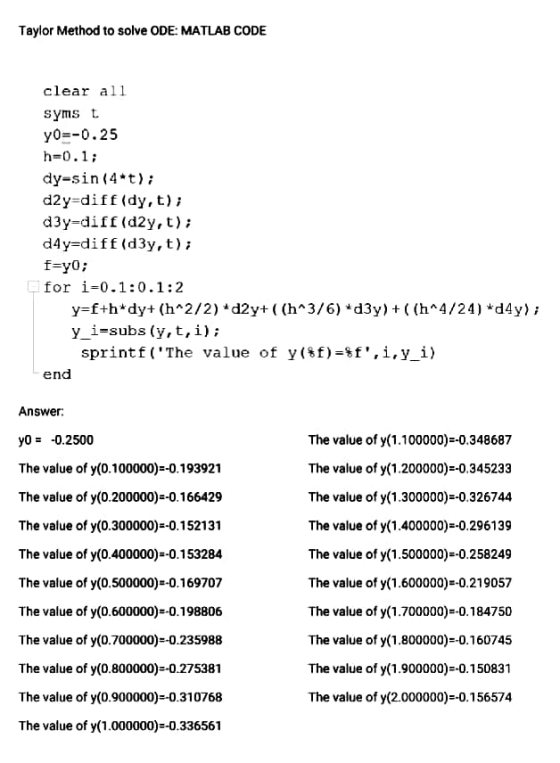
Consider the following ordinary differential equation: y' - sin(4t) = 0 (Eq. 4) The boundary condition...
3. Consider the initial value problem y(t) = y, y(0) = 1. a. Write down (i.e.,...
 3. Consider the initial value problem y(t) = y, y(0) = 1. a. Write down (i.e., write the formula which describes one step, Yn+1 = yn + ...) the second order Taylor method with step size h for this initial value problem. b. Write down the time stepping formula Yn+1 = Yn +... for the modified Euler method 9n+1 := yn + hf(en +3.29 + s(tn, yn)), for this initial value problem. c. What is the difference between the two...
this is numerical analysis. Please do a and b 4. Consider the ordinary differential equation 1'(x)...
 this is numerical analysis. Please do a and b
4. Consider the ordinary differential equation 1'(x) = f(x, y(x)), y(ro) = Yo. (1) (a) Use numerical integration to derive the trapezoidal method for the above with uniform step size h. (You don't have to give the truncation error.) (b) Given below is a multistep method for solving (1) (with uniform step size h): bo +1 = 34 – 2n=1 + h (362. Yn) = f(n=1, 4n-1)) What is the truncation...
this is numerical analysis. Please do a and b
4. Consider the ordinary differential equation 1'(x) = f(x, y(x)), y(ro) = Yo. (1) (a) Use numerical integration to derive the trapezoidal method for the above with uniform step size h. (You don't have to give the truncation error.) (b) Given below is a multistep method for solving (1) (with uniform step size h): bo +1 = 34 – 2n=1 + h (362. Yn) = f(n=1, 4n-1)) What is the truncation...
3. Consider the initial value problem y'(t) = y2, y(0) = 1. a. Write down (i.e.,...
 3. Consider the initial value problem y'(t) = y2, y(0) = 1. a. Write down (i.e., write the formula which describes one step, Yn+1 = yn + ...) the second order Taylor method with step size h for this initial value problem. b. Write down the time stepping formula Yn+1 = Yn +... for the modified Euler method h Yn+1 := yn + hf(tn + h 2:9 » Yn + 5 f (tnYn)), for this initial value problem. c. What...
QUESTION 9 Consider given ordinary differential equation, y"+y" - 2y = 0, y(t = 0) =...
 QUESTION 9 Consider given ordinary differential equation, y"+y" - 2y = 0, y(t = 0) = 0, y'(t = 0) = 1. What is the y at t= 0.2 when the equation is solved using finite difference method with At = 0.12 Use central difference approximation for y" and y'. Note: to receive the credit, the final numeric answer MUST be within the range of plus/minus 0.02. Use the 4 significant digits for the step-by-step calculation and final answer, i.e.,...
Consider the following boundary-value problem y" − 2y′ + y = x ^2− 1 , y(0) = 2, y(1) = 4 Apply the linear shooting method and the Euler method with step size of 1/3 to approximate the solution of the problem.
Consider the following boundary-value problem$$ y^{\prime \prime}-2 y^{\prime}+y=x^{2}-1, y(0)=2, \quad y(1)=4 $$Apply the linear shooting method and the Euler method with step size of \(\frac{1}{3}\) to marks) approximate the solution of the problem.
Write a MATLAB code to solve below 2nd order linear ordinary differential equation by finite difference method: y"-y'-0 in domain (-1, 1) with boundary condition y(x-1)--1 and y(x-1)-1. with...
 Write a MATLAB code to solve below 2nd order linear ordinary differential equation by finite difference method: y"-y'-0 in domain (-1, 1) with boundary condition y(x-1)--1 and y(x-1)-1. with boundary condition y an Use 2nd order approximation, i.e. O(dx2), and dx-0.05 to obtain numerical solution. Then plot the numerical solution as scattered markers together wi exp(2)-explx+1) as a continuous curve. Please add legend in your plot th the analytical solution y-1+
Write a MATLAB code to solve below 2nd order...
Write a MATLAB code to solve below 2nd order linear ordinary differential equation by finite difference method: y"-y'-0 in domain (-1, 1) with boundary condition y(x-1)--1 and y(x-1)-1. with boundary condition y an Use 2nd order approximation, i.e. O(dx2), and dx-0.05 to obtain numerical solution. Then plot the numerical solution as scattered markers together wi exp(2)-explx+1) as a continuous curve. Please add legend in your plot th the analytical solution y-1+
Write a MATLAB code to solve below 2nd order...
Problem Thre: 125 points) Consider the following initial value problem: dy-2y+ t The y(0) -1 ea dt ical solution of the differential equation is: y(O)(2-2t+3e-2+1)y fr exoc the differential equat...
 Problem Thre: 125 points) Consider the following initial value problem: dy-2y+ t The y(0) -1 ea dt ical solution of the differential equation is: y(O)(2-2t+3e-2+1)y fr exoc the differential equation numerically over the interval 0 s i s 2.0 and a step size h At 0.5.A Apply the following Runge-Kutta methods for each of the step. (show your calculations) i. [0.0 0.5: Euler method ii. [0.5 1.0]: Heun method. ii. [1.0 1.5): Midpoint method. iv. [1.5 2.0): 4h RK method...
Can't use math lab show workings Differential Equation The following ordinary differential equation is to be...
 Can't use math lab show workings
Differential Equation The following ordinary differential equation is to be solved using nu- merical methods. d + Bar = Ate - where A, 0,8 > 0 and x = x at t = 0. dt It is to be solved from t = 0 to t = 50.0. It has analytical solution r(t) = A te-al + A le-ale"), where A A B-a and A2 А (8 - a)2 Questions Answer the questions given...
Can't use math lab show workings
Differential Equation The following ordinary differential equation is to be solved using nu- merical methods. d + Bar = Ate - where A, 0,8 > 0 and x = x at t = 0. dt It is to be solved from t = 0 to t = 50.0. It has analytical solution r(t) = A te-al + A le-ale"), where A A B-a and A2 А (8 - a)2 Questions Answer the questions given...
3. Consider the differential equation dy 2x2y dx 0, y 1 In the following questions work...
 3. Consider the differential equation dy 2x2y dx 0, y 1 In the following questions work to 4 decimal places with the initial conditions x = throughout and give your answer to 3 decimal places, or use exact fractions (a) Use the Euler method to calculate an estimate of the value of y after four steps of length h 0.5 [4 marks] (b) Use the Modified Euler method to calculate an estimate of the value of y after two steps...
3. Given the ordinary differential equation: (x-2y) dx And the initial condition y(0) = 1, approximatey(0.5)...
 3. Given the ordinary differential equation: (x-2y) dx And the initial condition y(0) = 1, approximatey(0.5) using the Heun method and step sizes of 0.25.
 3. Consider the initial value problem y(t) = y, y(0) = 1. a. Write down (i.e., write the formula which describes one step, Yn+1 = yn + ...) the second order Taylor method with step size h for this initial value problem. b. Write down the time stepping formula Yn+1 = Yn +... for the modified Euler method 9n+1 := yn + hf(en +3.29 + s(tn, yn)), for this initial value problem. c. What is the difference between the two...
 this is numerical analysis. Please do a and b
4. Consider the ordinary differential equation 1'(x) = f(x, y(x)), y(ro) = Yo. (1) (a) Use numerical integration to derive the trapezoidal method for the above with uniform step size h. (You don't have to give the truncation error.) (b) Given below is a multistep method for solving (1) (with uniform step size h): bo +1 = 34 – 2n=1 + h (362. Yn) = f(n=1, 4n-1)) What is the truncation...
this is numerical analysis. Please do a and b
4. Consider the ordinary differential equation 1'(x) = f(x, y(x)), y(ro) = Yo. (1) (a) Use numerical integration to derive the trapezoidal method for the above with uniform step size h. (You don't have to give the truncation error.) (b) Given below is a multistep method for solving (1) (with uniform step size h): bo +1 = 34 – 2n=1 + h (362. Yn) = f(n=1, 4n-1)) What is the truncation...
 3. Consider the initial value problem y'(t) = y2, y(0) = 1. a. Write down (i.e., write the formula which describes one step, Yn+1 = yn + ...) the second order Taylor method with step size h for this initial value problem. b. Write down the time stepping formula Yn+1 = Yn +... for the modified Euler method h Yn+1 := yn + hf(tn + h 2:9 » Yn + 5 f (tnYn)), for this initial value problem. c. What...
 QUESTION 9 Consider given ordinary differential equation, y"+y" - 2y = 0, y(t = 0) = 0, y'(t = 0) = 1. What is the y at t= 0.2 when the equation is solved using finite difference method with At = 0.12 Use central difference approximation for y" and y'. Note: to receive the credit, the final numeric answer MUST be within the range of plus/minus 0.02. Use the 4 significant digits for the step-by-step calculation and final answer, i.e.,...
 Write a MATLAB code to solve below 2nd order linear ordinary differential equation by finite difference method: y"-y'-0 in domain (-1, 1) with boundary condition y(x-1)--1 and y(x-1)-1. with boundary condition y an Use 2nd order approximation, i.e. O(dx2), and dx-0.05 to obtain numerical solution. Then plot the numerical solution as scattered markers together wi exp(2)-explx+1) as a continuous curve. Please add legend in your plot th the analytical solution y-1+
Write a MATLAB code to solve below 2nd order...
Write a MATLAB code to solve below 2nd order linear ordinary differential equation by finite difference method: y"-y'-0 in domain (-1, 1) with boundary condition y(x-1)--1 and y(x-1)-1. with boundary condition y an Use 2nd order approximation, i.e. O(dx2), and dx-0.05 to obtain numerical solution. Then plot the numerical solution as scattered markers together wi exp(2)-explx+1) as a continuous curve. Please add legend in your plot th the analytical solution y-1+
Write a MATLAB code to solve below 2nd order...
 Problem Thre: 125 points) Consider the following initial value problem: dy-2y+ t The y(0) -1 ea dt ical solution of the differential equation is: y(O)(2-2t+3e-2+1)y fr exoc the differential equation numerically over the interval 0 s i s 2.0 and a step size h At 0.5.A Apply the following Runge-Kutta methods for each of the step. (show your calculations) i. [0.0 0.5: Euler method ii. [0.5 1.0]: Heun method. ii. [1.0 1.5): Midpoint method. iv. [1.5 2.0): 4h RK method...
 Can't use math lab show workings
Differential Equation The following ordinary differential equation is to be solved using nu- merical methods. d + Bar = Ate - where A, 0,8 > 0 and x = x at t = 0. dt It is to be solved from t = 0 to t = 50.0. It has analytical solution r(t) = A te-al + A le-ale"), where A A B-a and A2 А (8 - a)2 Questions Answer the questions given...
Can't use math lab show workings
Differential Equation The following ordinary differential equation is to be solved using nu- merical methods. d + Bar = Ate - where A, 0,8 > 0 and x = x at t = 0. dt It is to be solved from t = 0 to t = 50.0. It has analytical solution r(t) = A te-al + A le-ale"), where A A B-a and A2 А (8 - a)2 Questions Answer the questions given...
 3. Consider the differential equation dy 2x2y dx 0, y 1 In the following questions work to 4 decimal places with the initial conditions x = throughout and give your answer to 3 decimal places, or use exact fractions (a) Use the Euler method to calculate an estimate of the value of y after four steps of length h 0.5 [4 marks] (b) Use the Modified Euler method to calculate an estimate of the value of y after two steps...
 3. Given the ordinary differential equation: (x-2y) dx And the initial condition y(0) = 1, approximatey(0.5) using the Heun method and step sizes of 0.25.
Most questions answered within 3 hours.
-
Where is the error in this code sequence?
String s1 = "Hello";
String s2 = "ello";...
asked 10 months ago -
Financial data for Joel de Paris, Inc., for last year
follow:
Joel de Paris, Inc.
Balance...
asked 10 months ago -
Consider this reaction:
Al2(SO4)3 (aq)+ BaCl3
(aq) Al2Cl6 (aq)- +
3BaSO4(s) . What is the...
asked 10 months ago -
Suppose that Savneet is considering increasing her
recent random sample from 20 car rentals to 40...
asked 10 months ago -
Trucks arrive at an unloading terminal at an average rate of 120
per hour.
Trucks arrive...
asked 10 months ago -
Why are methanol and ethanol completely soluble in water while
octanol is not very little soluble....
asked 10 months ago -
A facilities manager at a university reads in a research report
that the mean amount of...
asked 10 months ago -
When the CuSO4 is rehydrated by adding water to the anhydrous
compound, is this an endothermic...
asked 10 months ago -
A ray of sunlight is passing from diamond into crown glass; the
angle of incidence is...
asked 10 months ago -
A block of mass 0.249 kg is placed on top of a light, vertical
spring of...
asked 10 months ago -
how do the kidneys compensate in the presences of acidosis
a) trigger hyperventilate
b) reserve acid...
asked 10 months ago -
Question 501 pts
The rental rate of capital to the firm increases. Which of the
following...
asked 10 months ago