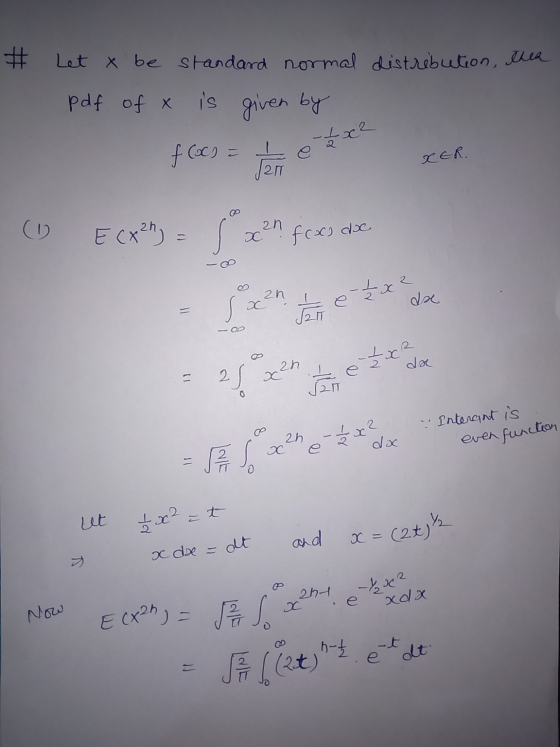
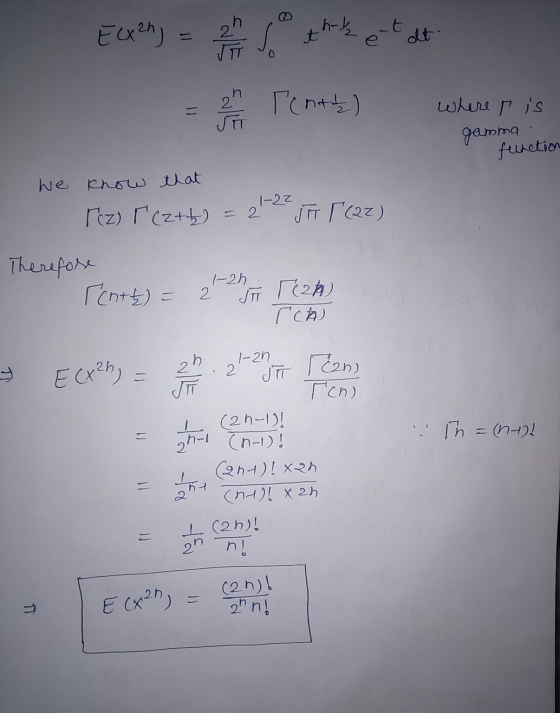
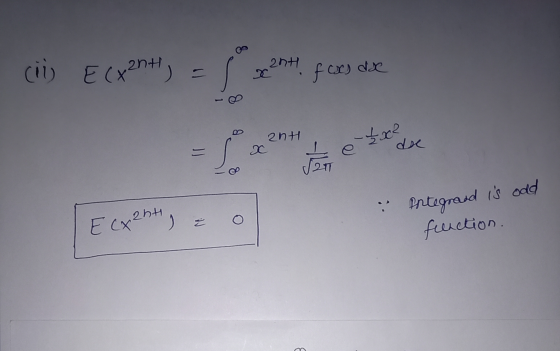
![Exercise 7. Let X be a standard normal random variable. Prove that for any integer n > 0, ELY?] = 1207) and E[x2n+] = 0.](http://img.homeworklib.com/questions/95951620-5ef7-11eb-a796-3d8a2051b48b.png?x-oss-process=image/resize,w_560)
Homework Answers
Add Answer to:
Exercise 7. Let X be a standard normal random variable. Prove that for any integer n...
3. Let X be a random variable and denote by Mx(t) its MGF. Prove that, for...
 3. Let X be a random variable and denote by Mx(t) its MGF. Prove that, for any t > 0, we have P[X >Mx(t)e
(2) Prove that the following are equivalent for x ER and A CR. (a) X E...
 (2) Prove that the following are equivalent for x ER and A CR. (a) X E A. Here A denotes the closure of A. (b) For every e > 0, N(x; e) n A +0. (c) For every open set U, if r EU then UNA+.
number? 10 3. Let X be a continuous random variable with a standard normal distribution. a....
 number? 10 3. Let X be a continuous random variable with a standard normal distribution. a. Verify that P(-2 < X < 2) > 0.75. b. Compute E(지)· 110]
Prove that is an integer for all n > 0.
 Prove that is an integer for all n > 0.
Let X be a continuous random variable. Prove that: P(21-; < X < xạ) = 1...
 Let X be a continuous random variable. Prove that: P(21-; < X < xạ) = 1 - a.
Let z=5 where x, y, z E R. Prove that z? +z2+z?>
 Let z=5 where x, y, z E R. Prove that z? +z2+z?>
6. Let X be a normal random variable with mean u = 10. What is the...
 6. Let X be a normal random variable with mean u = 10. What is the standard deviation o if it is known that p (IX – 101 <>) =
7. Let X1, X2, ... be an i.i.d. random variables. (a) Show that max(X1,... , X,n)/n...
 7. Let X1, X2, ... be an i.i.d. random variables. (a) Show that max(X1,... , X,n)/n >0 in probability if nP(Xn > n) -» 0. (b) Find a random variable Y satisfying nP(Y > n) ->0 and E(Y) = Oo
Standart Normal Probabilities Let Z be a standard normal random variable. Calculate the following probabilities using...
 Standart Normal Probabilities
Let Z be a standard normal random variable. Calculate the following probabilities using the calculator provided. Round your responses to at least three decimal places. P(Z >-2.11) P(Z 1.82) = P (-048<Z < 205) Clear Undo Help Next>> Explain
Standart Normal Probabilities
Let Z be a standard normal random variable. Calculate the following probabilities using the calculator provided. Round your responses to at least three decimal places. P(Z >-2.11) P(Z 1.82) = P (-048<Z < 205) Clear Undo Help Next>> Explain
Let X be an exponentially distributed random variable with parameter λ. Prove that P(X > s...
 Let X be an exponentially distributed random variable with parameter λ. Prove that P(X > s + tK > t) P(X > s) for any S,12 0
 3. Let X be a random variable and denote by Mx(t) its MGF. Prove that, for any t > 0, we have P[X >Mx(t)e
 (2) Prove that the following are equivalent for x ER and A CR. (a) X E A. Here A denotes the closure of A. (b) For every e > 0, N(x; e) n A +0. (c) For every open set U, if r EU then UNA+.
 number? 10 3. Let X be a continuous random variable with a standard normal distribution. a. Verify that P(-2 < X < 2) > 0.75. b. Compute E(지)· 110]
 Prove that is an integer for all n > 0.
 Let X be a continuous random variable. Prove that: P(21-; < X < xạ) = 1 - a.
 Let z=5 where x, y, z E R. Prove that z? +z2+z?>
 6. Let X be a normal random variable with mean u = 10. What is the standard deviation o if it is known that p (IX – 101 <>) =
 7. Let X1, X2, ... be an i.i.d. random variables. (a) Show that max(X1,... , X,n)/n >0 in probability if nP(Xn > n) -» 0. (b) Find a random variable Y satisfying nP(Y > n) ->0 and E(Y) = Oo
 Standart Normal Probabilities
Let Z be a standard normal random variable. Calculate the following probabilities using the calculator provided. Round your responses to at least three decimal places. P(Z >-2.11) P(Z 1.82) = P (-048<Z < 205) Clear Undo Help Next>> Explain
Standart Normal Probabilities
Let Z be a standard normal random variable. Calculate the following probabilities using the calculator provided. Round your responses to at least three decimal places. P(Z >-2.11) P(Z 1.82) = P (-048<Z < 205) Clear Undo Help Next>> Explain
 Let X be an exponentially distributed random variable with parameter λ. Prove that P(X > s + tK > t) P(X > s) for any S,12 0
Most questions answered within 3 hours.
-
Where is the error in this code sequence?
String s1 = "Hello";
String s2 = "ello";...
asked 10 months ago -
Financial data for Joel de Paris, Inc., for last year
follow:
Joel de Paris, Inc.
Balance...
asked 10 months ago -
Consider this reaction:
Al2(SO4)3 (aq)+ BaCl3
(aq) Al2Cl6 (aq)- +
3BaSO4(s) . What is the...
asked 10 months ago -
Suppose that Savneet is considering increasing her
recent random sample from 20 car rentals to 40...
asked 10 months ago -
Trucks arrive at an unloading terminal at an average rate of 120
per hour.
Trucks arrive...
asked 10 months ago -
Why are methanol and ethanol completely soluble in water while
octanol is not very little soluble....
asked 10 months ago -
A facilities manager at a university reads in a research report
that the mean amount of...
asked 10 months ago -
When the CuSO4 is rehydrated by adding water to the anhydrous
compound, is this an endothermic...
asked 10 months ago -
A ray of sunlight is passing from diamond into crown glass; the
angle of incidence is...
asked 10 months ago -
A block of mass 0.249 kg is placed on top of a light, vertical
spring of...
asked 10 months ago -
how do the kidneys compensate in the presences of acidosis
a) trigger hyperventilate
b) reserve acid...
asked 10 months ago -
Question 501 pts
The rental rate of capital to the firm increases. Which of the
following...
asked 10 months ago