
Homework Answers
Add Answer to:
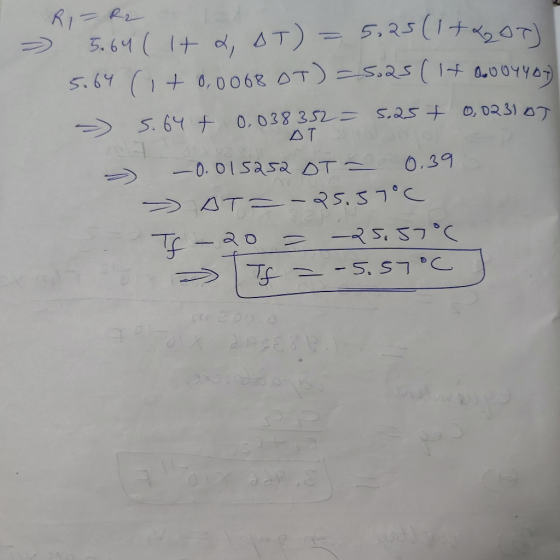
A wire with a temperature coefficient of resistance (-0.0060/C) has a resistance of 5.64 at 20°...
A given copper wire has a resistance of 5.05 Ω at 20.0°C while a tungsten wire...
A given copper wire has a resistance of 5.05 Ω at 20.0°C while a tungsten wire of the same diameter has a resistance of 4.69 Ω at 20.0°C. At what temperature will the two wires have the same resistance? Your response differs from the correct answer by more than 10%. Double check your calculations.°C
3 WA 017 A copper wire has a resistance of 0.455 2 at 20.0°C, and an...
 3 WA 017 A copper wire has a resistance of 0.455 2 at 20.0°C, and an iron wire has a resistance of 0.494 n at the same temperature. At what temperature are their resistances equal? The temperature coefficient of resistivity for copper is 3.90 x 10 (oc) and for iron it is 5.00 x 10 (Pc)- -34 What is the expression that gives the temperature dependence of resistance? Both materials go through the same temperature difference. How can you use...
A copper wire has a resistance of 0.500 Ω at 20.0°C, and an iron wire has...
A copper wire has a resistance of 0.500 Ω at 20.0°C, and an iron wire has a resistance of 0.520 Ω at the same temperature. At what temperature are their resistances equal? The temperature coefficient of resistivity for copper is 3.90 *10^-3(°C)−1 and for iron it is 5.00 *10^-3(°C)−1.
A copper wire has a resistance of 0.540 Ω at 20.0°C, and an iron wire has...
A copper wire has a resistance of 0.540 Ω at 20.0°C, and an iron wire has a resistance of 0.579 Ω at the same temperature. At what temperature are their resistances equal? The temperature coefficient of resistivity for copper is 3.90 10-3(°C)−1 and for iron it is 5.00 10-3(°C)−1.
A metal wire has a resistance of 14.00 Ω at a temperature of 25.0°C. If the...
A metal wire has a resistance of 14.00 Ω at a temperature of 25.0°C. If the same wire has a resistance of 14.55 Ω at 90.0°C, what is the resistance when its temperature is −32.0°C?
A coil of wire has a resistance of 38.0 Ω at 25° C and 43.7 Ω at 54° C. What is the temperature coefficient of resistivi...
A coil of wire has a resistance of 38.0 Ω at 25° C and 43.7 Ω at 54° C. What is the temperature coefficient of resistivity?
An aluminum wire has a resistance of 3.00 2 at 31.0°C. Determine its resistance (in 2)...
 An aluminum wire has a resistance of 3.00 2 at 31.0°C. Determine its resistance (in 2) at 431°C. The temperature coefficient of resistivity for aluminum wire is 3.90 x 10⁻³ (°C)-1. (Assume that the temperature coefficient of resistivity was measured using the reference temperature 20°C.)
The resistance of a certain wire is 20 Ohms. Another wire of the same material has...
The resistance of a certain wire is 20 Ohms. Another wire of the same material has a diameter 1/3 as great and twice the length. What is the resistance of the second wire?
Which of the following is the correct statement regarding resistance? a. the resistance of a wire...
Which of the following is the correct statement regarding resistance? a. the resistance of a wire is inversely proportional to the resistivity of the wire b. the resistance of a wire is directly proportional to the length of the wire c. the resistance of a wire is directly proportional to the area of the wire d. all of the above statements are correct e. none of the above statements are correct Consider two copper wires. One wire has twice the...
A copper wire has a resistance of 0.525 at 20.0°C, and an iron wire has a...
A copper wire has a resistance of 0.525 at 20.0°C, and an iron wire has a resistance of 0.545 at the same temperature. At what temperature are their resistances equal?
 3 WA 017 A copper wire has a resistance of 0.455 2 at 20.0°C, and an iron wire has a resistance of 0.494 n at the same temperature. At what temperature are their resistances equal? The temperature coefficient of resistivity for copper is 3.90 x 10 (oc) and for iron it is 5.00 x 10 (Pc)- -34 What is the expression that gives the temperature dependence of resistance? Both materials go through the same temperature difference. How can you use...
 An aluminum wire has a resistance of 3.00 2 at 31.0°C. Determine its resistance (in 2) at 431°C. The temperature coefficient of resistivity for aluminum wire is 3.90 x 10⁻³ (°C)-1. (Assume that the temperature coefficient of resistivity was measured using the reference temperature 20°C.)
Most questions answered within 3 hours.
-
Where is the error in this code sequence?
String s1 = "Hello";
String s2 = "ello";...
asked 10 months ago -
Financial data for Joel de Paris, Inc., for last year
follow:
Joel de Paris, Inc.
Balance...
asked 10 months ago -
Consider this reaction:
Al2(SO4)3 (aq)+ BaCl3
(aq) Al2Cl6 (aq)- +
3BaSO4(s) . What is the...
asked 10 months ago -
Suppose that Savneet is considering increasing her
recent random sample from 20 car rentals to 40...
asked 10 months ago -
Trucks arrive at an unloading terminal at an average rate of 120
per hour.
Trucks arrive...
asked 10 months ago -
Why are methanol and ethanol completely soluble in water while
octanol is not very little soluble....
asked 10 months ago -
A facilities manager at a university reads in a research report
that the mean amount of...
asked 10 months ago -
When the CuSO4 is rehydrated by adding water to the anhydrous
compound, is this an endothermic...
asked 10 months ago -
A ray of sunlight is passing from diamond into crown glass; the
angle of incidence is...
asked 10 months ago -
A block of mass 0.249 kg is placed on top of a light, vertical
spring of...
asked 10 months ago -
how do the kidneys compensate in the presences of acidosis
a) trigger hyperventilate
b) reserve acid...
asked 10 months ago -
Question 501 pts
The rental rate of capital to the firm increases. Which of the
following...
asked 10 months ago