
Homework Answers


Add Answer to:
5.62 In the system shown in Fig. 5.24, the mass m is excited by a harmonic...
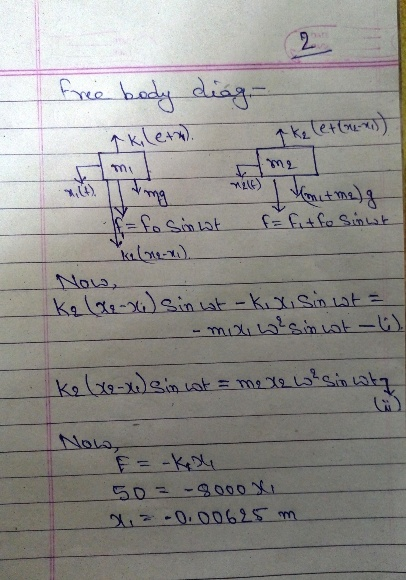
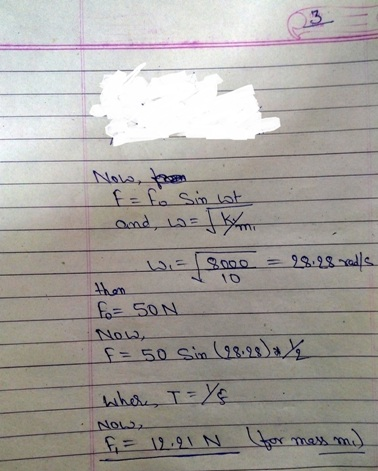
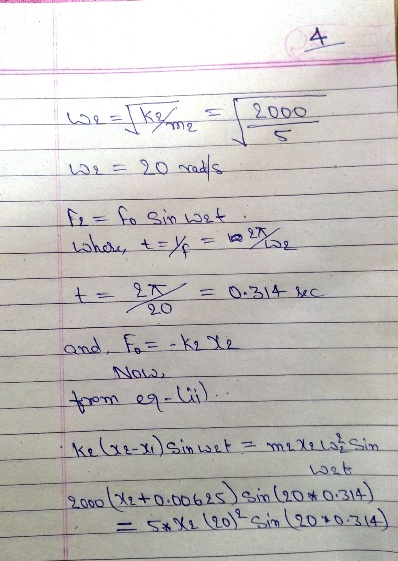
The following system is composed by two masses The first mass m, = 21 kg, moving...
 The following system is composed by two masses The first mass m, = 21 kg, moving horizontally (x1, positive rightwards) • The second mass m2 = 2.4 kg, moving horizontally (X2. positive rightwards) The first mass is connected to the ground (on the left) by two springs, each with stiffness k = 201 N/m. The second mass is connected to the first mass by another spring, also with stiffness k = 201 N/m. A harmonic force is applied to the...
A spring-mass system with m = 8 kg and k = 4000 N/m subjected to a...
A spring-mass system with m = 8 kg and k = 4000 N/m subjected to a harmonic force of amplitude 200 N and frequency (). When the mass of the system is increased by 20% from its original value, the amplitude of the forced motion of the new mass is observed to be 25% off the original one. Determine the frequency of the harmonic force and the amplitude of original system
A spring-mass system with m-10 kg and k-5000 N/m is subjected to a harmonic force having...
 A spring-mass system with m-10 kg and k-5000 N/m is subjected to a harmonic force having an amplitude of 250 N and frequency of ow. If the maximum amplitude of the mass is observed to be 100 mm, find the value of o. (Points 4/10)
Problem # 4 15 points The base of a damped spring-mass system, with m 25 kg...
 Problem # 4 15 points The base of a damped spring-mass system, with m 25 kg and k 2500 N/m, is subjected to a harmonic excitation y(t) Xo cos ω. The amplitude of the mass is found to be 0.05 m when the base is excited at the natural frequency of the system with Yo 0.0 m. Determine the damping constant of the system.
4.9. Draw a Simulink diagram to represent the system shown in Example 4.3. Plot x, and...
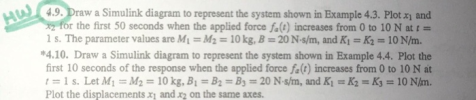 4.9. Draw a Simulink diagram to represent the system shown in Example 4.3. Plot x, and x2 for the first 50 seconds when the applied force fal increases from 0 to 10 N at t = 1 s. The parameter values are M1 = M2 = 10 kg, B = 20 Ns/m, and Ki = K2 = 10 N/m. *4.10. Draw a Simulink diagram to represent the system shown in Example 4.4. Plot the first 10 seconds of the response...
QUESTION 6 130 MARKS For a vibrating system, the body mass is 10 kg, stiffness is 2.5 kN/m, and damping constant is 45...
 QUESTION 6 130 MARKS For a vibrating system, the body mass is 10 kg, stiffness is 2.5 kN/m, and damping constant is 45 Ns/m. A harmonic force of amplitude 180 N and frequency 3.5 Hz acts on the mass. If the initial displacement and velocity of the mass are 15 mm and 5 m/s, compute the complete solution representing the motion of the mass. 45 (30 Marks)
QUESTION 6 130 MARKS For a vibrating system, the body mass is 10...
QUESTION 6 130 MARKS For a vibrating system, the body mass is 10 kg, stiffness is 2.5 kN/m, and damping constant is 45 Ns/m. A harmonic force of amplitude 180 N and frequency 3.5 Hz acts on the mass. If the initial displacement and velocity of the mass are 15 mm and 5 m/s, compute the complete solution representing the motion of the mass. 45 (30 Marks)
QUESTION 6 130 MARKS For a vibrating system, the body mass is 10...
EXam 2 Name: 1. A n undamped vertical system consists of a mass weighing 100 N...
 EXam 2 Name: 1. A n undamped vertical system consists of a mass weighing 100 N and a spring of stiffness 5000 N/m. It is acted on by a harmonic force of amplitude 80 N and frequency 5 Hz. Find i) The displacement of the spring due to the weight of the mass, The static displacement of the spring due to the maximum applied force, and The amplitude of forced motion of the mass for zero initial conditions iii)
Test Consider a two-degrees-of-freedom system shown below. ド. PN What is the amplitude of vibration (particular solution only) of mass 2 (at the input frequency)? The answer must be positive. Ke...
 Test Consider a two-degrees-of-freedom system shown below. ド. PN What is the amplitude of vibration (particular solution only) of mass 2 (at the input frequency)? The answer must be positive. Keep 3 significant figures, and omit units. Use m1 2 kg m2 4 kg k1 147 N/m k2 146 N/m K3 192 N/m F1 # 411 cos(0.50 N Note that the system is not damped. The homogeneous response does not decay to zero. The masses vibrates at three different frequencies...
A 2.8 m long wire having a mass of 0.14 kg is fixed at both ends...
A 2.8 m long wire having a mass of 0.14 kg is fixed at both ends and is under tension of 37 N. When the nth harmonic is excited, there is a node 0.56 m from one end. (a) What is n? n = (b) What are the frequencies of the first three allowed modes of vibration? f1 = Hz f2 = Hz f3 = Hz
For a mass-spring system shown in the figure below. Write the dynamic equations in matrix form...
 For a mass-spring system shown in the figure below. Write the dynamic equations in matrix form and find the natural frequencies for this system, eigen values, eigen vectors and mode shapes assuming: m1=1 kg, m2=4 kg, k1=k3=10 N/m, and k2=2 N/m. / ر2 دی) x1(0) x2(0) K3 K1 W K2 mi W4 m2 (-?
 The following system is composed by two masses The first mass m, = 21 kg, moving horizontally (x1, positive rightwards) • The second mass m2 = 2.4 kg, moving horizontally (X2. positive rightwards) The first mass is connected to the ground (on the left) by two springs, each with stiffness k = 201 N/m. The second mass is connected to the first mass by another spring, also with stiffness k = 201 N/m. A harmonic force is applied to the...
 A spring-mass system with m-10 kg and k-5000 N/m is subjected to a harmonic force having an amplitude of 250 N and frequency of ow. If the maximum amplitude of the mass is observed to be 100 mm, find the value of o. (Points 4/10)
 Problem # 4 15 points The base of a damped spring-mass system, with m 25 kg and k 2500 N/m, is subjected to a harmonic excitation y(t) Xo cos ω. The amplitude of the mass is found to be 0.05 m when the base is excited at the natural frequency of the system with Yo 0.0 m. Determine the damping constant of the system.
 4.9. Draw a Simulink diagram to represent the system shown in Example 4.3. Plot x, and x2 for the first 50 seconds when the applied force fal increases from 0 to 10 N at t = 1 s. The parameter values are M1 = M2 = 10 kg, B = 20 Ns/m, and Ki = K2 = 10 N/m. *4.10. Draw a Simulink diagram to represent the system shown in Example 4.4. Plot the first 10 seconds of the response...
 QUESTION 6 130 MARKS For a vibrating system, the body mass is 10 kg, stiffness is 2.5 kN/m, and damping constant is 45 Ns/m. A harmonic force of amplitude 180 N and frequency 3.5 Hz acts on the mass. If the initial displacement and velocity of the mass are 15 mm and 5 m/s, compute the complete solution representing the motion of the mass. 45 (30 Marks)
QUESTION 6 130 MARKS For a vibrating system, the body mass is 10...
QUESTION 6 130 MARKS For a vibrating system, the body mass is 10 kg, stiffness is 2.5 kN/m, and damping constant is 45 Ns/m. A harmonic force of amplitude 180 N and frequency 3.5 Hz acts on the mass. If the initial displacement and velocity of the mass are 15 mm and 5 m/s, compute the complete solution representing the motion of the mass. 45 (30 Marks)
QUESTION 6 130 MARKS For a vibrating system, the body mass is 10...
 EXam 2 Name: 1. A n undamped vertical system consists of a mass weighing 100 N and a spring of stiffness 5000 N/m. It is acted on by a harmonic force of amplitude 80 N and frequency 5 Hz. Find i) The displacement of the spring due to the weight of the mass, The static displacement of the spring due to the maximum applied force, and The amplitude of forced motion of the mass for zero initial conditions iii)
 Test Consider a two-degrees-of-freedom system shown below. ド. PN What is the amplitude of vibration (particular solution only) of mass 2 (at the input frequency)? The answer must be positive. Keep 3 significant figures, and omit units. Use m1 2 kg m2 4 kg k1 147 N/m k2 146 N/m K3 192 N/m F1 # 411 cos(0.50 N Note that the system is not damped. The homogeneous response does not decay to zero. The masses vibrates at three different frequencies...
 For a mass-spring system shown in the figure below. Write the dynamic equations in matrix form and find the natural frequencies for this system, eigen values, eigen vectors and mode shapes assuming: m1=1 kg, m2=4 kg, k1=k3=10 N/m, and k2=2 N/m. / ر2 دی) x1(0) x2(0) K3 K1 W K2 mi W4 m2 (-?
Most questions answered within 3 hours.
-
Where is the error in this code sequence?
String s1 = "Hello";
String s2 = "ello";...
asked 11 months ago -
Financial data for Joel de Paris, Inc., for last year
follow:
Joel de Paris, Inc.
Balance...
asked 11 months ago -
Consider this reaction:
Al2(SO4)3 (aq)+ BaCl3
(aq) Al2Cl6 (aq)- +
3BaSO4(s) . What is the...
asked 11 months ago -
Suppose that Savneet is considering increasing her
recent random sample from 20 car rentals to 40...
asked 11 months ago -
Trucks arrive at an unloading terminal at an average rate of 120
per hour.
Trucks arrive...
asked 11 months ago -
Why are methanol and ethanol completely soluble in water while
octanol is not very little soluble....
asked 11 months ago -
A facilities manager at a university reads in a research report
that the mean amount of...
asked 11 months ago -
When the CuSO4 is rehydrated by adding water to the anhydrous
compound, is this an endothermic...
asked 11 months ago -
A ray of sunlight is passing from diamond into crown glass; the
angle of incidence is...
asked 11 months ago -
A block of mass 0.249 kg is placed on top of a light, vertical
spring of...
asked 11 months ago -
how do the kidneys compensate in the presences of acidosis
a) trigger hyperventilate
b) reserve acid...
asked 11 months ago -
Question 501 pts
The rental rate of capital to the firm increases. Which of the
following...
asked 11 months ago