
Homework Answers
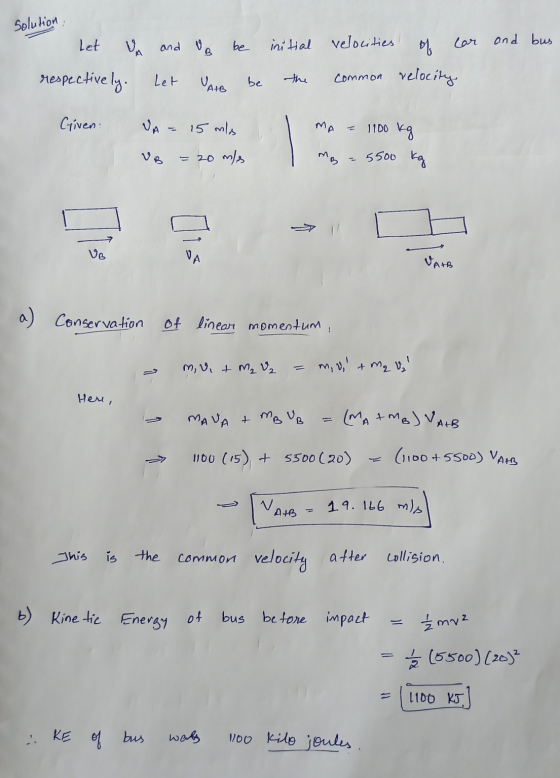
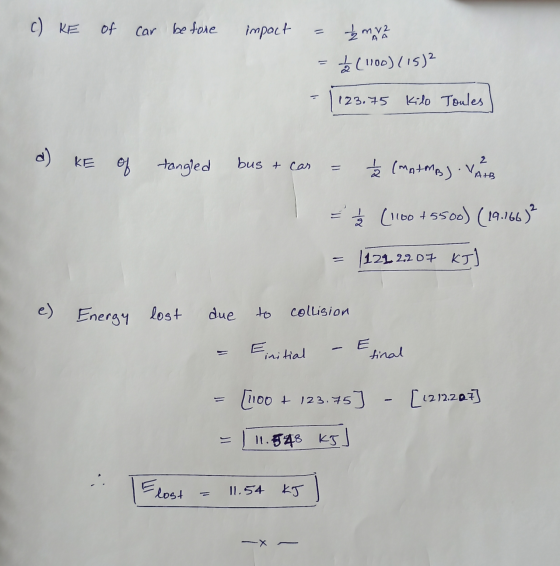
Detailed solution is as shown in the attached images.
The results obtained are :
a) 19.166 m/s
b) 1100 KJ
c) 123.75 KJ
d) 1212.207 KJ
e) 11.543 KJ
Add Answer to:
Q5. Part a) The 5500 kg bus B is traveling to the right at 20 m/s....
The 5-Mg bus B is traveling to the right at 20 m/s. Meanwhile a 2-Mg car...
 The 5-Mg bus B is traveling to the right at 20 m/s. Meanwhile a 2-Mg car A is traveling at 15 m/s to the right. If the vehicles crash and become entangled, determine their common velocity just after the collision. Assume that the vehicles are free to roll during collision. VB = 20 m/s B VA = 15 m/s A
Problem 3: 15–35. The 5-Mg bus B is traveling to the right at 20 m/s. Meanwhile...
 Problem 3: 15–35. The 5-Mg bus B is traveling to the right at 20 m/s. Meanwhile a 2-Mg car A is traveling at 15 m/s to the right. If the vehicles crash and become entangled, determine their common velocity just after the collision. Assume that the vehicles are free to roll during collision.
Review The 5.4-Mg bus B is traveling to the right at UB = 17 m/s. Meanwhile...
 Review The 5.4-Mg bus B is traveling to the right at UB = 17 m/s. Meanwhile a 2-Mg car A is traveling at VA = 14 m/s to the right, the Vehicles crash and become entangled. Assume that the vehicles are free to roll during collision. (Figure 1) Part A Determine their common velocity just after the collision. Express your answer to three significant figures and include the appropriate units. Figure ? PA < 1 of 1 > Value Units...
A pickup truck with mass 18• 105 gm is traveling eastbound at 15 m/s, while a compact car (900 kg) is traveling westbound with-15 m/s
A pickup truck with mass 18• 105 gm is traveling eastbound at 15 m/s, while a compact car (900 kg) is traveling westbound with-15 m/s. The vehicles collide head-on, becoming entangled. a. Find the speed of the entangled vehicles after the collision. b. Find the change in velocity of each vehicle. c. Find the change in kinetic energy d. If the mass of both the vehicles were doubled, calculate how would the final velocity and change in kinetic energy be affected?
Date: 10/30/2019 An SUV with mass 1.80x10 kg is traveling, while a compact car with mass...
 Date: 10/30/2019 An SUV with mass 1.80x10 kg is traveling, while a compact car with mass 9.00 x 10 kg is traveling behind. If two vehicles are both traveling eastward, the compact car leading the SUV. The driver of the compact car slams on the brakes suddenly, slowing the vehicle to 6.00 m/s. If the SUV traveling at 18.0 m/s crashes into the compact car, find (a) the speed of the system right after the collision, assuming the two vehicles...
A 1500-kg car traveling east at 50 m/s collides with a 2200-kg truck traveling north at...
 A 1500-kg car traveling east at 50 m/s collides with a 2200-kg truck traveling north at 66 m/s. The car and truck become entangled and slide to a stop. What is the final speed immediately after the collision? What angle with respect to the east direction do the entangled vehicles slide?
Use the worked example above to help you solve this problem. An pickup truck with mass...
Use the worked example above to help you solve this problem. An pickup truck with mass 1.75 103 kg is traveling eastbound at +15.5 m/s, while a compact car with mass 8.68 102 kg is traveling westbound at -15.5 m/s. (See figure.) The vehicles collide head-on, becoming entangled. (a) Find the speed of the entangled vehicles after the collision. m/s (b) Find the change in the velocity of each vehicle. Δvtruck = /s Δvcar = 20.5 m/s (correct) (c) Find...
2. In a completely inelastic collision, a 500 traveling west at 10 m/s. kg car traveling...
 2. In a completely inelastic collision, a 500 traveling west at 10 m/s. kg car traveling east at 30 m's hit a 2000 kg truck a. At what speed and in what direction will the joined car/truck go after the collision? b. Calculate the kinetic energy of the car before the collision. c. Calculate the kinetic energy of the truck before the collision. d. Calculate the kinetic energy of the joined car and truck together after the collision. e. How...
A 900-kg car traveling east at 15.0 m/s collides with a 750-kg car traveling north at...
A 900-kg car traveling east at 15.0 m/s collides with a 750-kg car traveling north at 20.0 m/s. The cars stick together. Assume that any other unbalanced forces are negligible. a. What is the speed of the wreckage just after the collision? b. In what direction does the wreckage move just after the collision? c. How much kinetic energy is lost in this collision.
A 1 105.0 kg car traveling initially with a speed of 25.000 m/s in an easterly...
 A 1 105.0 kg car traveling initially with a speed of 25.000 m/s in an easterly direction crashes into the back of a 9 900.0 kg truck moving in the same direction at 20.000 m/s. The velocity of the car right after the collision is 18.000 m/s to the east. Before Alter (a) What is the velocity of the truck right after the collision? (Give your answer to five significant figures.) m/s east (b) What is the change in mechanical...
 The 5-Mg bus B is traveling to the right at 20 m/s. Meanwhile a 2-Mg car A is traveling at 15 m/s to the right. If the vehicles crash and become entangled, determine their common velocity just after the collision. Assume that the vehicles are free to roll during collision. VB = 20 m/s B VA = 15 m/s A
 Problem 3: 15–35. The 5-Mg bus B is traveling to the right at 20 m/s. Meanwhile a 2-Mg car A is traveling at 15 m/s to the right. If the vehicles crash and become entangled, determine their common velocity just after the collision. Assume that the vehicles are free to roll during collision.
 Review The 5.4-Mg bus B is traveling to the right at UB = 17 m/s. Meanwhile a 2-Mg car A is traveling at VA = 14 m/s to the right, the Vehicles crash and become entangled. Assume that the vehicles are free to roll during collision. (Figure 1) Part A Determine their common velocity just after the collision. Express your answer to three significant figures and include the appropriate units. Figure ? PA < 1 of 1 > Value Units...
 Date: 10/30/2019 An SUV with mass 1.80x10 kg is traveling, while a compact car with mass 9.00 x 10 kg is traveling behind. If two vehicles are both traveling eastward, the compact car leading the SUV. The driver of the compact car slams on the brakes suddenly, slowing the vehicle to 6.00 m/s. If the SUV traveling at 18.0 m/s crashes into the compact car, find (a) the speed of the system right after the collision, assuming the two vehicles...
 A 1500-kg car traveling east at 50 m/s collides with a 2200-kg truck traveling north at 66 m/s. The car and truck become entangled and slide to a stop. What is the final speed immediately after the collision? What angle with respect to the east direction do the entangled vehicles slide?
 2. In a completely inelastic collision, a 500 traveling west at 10 m/s. kg car traveling east at 30 m's hit a 2000 kg truck a. At what speed and in what direction will the joined car/truck go after the collision? b. Calculate the kinetic energy of the car before the collision. c. Calculate the kinetic energy of the truck before the collision. d. Calculate the kinetic energy of the joined car and truck together after the collision. e. How...
 A 1 105.0 kg car traveling initially with a speed of 25.000 m/s in an easterly direction crashes into the back of a 9 900.0 kg truck moving in the same direction at 20.000 m/s. The velocity of the car right after the collision is 18.000 m/s to the east. Before Alter (a) What is the velocity of the truck right after the collision? (Give your answer to five significant figures.) m/s east (b) What is the change in mechanical...
Most questions answered within 3 hours.
-
Where is the error in this code sequence?
String s1 = "Hello";
String s2 = "ello";...
asked 11 months ago -
Financial data for Joel de Paris, Inc., for last year
follow:
Joel de Paris, Inc.
Balance...
asked 11 months ago -
Consider this reaction:
Al2(SO4)3 (aq)+ BaCl3
(aq) Al2Cl6 (aq)- +
3BaSO4(s) . What is the...
asked 11 months ago -
Suppose that Savneet is considering increasing her
recent random sample from 20 car rentals to 40...
asked 11 months ago -
Trucks arrive at an unloading terminal at an average rate of 120
per hour.
Trucks arrive...
asked 11 months ago -
Why are methanol and ethanol completely soluble in water while
octanol is not very little soluble....
asked 11 months ago -
A facilities manager at a university reads in a research report
that the mean amount of...
asked 11 months ago -
When the CuSO4 is rehydrated by adding water to the anhydrous
compound, is this an endothermic...
asked 11 months ago -
A ray of sunlight is passing from diamond into crown glass; the
angle of incidence is...
asked 11 months ago -
A block of mass 0.249 kg is placed on top of a light, vertical
spring of...
asked 11 months ago -
how do the kidneys compensate in the presences of acidosis
a) trigger hyperventilate
b) reserve acid...
asked 11 months ago -
Question 501 pts
The rental rate of capital to the firm increases. Which of the
following...
asked 11 months ago