This is the NMR of the reaction product mentioned in the question. The reaction conditions used...

 This is the NMR of the reaction product
mentioned in the question. The reaction conditions used in the lab
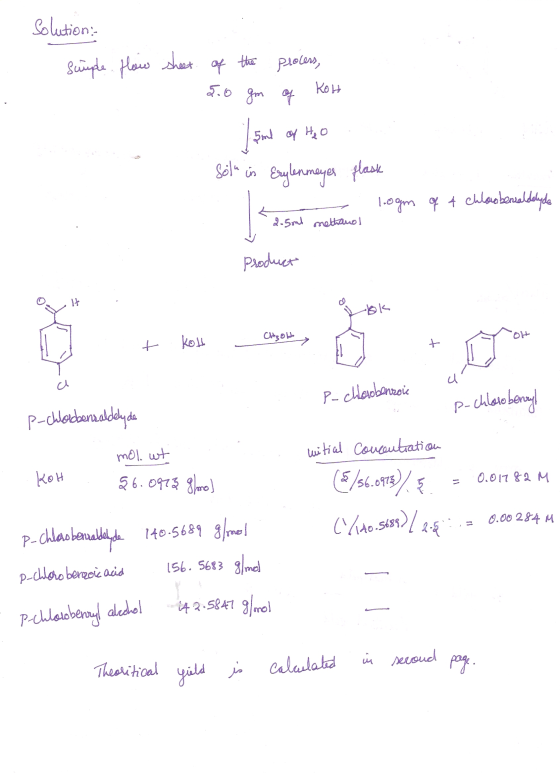
were part of the Cannizzaro Reaction. We began by weighing out ~5.0
g potassium hydroxide (KOH) and dissolved in 5 mL of water in an
Erlenmeyer flask. Then we weighed out ~1.0 g 4-chlorobenzaldehyde
and added 2.5 mL methanol, with stirring, to dissolve the
4-chlorobenzaldehyde.
This is the NMR of the reaction product
mentioned in the question. The reaction conditions used in the lab
were part of the Cannizzaro Reaction. We began by weighing out ~5.0
g potassium hydroxide (KOH) and dissolved in 5 mL of water in an
Erlenmeyer flask. Then we weighed out ~1.0 g 4-chlorobenzaldehyde
and added 2.5 mL methanol, with stirring, to dissolve the
4-chlorobenzaldehyde.
Homework Answers

Add Answer to:
This is the NMR of the reaction product
mentioned in the question. The reaction conditions used...
What is the balanced chemical equation for this reaction? HE ALDOL REACTION: TETRAPHENYLCYCLOPENTADIENONE Synthetic Chemistry Lab....
 What is the balanced chemical equation for this reaction?
HE ALDOL REACTION: TETRAPHENYLCYCLOPENTADIENONE Synthetic Chemistry Lab. Semester 1, 2019 1F Ph Ph Ph Ph КОН, ETOH Ph Ph Ph Ph Reflux Buchner filtration KOH: corrosive - especially as a solution in ethanol! Dissolve potassium hydroxide (145 mg) in ethanol (1 mL) in a 10 mL round bottomed flask. Add benzil (1 g) and 1,3-diphenylacetone (1 g) to a 50 mL round bottomed flask. Add ethanol (7 mL) and a magnetic...
What is the balanced chemical equation for this reaction?
HE ALDOL REACTION: TETRAPHENYLCYCLOPENTADIENONE Synthetic Chemistry Lab. Semester 1, 2019 1F Ph Ph Ph Ph КОН, ETOH Ph Ph Ph Ph Reflux Buchner filtration KOH: corrosive - especially as a solution in ethanol! Dissolve potassium hydroxide (145 mg) in ethanol (1 mL) in a 10 mL round bottomed flask. Add benzil (1 g) and 1,3-diphenylacetone (1 g) to a 50 mL round bottomed flask. Add ethanol (7 mL) and a magnetic...
Saponification Reaction (HINT: See your post-lab question from last week) moles 1 equivalents! Mw...
 Saponification Reaction (HINT: See your post-lab question from last week) moles 1 equivalents! Mw (g/mol)-Density (g/mL) Amount Compound Methyl cinnamate KOH MeOH Cinnamic acid product 162.19 56.11 32.04 1.09 2.12 0.79 N/A produet mL NA Experimental: 1. Set up a water bath and maintain at a temperature of roughly 35°C. 2. Combine the cinnamate, KOH, and methanol into the 25 ml round bottom flask. 3. Position the flask into the water bath so that the water of the bath rests...
What is the reaction product(s) of oleic acid & sodium methoxide? Show the structure(s). Part A:...
What is the reaction product(s) of oleic acid & sodium methoxide? Show the structure(s). Part A: Acid Catalyzed Fischer Esterification of Free Fatty Acids Add 20 mL of canola oil and a magnetic stir bar to a 125-mL Erlenmeyer flask, and place the flask on a magnetic stirring plate. Add 2–3 mL of methanol and up to three drops of concentrated sulfuric acid Perform this step with caution, as this is a strong acid! Immerse a thermometer into the reaction...
ead use ofT biodlesel fuel using this synthetic method. Prelab 1 Caicuiate the molar mass of...
 ead use ofT biodlesel fuel using this synthetic method. Prelab 1 Caicuiate the molar mass of potassium hydroxide, KOH 2. Approximately 5.9 g of KOH is needed to catalyze the transesterification process for 1L of oil to biodiesel. Calculate the mass of KOH needed to convert 100 mL of oil to biodiesei. 3. Convert the mass of KOH determined in (2) above to moles. 4. What volume of methanol needs to be added to this many moles of KOH to...
In the following method: Reaction: In separate flasks, prepare three solutions: i) copper (II) acetate (1.7...
In the following method: Reaction: In separate flasks, prepare three solutions: i) copper (II) acetate (1.7 g) in water (50 ml) (may require some warming to assist dissolving) ii) salicaldehyde (2.7 ml) in methanol (50 ml) along with methylamine (5.2 ml, 33% in ethanol) and methanol (50 ml) and stand in a covered conical flask (500 ml) at room temperature for 5 minutes. iii) dissolve sodium acetate (5.0 g) in water (50 ml). Place a magnetic stirrer bean into the...
(4 pts) (4 pts) (4 pts) (1 pts) 5. Calculations 6. Conclusions 7. Post lab Questions...
 (4 pts) (4 pts) (4 pts) (1 pts) 5. Calculations 6. Conclusions 7. Post lab Questions 8. TA signature POST LAB QUESTIONS: 1. Why do we add methanol to the reaction if we see a purple ring? 2. What reaction is occurring with the methanol (show reaction)? Does this reactior affect your product? 3. Why do you get a precipitate when adding the HCl to make the solution acidic? Exp 8-5 Experiment 8: Preparation of Adipic Acid from Cyclohexene Oxidation...
The empirical formula of the product is (1 pt) Consider the following reaction between oxalic acid...
 The empirical formula of the product is (1 pt) Consider the following reaction between oxalic acid and potassium hydroxide. 2. H20 + K2C204 H2C204 + KOH A 1.500 g sample of oxalic acid is dissolved in water and titrated with 32.67 mL of KOH to a phenolphthalein end point. What is the molar concentration of the KOH solution? (5 pts)
How do I find the theoretical masses of the elimination product and the addition product? The molecular weights are pro...
 How do I find the theoretical masses of the elimination
product and the addition product? The molecular weights are
provided in table
Aldol Addition and Condensation Alm. You will perform two reactions, one of which is an aldol addition and one provides the aldol condensation product. Both procedures will be performed ALDOL ADDITION conditions ALDOL CONDENSATION MSDS - ME Reactants Table Reactant(s) 2-acetylpyridine 4-nitrobenzaldehyde methanol Sodium carbonate water MW Density BPMP D 11.12 12.04 USD ROISS 0.180 MW BP MP...
How do I find the theoretical masses of the elimination
product and the addition product? The molecular weights are
provided in table
Aldol Addition and Condensation Alm. You will perform two reactions, one of which is an aldol addition and one provides the aldol condensation product. Both procedures will be performed ALDOL ADDITION conditions ALDOL CONDENSATION MSDS - ME Reactants Table Reactant(s) 2-acetylpyridine 4-nitrobenzaldehyde methanol Sodium carbonate water MW Density BPMP D 11.12 12.04 USD ROISS 0.180 MW BP MP...
CHEM 2001 Exp post lab Staple this to the post lab grade sheet... 5. Calculate the...
 CHEM 2001 Exp post lab Staple this to the post lab grade sheet... 5. Calculate the theoretical yield for this reaction using measurements from procedure. 6. If you obtained an actual yield of 0.57g. what is the yield? 7. What IR absorptions do you expect for the starting material (only in the functional group reg 4000cm to 1500cm)? 8. What IR absorptions do you expect for the product (only in the functional group region 4000cm 1500cm-')? to 9. If you...
tthe weight of my product is 0.87 g and they gave me the density! how can...
 tthe weight of my product is 0.87 g and they gave me the
density! how can i calculte the percent yield?
- Page < 8 > of 14 | 0 Data and Observations Weight of product: Melting range of product: Attach any spectra to your laboratory report Calculations and Graphs Calculate the percent yield. Keep in mind that the reagents may not be 100% pure; refer to labels on the containers. The density of 50% aqueous sodium hydroxide is 1.5...
tthe weight of my product is 0.87 g and they gave me the
density! how can i calculte the percent yield?
- Page < 8 > of 14 | 0 Data and Observations Weight of product: Melting range of product: Attach any spectra to your laboratory report Calculations and Graphs Calculate the percent yield. Keep in mind that the reagents may not be 100% pure; refer to labels on the containers. The density of 50% aqueous sodium hydroxide is 1.5...
 What is the balanced chemical equation for this reaction?
HE ALDOL REACTION: TETRAPHENYLCYCLOPENTADIENONE Synthetic Chemistry Lab. Semester 1, 2019 1F Ph Ph Ph Ph КОН, ETOH Ph Ph Ph Ph Reflux Buchner filtration KOH: corrosive - especially as a solution in ethanol! Dissolve potassium hydroxide (145 mg) in ethanol (1 mL) in a 10 mL round bottomed flask. Add benzil (1 g) and 1,3-diphenylacetone (1 g) to a 50 mL round bottomed flask. Add ethanol (7 mL) and a magnetic...
What is the balanced chemical equation for this reaction?
HE ALDOL REACTION: TETRAPHENYLCYCLOPENTADIENONE Synthetic Chemistry Lab. Semester 1, 2019 1F Ph Ph Ph Ph КОН, ETOH Ph Ph Ph Ph Reflux Buchner filtration KOH: corrosive - especially as a solution in ethanol! Dissolve potassium hydroxide (145 mg) in ethanol (1 mL) in a 10 mL round bottomed flask. Add benzil (1 g) and 1,3-diphenylacetone (1 g) to a 50 mL round bottomed flask. Add ethanol (7 mL) and a magnetic...
 Saponification Reaction (HINT: See your post-lab question from last week) moles 1 equivalents! Mw (g/mol)-Density (g/mL) Amount Compound Methyl cinnamate KOH MeOH Cinnamic acid product 162.19 56.11 32.04 1.09 2.12 0.79 N/A produet mL NA Experimental: 1. Set up a water bath and maintain at a temperature of roughly 35°C. 2. Combine the cinnamate, KOH, and methanol into the 25 ml round bottom flask. 3. Position the flask into the water bath so that the water of the bath rests...
 ead use ofT biodlesel fuel using this synthetic method. Prelab 1 Caicuiate the molar mass of potassium hydroxide, KOH 2. Approximately 5.9 g of KOH is needed to catalyze the transesterification process for 1L of oil to biodiesel. Calculate the mass of KOH needed to convert 100 mL of oil to biodiesei. 3. Convert the mass of KOH determined in (2) above to moles. 4. What volume of methanol needs to be added to this many moles of KOH to...
 (4 pts) (4 pts) (4 pts) (1 pts) 5. Calculations 6. Conclusions 7. Post lab Questions 8. TA signature POST LAB QUESTIONS: 1. Why do we add methanol to the reaction if we see a purple ring? 2. What reaction is occurring with the methanol (show reaction)? Does this reactior affect your product? 3. Why do you get a precipitate when adding the HCl to make the solution acidic? Exp 8-5 Experiment 8: Preparation of Adipic Acid from Cyclohexene Oxidation...
 The empirical formula of the product is (1 pt) Consider the following reaction between oxalic acid and potassium hydroxide. 2. H20 + K2C204 H2C204 + KOH A 1.500 g sample of oxalic acid is dissolved in water and titrated with 32.67 mL of KOH to a phenolphthalein end point. What is the molar concentration of the KOH solution? (5 pts)
 How do I find the theoretical masses of the elimination
product and the addition product? The molecular weights are
provided in table
Aldol Addition and Condensation Alm. You will perform two reactions, one of which is an aldol addition and one provides the aldol condensation product. Both procedures will be performed ALDOL ADDITION conditions ALDOL CONDENSATION MSDS - ME Reactants Table Reactant(s) 2-acetylpyridine 4-nitrobenzaldehyde methanol Sodium carbonate water MW Density BPMP D 11.12 12.04 USD ROISS 0.180 MW BP MP...
How do I find the theoretical masses of the elimination
product and the addition product? The molecular weights are
provided in table
Aldol Addition and Condensation Alm. You will perform two reactions, one of which is an aldol addition and one provides the aldol condensation product. Both procedures will be performed ALDOL ADDITION conditions ALDOL CONDENSATION MSDS - ME Reactants Table Reactant(s) 2-acetylpyridine 4-nitrobenzaldehyde methanol Sodium carbonate water MW Density BPMP D 11.12 12.04 USD ROISS 0.180 MW BP MP...
 CHEM 2001 Exp post lab Staple this to the post lab grade sheet... 5. Calculate the theoretical yield for this reaction using measurements from procedure. 6. If you obtained an actual yield of 0.57g. what is the yield? 7. What IR absorptions do you expect for the starting material (only in the functional group reg 4000cm to 1500cm)? 8. What IR absorptions do you expect for the product (only in the functional group region 4000cm 1500cm-')? to 9. If you...
 tthe weight of my product is 0.87 g and they gave me the
density! how can i calculte the percent yield?
- Page < 8 > of 14 | 0 Data and Observations Weight of product: Melting range of product: Attach any spectra to your laboratory report Calculations and Graphs Calculate the percent yield. Keep in mind that the reagents may not be 100% pure; refer to labels on the containers. The density of 50% aqueous sodium hydroxide is 1.5...
tthe weight of my product is 0.87 g and they gave me the
density! how can i calculte the percent yield?
- Page < 8 > of 14 | 0 Data and Observations Weight of product: Melting range of product: Attach any spectra to your laboratory report Calculations and Graphs Calculate the percent yield. Keep in mind that the reagents may not be 100% pure; refer to labels on the containers. The density of 50% aqueous sodium hydroxide is 1.5...
Most questions answered within 3 hours.
-
Where is the error in this code sequence?
String s1 = "Hello";
String s2 = "ello";...
asked 11 months ago -
Financial data for Joel de Paris, Inc., for last year
follow:
Joel de Paris, Inc.
Balance...
asked 11 months ago -
Consider this reaction:
Al2(SO4)3 (aq)+ BaCl3
(aq) Al2Cl6 (aq)- +
3BaSO4(s) . What is the...
asked 11 months ago -
Suppose that Savneet is considering increasing her
recent random sample from 20 car rentals to 40...
asked 11 months ago -
Trucks arrive at an unloading terminal at an average rate of 120
per hour.
Trucks arrive...
asked 11 months ago -
Why are methanol and ethanol completely soluble in water while
octanol is not very little soluble....
asked 11 months ago -
A facilities manager at a university reads in a research report
that the mean amount of...
asked 11 months ago -
When the CuSO4 is rehydrated by adding water to the anhydrous
compound, is this an endothermic...
asked 11 months ago -
A ray of sunlight is passing from diamond into crown glass; the
angle of incidence is...
asked 11 months ago -
A block of mass 0.249 kg is placed on top of a light, vertical
spring of...
asked 11 months ago -
how do the kidneys compensate in the presences of acidosis
a) trigger hyperventilate
b) reserve acid...
asked 11 months ago -
Question 501 pts
The rental rate of capital to the firm increases. Which of the
following...
asked 11 months ago