
Homework Answers
In Cl - SiH3 , Cl is more electronegative than Si . SO Cl will have highest negative charge
In Cl - CH3 , Cl is more electronegative than C . SO Cl will have highest negative charge
Add Answer to:
Click on the atom with the highest negative charge in each of the following bonds. In...
Classify each of the following bonds as nonpolar covalent, polar covalent, or ionic. If a bond is...
Classify each of the following bonds as nonpolar covalent, polar covalent, or ionic. If a bond is polar covalent, identify the atom that has the partial negative charge and the atom that has the partial positive charge. If a bond is ionic, identify the ion that has the negative charge and the ion that has the positive charge. a.) Se-I b.) N-Sr
Please help me do these 1. Draw the following bonds and label the electronegativity values of...
 Please help me do these
1. Draw the following bonds and label the electronegativity values of each atom. 2. Label the charge (8* or 8') on each atom in the bond (if they exist) and classify the bond as non-polar covalent, polar covalent or ionic. a) H-CI b) C-H c) NHO d) I-Br c) M-5 e) Mg-S DPH f) P-H vcc g) C-C m) AlH h) Al-H
Please help me do these
1. Draw the following bonds and label the electronegativity values of each atom. 2. Label the charge (8* or 8') on each atom in the bond (if they exist) and classify the bond as non-polar covalent, polar covalent or ionic. a) H-CI b) C-H c) NHO d) I-Br c) M-5 e) Mg-S DPH f) P-H vcc g) C-C m) AlH h) Al-H
QUESTION 19 Each of the following substances contains polar bonds - CO, NO, 502. OF2. On which atom(s) in each mole...
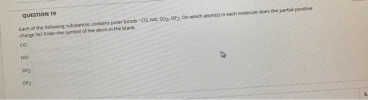 QUESTION 19 Each of the following substances contains polar bonds - CO, NO, 502. OF2. On which atom(s) in each molecule does the partial positive charge lie? Enter the symbol of the atom in the blank. NO
1. Which of the following bonds is the most polar covalent but not ionic? 2. Which...
 1. Which of the following bonds is the most polar covalent but
not ionic?
2. Which of the following bonds is the least polar covalent
(but not non-polar covalent bond)?
3. For the following bonds assigned charges to each atom use +
and - for ionic compounds and S+ and S- for covalent bonds where
electrons are not equally shared. If a covalent bond has electrons
equally shared, leave it blank.
1. Which of the following bonds is the most polar covalent but
not ionic?
2. Which of the following bonds is the least polar covalent
(but not non-polar covalent bond)?
3. For the following bonds assigned charges to each atom use +
and - for ionic compounds and S+ and S- for covalent bonds where
electrons are not equally shared. If a covalent bond has electrons
equally shared, leave it blank.
2. Calculate formal charge for each atom. Circle the most favorable structure, if any. : N-c30:...
 2. Calculate formal charge for each atom. Circle the most favorable structure, if any. : N-c30: _ N=cro - :NEC-Ö: 3. Draw resonance structures for the following molecules. Calculate formal charge for each atom. Circle the most favorable structure, if any. a) COBr2 b) CH3CONH2 (connectivity as shown below) нсин c N 4. For each of the following, draw all bond dipoles on the first structure, then draw the net dipole on the second structure. If non-polar, write "no net"...
In a covalent bond between two atoms, the more electronegative atom will attract more electron density...
 In a covalent bond between two atoms, the more electronegative atom will attract more electron density toward itself, producing a polar bond. The more electronegative element will carry a partial negative charge, whereas the less electronegative element will carry a partial positive charge. The direction of the bond dipole is always toward the more electronegative element. This is often indicated by an arrow, as shown in the figure. The magnitude of the bond polarity can be estimated by using the...
For each central atom of fentanyl, which are polar and non polar? If they are polar,...
For each central atom of fentanyl, which are polar and non polar? If they are polar, which form hydrogen bonds and which form dipole-dipole bonds?
3. The compound BrCl contains a. polar covalent bonds with partial negative charges on the Cl...
 3. The compound BrCl contains a. polar covalent bonds with partial negative charges on the Cl atoms. b. ionic bonds c. polar covalent bonds with partial negative charges on the Br atoms d. nonpolar covalent bonds. 14. How many valence electrons does an atom of Ca possess? 2 а. b. с. d. е. Identify the most reactive alkali metal with water. Cs 15. a. b. К Li с. d. Rb Na е. 16. Which of the following visible colors of...
Please add explanation if you can Q1) What is the formal charge on each atom in...
Please add explanation if you can Q1) What is the formal charge on each atom in dichloromethane, CH2Cl2? a. C atom = 0, each H atom = 0, and each Cl atom = 0 b. C atom = –2, each H atom = +1, and two Cl atoms = 0 c. C atom = +4, each H = –1, and each Cl atom = –1 d. C atom = +4, each H = +1, and each Cl atom = –1...
Sho Consider the following molecule. Draw the Lewis Structure and use that to fill in the following chart: AlCl 24 Number of Valence e (Whole Structure) Areas of e Density Around Central Atom: El...
 Sho Consider the following molecule. Draw the Lewis Structure and use that to fill in the following chart: AlCl 24 Number of Valence e (Whole Structure) Areas of e Density Around Central Atom: Electronic Geometry: Trigonal Planar # Bonding Areas (Central Atom): # Non-Bonding Areas (Central Atom): Molecular Geometry Select an answer Bond Angles (Central Atom) Select an answer Select an answer Polar Bonds? Polar Molecule? Select an answer Any Pi (Double/Triple) Bonds? Select an answer
Sho Consider the following...
Sho Consider the following molecule. Draw the Lewis Structure and use that to fill in the following chart: AlCl 24 Number of Valence e (Whole Structure) Areas of e Density Around Central Atom: Electronic Geometry: Trigonal Planar # Bonding Areas (Central Atom): # Non-Bonding Areas (Central Atom): Molecular Geometry Select an answer Bond Angles (Central Atom) Select an answer Select an answer Polar Bonds? Polar Molecule? Select an answer Any Pi (Double/Triple) Bonds? Select an answer
Sho Consider the following...
 Please help me do these
1. Draw the following bonds and label the electronegativity values of each atom. 2. Label the charge (8* or 8') on each atom in the bond (if they exist) and classify the bond as non-polar covalent, polar covalent or ionic. a) H-CI b) C-H c) NHO d) I-Br c) M-5 e) Mg-S DPH f) P-H vcc g) C-C m) AlH h) Al-H
Please help me do these
1. Draw the following bonds and label the electronegativity values of each atom. 2. Label the charge (8* or 8') on each atom in the bond (if they exist) and classify the bond as non-polar covalent, polar covalent or ionic. a) H-CI b) C-H c) NHO d) I-Br c) M-5 e) Mg-S DPH f) P-H vcc g) C-C m) AlH h) Al-H
 QUESTION 19 Each of the following substances contains polar bonds - CO, NO, 502. OF2. On which atom(s) in each molecule does the partial positive charge lie? Enter the symbol of the atom in the blank. NO
 1. Which of the following bonds is the most polar covalent but
not ionic?
2. Which of the following bonds is the least polar covalent
(but not non-polar covalent bond)?
3. For the following bonds assigned charges to each atom use +
and - for ionic compounds and S+ and S- for covalent bonds where
electrons are not equally shared. If a covalent bond has electrons
equally shared, leave it blank.
1. Which of the following bonds is the most polar covalent but
not ionic?
2. Which of the following bonds is the least polar covalent
(but not non-polar covalent bond)?
3. For the following bonds assigned charges to each atom use +
and - for ionic compounds and S+ and S- for covalent bonds where
electrons are not equally shared. If a covalent bond has electrons
equally shared, leave it blank.
 2. Calculate formal charge for each atom. Circle the most favorable structure, if any. : N-c30: _ N=cro - :NEC-Ö: 3. Draw resonance structures for the following molecules. Calculate formal charge for each atom. Circle the most favorable structure, if any. a) COBr2 b) CH3CONH2 (connectivity as shown below) нсин c N 4. For each of the following, draw all bond dipoles on the first structure, then draw the net dipole on the second structure. If non-polar, write "no net"...
 In a covalent bond between two atoms, the more electronegative atom will attract more electron density toward itself, producing a polar bond. The more electronegative element will carry a partial negative charge, whereas the less electronegative element will carry a partial positive charge. The direction of the bond dipole is always toward the more electronegative element. This is often indicated by an arrow, as shown in the figure. The magnitude of the bond polarity can be estimated by using the...
 3. The compound BrCl contains a. polar covalent bonds with partial negative charges on the Cl atoms. b. ionic bonds c. polar covalent bonds with partial negative charges on the Br atoms d. nonpolar covalent bonds. 14. How many valence electrons does an atom of Ca possess? 2 а. b. с. d. е. Identify the most reactive alkali metal with water. Cs 15. a. b. К Li с. d. Rb Na е. 16. Which of the following visible colors of...
 Sho Consider the following molecule. Draw the Lewis Structure and use that to fill in the following chart: AlCl 24 Number of Valence e (Whole Structure) Areas of e Density Around Central Atom: Electronic Geometry: Trigonal Planar # Bonding Areas (Central Atom): # Non-Bonding Areas (Central Atom): Molecular Geometry Select an answer Bond Angles (Central Atom) Select an answer Select an answer Polar Bonds? Polar Molecule? Select an answer Any Pi (Double/Triple) Bonds? Select an answer
Sho Consider the following...
Sho Consider the following molecule. Draw the Lewis Structure and use that to fill in the following chart: AlCl 24 Number of Valence e (Whole Structure) Areas of e Density Around Central Atom: Electronic Geometry: Trigonal Planar # Bonding Areas (Central Atom): # Non-Bonding Areas (Central Atom): Molecular Geometry Select an answer Bond Angles (Central Atom) Select an answer Select an answer Polar Bonds? Polar Molecule? Select an answer Any Pi (Double/Triple) Bonds? Select an answer
Sho Consider the following...
Most questions answered within 3 hours.
-
Where is the error in this code sequence?
String s1 = "Hello";
String s2 = "ello";...
asked 10 months ago -
Financial data for Joel de Paris, Inc., for last year
follow:
Joel de Paris, Inc.
Balance...
asked 10 months ago -
Consider this reaction:
Al2(SO4)3 (aq)+ BaCl3
(aq) Al2Cl6 (aq)- +
3BaSO4(s) . What is the...
asked 10 months ago -
Suppose that Savneet is considering increasing her
recent random sample from 20 car rentals to 40...
asked 10 months ago -
Trucks arrive at an unloading terminal at an average rate of 120
per hour.
Trucks arrive...
asked 10 months ago -
Why are methanol and ethanol completely soluble in water while
octanol is not very little soluble....
asked 10 months ago -
A facilities manager at a university reads in a research report
that the mean amount of...
asked 10 months ago -
When the CuSO4 is rehydrated by adding water to the anhydrous
compound, is this an endothermic...
asked 10 months ago -
A ray of sunlight is passing from diamond into crown glass; the
angle of incidence is...
asked 10 months ago -
A block of mass 0.249 kg is placed on top of a light, vertical
spring of...
asked 10 months ago -
how do the kidneys compensate in the presences of acidosis
a) trigger hyperventilate
b) reserve acid...
asked 10 months ago -
Question 501 pts
The rental rate of capital to the firm increases. Which of the
following...
asked 10 months ago