Figure 1 presents a simple three-zone system, the link travel times in minutes (wij) for this...
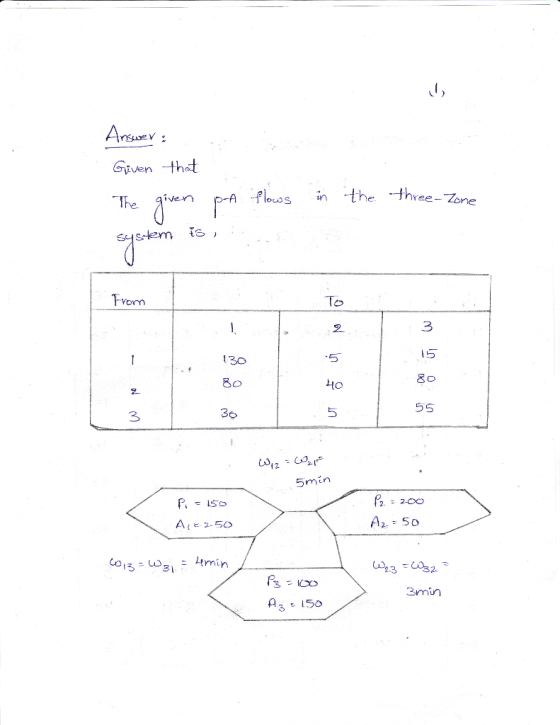
Figure 1 presents a simple three-zone system, the link travel times in minutes (wij) for this system, and the observed zonal productions and attractions. Assuming a doubly constrained gravity model with friction factor Fij = Wij-b
a. Compute P-A flows (production-attraction matrix) for this system for values of b of 1.0, and 1.5.
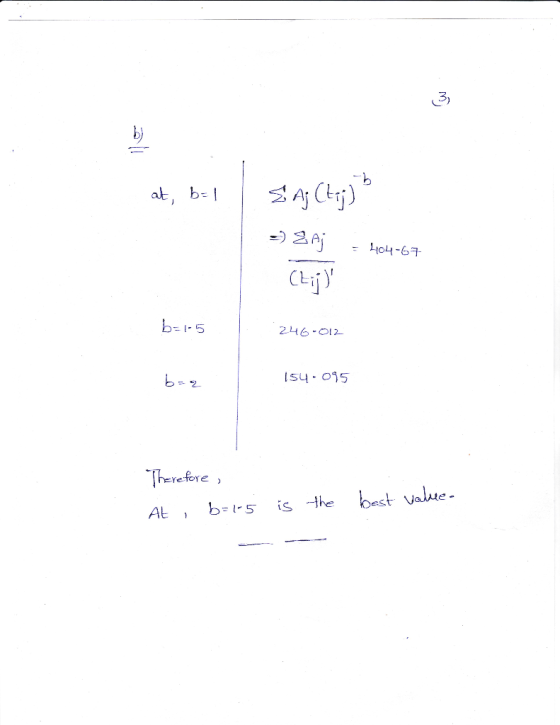
b. Table 1 below presents the observed P-A flows for this system. Which value of b provides the “best-fit” to the observed data? Note: Best-fit should be measured by R2 , the coefficient of determination.
Show the steps of your solution to the problem.
Table 1: Observed P-A flows for three-zone system
| From | To | ||
| 1 | 2 | 3 | |
| 1 | 130 | 5 | 15 |
| 2 | 80 | 40 | 80 |
| 3 | 30 | 5 | 55 |
W12=W21=5min
|
P1 = 150 P2 = 200 A1 = 250 A2= 50 P3 =100 A3 = 150 |
w13=w31=4min w23=w32=3min
w11=w22=w33=2min
Homework Answers
Add Answer to:
Figure 1 presents a simple three-zone system, the link travel
times in minutes (wij) for this...
Problem 4 Figure 1 presents a simple three-zone system, the link travel times in minutes (wj) for...
 Problem 4 Figure 1 presents a simple three-zone system, the link travel times in minutes (wj) for this system, and the observed zonal productions and attractions. Assuming a doubly constrained gravity model with friction factor F, (a) Compute P-A flows (production-attraction matrix) for this system for values of b of 1.0, and 1.5 (b) Table 1 below presents the observed P-A flows for this system. Which value of b provides the "best-fit" to the observed data? Note: Best-fit should be...
 Problem 4 Figure 1 presents a simple three-zone system, the link travel times in minutes (wj) for this system, and the observed zonal productions and attractions. Assuming a doubly constrained gravity model with friction factor F, (a) Compute P-A flows (production-attraction matrix) for this system for values of b of 1.0, and 1.5 (b) Table 1 below presents the observed P-A flows for this system. Which value of b provides the "best-fit" to the observed data? Note: Best-fit should be...
Most questions answered within 3 hours.
-
Where is the error in this code sequence?
String s1 = "Hello";
String s2 = "ello";...
asked 10 months ago -
Financial data for Joel de Paris, Inc., for last year
follow:
Joel de Paris, Inc.
Balance...
asked 10 months ago -
Consider this reaction:
Al2(SO4)3 (aq)+ BaCl3
(aq) Al2Cl6 (aq)- +
3BaSO4(s) . What is the...
asked 10 months ago -
Suppose that Savneet is considering increasing her
recent random sample from 20 car rentals to 40...
asked 10 months ago -
Trucks arrive at an unloading terminal at an average rate of 120
per hour.
Trucks arrive...
asked 10 months ago -
Why are methanol and ethanol completely soluble in water while
octanol is not very little soluble....
asked 10 months ago -
A facilities manager at a university reads in a research report
that the mean amount of...
asked 10 months ago -
When the CuSO4 is rehydrated by adding water to the anhydrous
compound, is this an endothermic...
asked 10 months ago -
A ray of sunlight is passing from diamond into crown glass; the
angle of incidence is...
asked 10 months ago -
A block of mass 0.249 kg is placed on top of a light, vertical
spring of...
asked 10 months ago -
how do the kidneys compensate in the presences of acidosis
a) trigger hyperventilate
b) reserve acid...
asked 10 months ago -
Question 501 pts
The rental rate of capital to the firm increases. Which of the
following...
asked 10 months ago