Answer questions A-D please. ONLY ANSWER THE QUESTIONS IF YOU KNOW IT FOR SURE BECAUSE MY MONEY IS BEING WASTED WHEN MY QUESTIONS ARE BEING ANSWERED WRONG. Thank you!!!
A.) Below is a summary of alkene reactions. Complete
them by providing the missing structures (including stereochemistry
wherever it applies).

B.) Draw the structure of the carbocation formed
during the reaction of the alkene from chart A with HCl.
C.) Draw the mechanism of the reaction of Br2 addition.
D.) Draw the mechanism of the reaction of Br2 addition with the
free radical initiator tBu-O-O-tBu.
Homework Answers

Add Answer to:
Answer questions A-D please. ONLY ANSWER THE QUESTIONS
IF YOU KNOW IT FOR SURE BECAUSE MY...
Starting from 3-methylhex-1-ene as the substrate at the center of your page, draw a reaction map showing the regiochemical and stereochemical outcome or outcomes for each of the following series of reagents. Name each of your products, including stereoche
Starting from 3-methylhex-1-ene as the substrate at the center of your page, draw a reaction map showing the regiochemical and stereochemical outcome or outcomes for each of the following series of reagents. Name each of your products, including stereochemical designations for any chirality centers that are generated.**Pay attention to the possibility of rearrangement when your mechanism produces a carbocation. A. H2SO4, H2OB. 1. Hg(OAc)2, H2O; 2. NaBH4C. 1. BH3•THF; 2. H2O2, NaOHD. Br2, CCl4E. Br2, H2OF. HBrG. HBr, ROORH. 1. O3; 2. DMSI. H2, Pt
can someone please answer this? thank you! For each reaction shown below, identify the primary product....
 can
someone please answer this? thank you!
For each reaction shown below, identify the primary product. B regiochemistry and stereochemistry if applicable. Br2, H2O KMnO4, NaOH cold 1. Hg(OAc)2, H2O 2. NABH4 1. O3 2. Zn/ACOH 1. BH3 2. H-О, NaOH Cl2 Write the mechanism of the first reaction, the bromohydrin r
can
someone please answer this? thank you!
For each reaction shown below, identify the primary product. B regiochemistry and stereochemistry if applicable. Br2, H2O KMnO4, NaOH cold 1. Hg(OAc)2, H2O 2. NABH4 1. O3 2. Zn/ACOH 1. BH3 2. H-О, NaOH Cl2 Write the mechanism of the first reaction, the bromohydrin r
Acid Catalyzed Hydration-treatment of alkenes with water in the presence of acid catalyst leads to the...
 Acid Catalyzed Hydration-treatment of alkenes with water in the presence of acid catalyst leads to the formation of alcohols. H2SO4/H2O > 150°C Mechanism Major Product Acid catalyzed dehydration goes through a carbocation intermediate. This means that the Markovnikov product is obtained when carbocation rearrangements do not occur. The need for excessively high temperatures makes this reaction of limited use in laboratory synthesis. Oxymercuration - Oxymercuration involves the addition of Hg to the alkene using mercury (II) acetate Hg(OAc) followed by...
Please include the mechanism In each reaction box, place the best reagent and conditions from the...
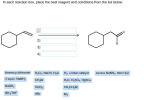 Please include the mechanism
In each reaction box, place the best reagent and conditions from the list below. CEOY bromocyclohexane H2O, NaOH, H,O H, Lindlar catalyst excess NaNH2, then H2O 2 equiv. NaNH2 CH3Br SOCI H20, H2SO4, HgSO4 CH3CH2B1 NaBH4 BHYTHF НВК Br2
Please include the mechanism
In each reaction box, place the best reagent and conditions from the list below. CEOY bromocyclohexane H2O, NaOH, H,O H, Lindlar catalyst excess NaNH2, then H2O 2 equiv. NaNH2 CH3Br SOCI H20, H2SO4, HgSO4 CH3CH2B1 NaBH4 BHYTHF НВК Br2
s) Predict the principal organic product(s) in each of the following reactions. Draw the correct stereoisom...
 s) Predict the principal organic product(s) in each of the following reactions. Draw the correct stereoisom wherever applicable (Structures with incomplete/wrong stereochemistry will not be accepted!!). CH₃ Clz Br2 Н,0 CCIA 1) BH3. THE 2) H2Oz/NaOH 1) O₃ 2) (CH3)2S МСРВА MCPECIES CH2Cl2 OsO4 NMO 1) МСРВА 2) H2O/H30* Hoy for Hos 1) Brz/H20 2) NaOH 1) Hg(OAC)2, H2O/THF 2) NaBHA = 1) O₃ 2) H20 340 H2SO4 HgSO4 2 Brz CCIA 2 HCI 26. pts) Listed below is information...
Answer the following two questions about the following synthetic scheme. (Numbers in parentheses below the structures...
 Answer the following two questions about the following synthetic scheme. (Numbers in parentheses below the structures are for identification purposes.) CH, Cl/h CI KOH CI +K -HCI - H2O NO2 NO NO2 (1) (2) (3) CA NO2 NO2 NO2 -KCI -HCI CI (4) (5) NO, NO H/Pd/C A NH2 -NH (6) (7) NH2 Br + (9) (8) ta +NH -HCI -HCI CI HAN (10) What is the role of KOH in the conversion of 2) to (3)? Select one: O...
List Notes You may attempt this question 4 more times for credit Score: Sorry, you are...
 List Notes You may attempt this question 4 more times for credit Score: Sorry, you are incorrect Answer(s): (Your response(s) are shown below.) Question 8.33 em tion The acid-catalyzed addition of alcohols to alkenes occurs via a mechanism analogous to acid-catalyzed alkene hydration. The reaction occurs in 3 1) Addition of H to the alkene, together with any possible carbocation rearrangements: 2) Addition of the alcohol to the carbocation: 3) Deprotonation to yield the product ether ation sage tages Draw...
Please help look this over I just want to double check my answer! thanks! Critical Thinking...
 Please help look this over I just want to double check my
answer! thanks!
Critical Thinking Questions: 2) The polymerization of ethylene ("monomer") with a radical initiator follows the same chain reaction. Please write the mechanism (all arrows) from ethylene (==ethene) to polyethylene). Start with an initiator of R-R. After breaking the initiator bond to your radicals, use either radical for your 1"' reaction with ethylene. Indicate repeating reactions by multiple arrows. Write the final product in a common short...
Please help look this over I just want to double check my
answer! thanks!
Critical Thinking Questions: 2) The polymerization of ethylene ("monomer") with a radical initiator follows the same chain reaction. Please write the mechanism (all arrows) from ethylene (==ethene) to polyethylene). Start with an initiator of R-R. After breaking the initiator bond to your radicals, use either radical for your 1"' reaction with ethylene. Indicate repeating reactions by multiple arrows. Write the final product in a common short...
Can you check my answers please? To answer the questions below use the following information: Cyanohydrins...
 Can
you check my answers please?
To answer the questions below use the following information: Cyanohydrins are important intermediates in the synthesis of c-hydroxycarboxylic acids from ketones and aldehydes. The nitrile functional group can be hydrolyzed by aqueous acid to yield a carboxylic acid. Nitriles can also be hydrolyzed to carboxylic acids using aqueous base. Unfortunately, when a cyanohydrin is treated with aqueous base the original carbonyl compound is isolated OH CHCOOH HO CN OBU H HCEN H NAOH H20...
Can
you check my answers please?
To answer the questions below use the following information: Cyanohydrins are important intermediates in the synthesis of c-hydroxycarboxylic acids from ketones and aldehydes. The nitrile functional group can be hydrolyzed by aqueous acid to yield a carboxylic acid. Nitriles can also be hydrolyzed to carboxylic acids using aqueous base. Unfortunately, when a cyanohydrin is treated with aqueous base the original carbonyl compound is isolated OH CHCOOH HO CN OBU H HCEN H NAOH H20...
Please completely answer the questions, thank you! For the reactions below, 1. supply the reagents needed...
 Please completely answer the questions, thank you!
For the reactions below, 1. supply the reagents needed to carry out the reaction, by writing them above the reaction arrow. 2. Use choices 1A through 11, 2A through 24, and 3A through 3X, above to answer the questions about reaction types and mechanistic details. 3. For the reactions in column 3, that require you to diagram the mechanism, diagram the mechanism. Column 1 Column 2 Column 3 Type of Reaction The Reason...
Please completely answer the questions, thank you!
For the reactions below, 1. supply the reagents needed to carry out the reaction, by writing them above the reaction arrow. 2. Use choices 1A through 11, 2A through 24, and 3A through 3X, above to answer the questions about reaction types and mechanistic details. 3. For the reactions in column 3, that require you to diagram the mechanism, diagram the mechanism. Column 1 Column 2 Column 3 Type of Reaction The Reason...
 can
someone please answer this? thank you!
For each reaction shown below, identify the primary product. B regiochemistry and stereochemistry if applicable. Br2, H2O KMnO4, NaOH cold 1. Hg(OAc)2, H2O 2. NABH4 1. O3 2. Zn/ACOH 1. BH3 2. H-О, NaOH Cl2 Write the mechanism of the first reaction, the bromohydrin r
can
someone please answer this? thank you!
For each reaction shown below, identify the primary product. B regiochemistry and stereochemistry if applicable. Br2, H2O KMnO4, NaOH cold 1. Hg(OAc)2, H2O 2. NABH4 1. O3 2. Zn/ACOH 1. BH3 2. H-О, NaOH Cl2 Write the mechanism of the first reaction, the bromohydrin r
 Acid Catalyzed Hydration-treatment of alkenes with water in the presence of acid catalyst leads to the formation of alcohols. H2SO4/H2O > 150°C Mechanism Major Product Acid catalyzed dehydration goes through a carbocation intermediate. This means that the Markovnikov product is obtained when carbocation rearrangements do not occur. The need for excessively high temperatures makes this reaction of limited use in laboratory synthesis. Oxymercuration - Oxymercuration involves the addition of Hg to the alkene using mercury (II) acetate Hg(OAc) followed by...
 Please include the mechanism
In each reaction box, place the best reagent and conditions from the list below. CEOY bromocyclohexane H2O, NaOH, H,O H, Lindlar catalyst excess NaNH2, then H2O 2 equiv. NaNH2 CH3Br SOCI H20, H2SO4, HgSO4 CH3CH2B1 NaBH4 BHYTHF НВК Br2
Please include the mechanism
In each reaction box, place the best reagent and conditions from the list below. CEOY bromocyclohexane H2O, NaOH, H,O H, Lindlar catalyst excess NaNH2, then H2O 2 equiv. NaNH2 CH3Br SOCI H20, H2SO4, HgSO4 CH3CH2B1 NaBH4 BHYTHF НВК Br2
 s) Predict the principal organic product(s) in each of the following reactions. Draw the correct stereoisom wherever applicable (Structures with incomplete/wrong stereochemistry will not be accepted!!). CH₃ Clz Br2 Н,0 CCIA 1) BH3. THE 2) H2Oz/NaOH 1) O₃ 2) (CH3)2S МСРВА MCPECIES CH2Cl2 OsO4 NMO 1) МСРВА 2) H2O/H30* Hoy for Hos 1) Brz/H20 2) NaOH 1) Hg(OAC)2, H2O/THF 2) NaBHA = 1) O₃ 2) H20 340 H2SO4 HgSO4 2 Brz CCIA 2 HCI 26. pts) Listed below is information...
 Answer the following two questions about the following synthetic scheme. (Numbers in parentheses below the structures are for identification purposes.) CH, Cl/h CI KOH CI +K -HCI - H2O NO2 NO NO2 (1) (2) (3) CA NO2 NO2 NO2 -KCI -HCI CI (4) (5) NO, NO H/Pd/C A NH2 -NH (6) (7) NH2 Br + (9) (8) ta +NH -HCI -HCI CI HAN (10) What is the role of KOH in the conversion of 2) to (3)? Select one: O...
 List Notes You may attempt this question 4 more times for credit Score: Sorry, you are incorrect Answer(s): (Your response(s) are shown below.) Question 8.33 em tion The acid-catalyzed addition of alcohols to alkenes occurs via a mechanism analogous to acid-catalyzed alkene hydration. The reaction occurs in 3 1) Addition of H to the alkene, together with any possible carbocation rearrangements: 2) Addition of the alcohol to the carbocation: 3) Deprotonation to yield the product ether ation sage tages Draw...
 Please help look this over I just want to double check my
answer! thanks!
Critical Thinking Questions: 2) The polymerization of ethylene ("monomer") with a radical initiator follows the same chain reaction. Please write the mechanism (all arrows) from ethylene (==ethene) to polyethylene). Start with an initiator of R-R. After breaking the initiator bond to your radicals, use either radical for your 1"' reaction with ethylene. Indicate repeating reactions by multiple arrows. Write the final product in a common short...
Please help look this over I just want to double check my
answer! thanks!
Critical Thinking Questions: 2) The polymerization of ethylene ("monomer") with a radical initiator follows the same chain reaction. Please write the mechanism (all arrows) from ethylene (==ethene) to polyethylene). Start with an initiator of R-R. After breaking the initiator bond to your radicals, use either radical for your 1"' reaction with ethylene. Indicate repeating reactions by multiple arrows. Write the final product in a common short...
 Can
you check my answers please?
To answer the questions below use the following information: Cyanohydrins are important intermediates in the synthesis of c-hydroxycarboxylic acids from ketones and aldehydes. The nitrile functional group can be hydrolyzed by aqueous acid to yield a carboxylic acid. Nitriles can also be hydrolyzed to carboxylic acids using aqueous base. Unfortunately, when a cyanohydrin is treated with aqueous base the original carbonyl compound is isolated OH CHCOOH HO CN OBU H HCEN H NAOH H20...
Can
you check my answers please?
To answer the questions below use the following information: Cyanohydrins are important intermediates in the synthesis of c-hydroxycarboxylic acids from ketones and aldehydes. The nitrile functional group can be hydrolyzed by aqueous acid to yield a carboxylic acid. Nitriles can also be hydrolyzed to carboxylic acids using aqueous base. Unfortunately, when a cyanohydrin is treated with aqueous base the original carbonyl compound is isolated OH CHCOOH HO CN OBU H HCEN H NAOH H20...
 Please completely answer the questions, thank you!
For the reactions below, 1. supply the reagents needed to carry out the reaction, by writing them above the reaction arrow. 2. Use choices 1A through 11, 2A through 24, and 3A through 3X, above to answer the questions about reaction types and mechanistic details. 3. For the reactions in column 3, that require you to diagram the mechanism, diagram the mechanism. Column 1 Column 2 Column 3 Type of Reaction The Reason...
Please completely answer the questions, thank you!
For the reactions below, 1. supply the reagents needed to carry out the reaction, by writing them above the reaction arrow. 2. Use choices 1A through 11, 2A through 24, and 3A through 3X, above to answer the questions about reaction types and mechanistic details. 3. For the reactions in column 3, that require you to diagram the mechanism, diagram the mechanism. Column 1 Column 2 Column 3 Type of Reaction The Reason...
Most questions answered within 3 hours.
-
Where is the error in this code sequence?
String s1 = "Hello";
String s2 = "ello";...
asked 11 months ago -
Financial data for Joel de Paris, Inc., for last year
follow:
Joel de Paris, Inc.
Balance...
asked 11 months ago -
Consider this reaction:
Al2(SO4)3 (aq)+ BaCl3
(aq) Al2Cl6 (aq)- +
3BaSO4(s) . What is the...
asked 11 months ago -
Suppose that Savneet is considering increasing her
recent random sample from 20 car rentals to 40...
asked 11 months ago -
Trucks arrive at an unloading terminal at an average rate of 120
per hour.
Trucks arrive...
asked 11 months ago -
Why are methanol and ethanol completely soluble in water while
octanol is not very little soluble....
asked 11 months ago -
A facilities manager at a university reads in a research report
that the mean amount of...
asked 11 months ago -
When the CuSO4 is rehydrated by adding water to the anhydrous
compound, is this an endothermic...
asked 11 months ago -
A ray of sunlight is passing from diamond into crown glass; the
angle of incidence is...
asked 11 months ago -
A block of mass 0.249 kg is placed on top of a light, vertical
spring of...
asked 11 months ago -
how do the kidneys compensate in the presences of acidosis
a) trigger hyperventilate
b) reserve acid...
asked 11 months ago -
Question 501 pts
The rental rate of capital to the firm increases. Which of the
following...
asked 11 months ago