
Homework Answers
Please find the attachment.
Add Answer to:
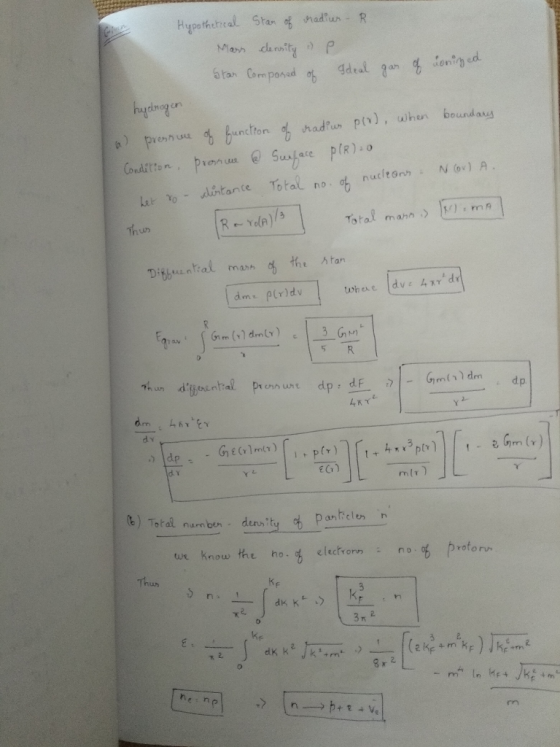
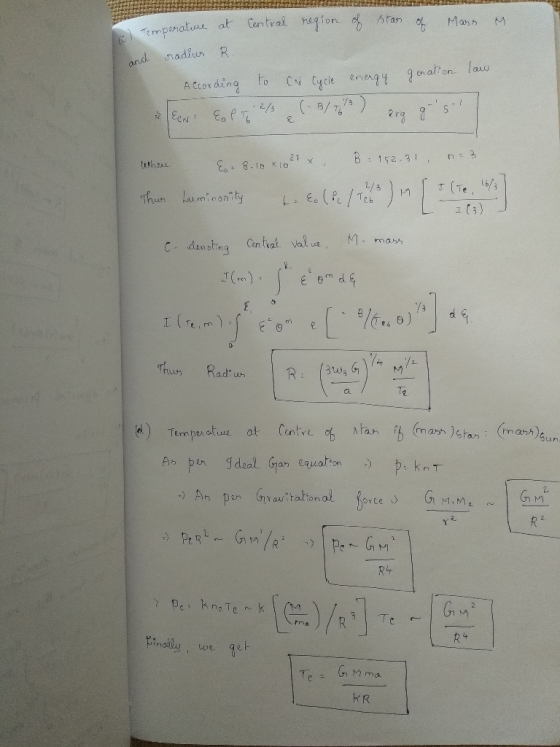
Imagine a hypothetical star of radius R, whose mass density ρ is constant throughout the star....
Consider a solid hemisphere of radius R, constant mass density ρ, and a total mass M....
Consider a solid hemisphere of radius R, constant mass density ρ, and a total mass M. Calculate all elements of the inertia tensor (in terms of M and R) of the hemisphere for a reference frame with its origin at the center of the circular base of the hemisphere. Make sure to clearly sketch the hemisphere and axes positions.
PROBLEM4 (a) Write an expression for the mass density ρ(r) of a point particle with a...
 PROBLEM4 (a) Write an expression for the mass density ρ(r) of a point particle with a mass m at a position r; How much is the volume integral of ρ over the entire space? (b) What is the mass density of a system of two point particles with mass m each. One of the particle is at the origin of the coordinate system and the other one is at ä. How much is the integral of the density over the...
Charge is distributed throughout a spherical volume of radius R with a density ρ ar where...
 Charge is distributed throughout a spherical volume of radius R with a density ρ ar where α is a constant. an risthe distance from the center of the sphere. Determine the electric field due to the charge at a point a distance r from the center that is inside the sphere, and at a point a distance r from the center that is outside the sphere. (Enter the radial component of the electric field. Use the following as necessary: R,...
3 GM2 (5) The gravitational potential of a uniform-density sphere of mass M and radius R is E,-- Consider a white dwarf...
 3 GM2 (5) The gravitational potential of a uniform-density sphere of mass M and radius R is E,-- Consider a white dwarf star which contains N electrons whose Fermi energy is Es. Since kaT <<Ef, the average electron energy is 3/5Er (derived in assignment 1) and the total electron energy is Ed-3/5NEs. The energies of the nuclei can be neglected. OE (a) Derive an expression for the gravitational pressure: P- OE (b) Derive an expression for the degeneracy pressure: Pa-...
6. Imagine a non-conducting ball with a uniform volume charge density ρ(r) po (a constant). What...
 6. Imagine a non-conducting ball with a uniform volume charge density ρ(r) po (a constant). What is the electric field inside the ball at a point P at a distance r B from the center of the ball p(r)
Find the center of mass of a hemisphere with radius r, whose density is uniform.
 Find the center of mass of a hemisphere with radius r, whose density is uniform.
4. Consider a planet of radius R in which the density decreases linearly from center to...
 4. Consider a planet of radius R in which the density decreases linearly from center to edge, vanishing at the edge: This should look familiar: we calculated its mass (MToR/3) and moment of inertia (1 = 4MR2/15) in lecture. Its contents are unit mass Л and thermal conductivity taking its surface temperature to be T, and its central temperature to be finite. characterized by radioactive heating power per KT. Derive a formula for its internal temperature T(r), . Consider a...
A satellite of mass m is in a circular orbit of radius R2 around a spherical planet of radius R1 made of a material with density ρ. ( R2 is measured from the center of the planet, not its surface.) Use G for the universal gravitational constant.
 A satellite of mass m is in a circular orbit of radius R2 around a spherical planet of radius R1 made of a material with density ρ. ( R2 is measured from the center of the planet, not its surface.) Use G for the universal gravitational constant.A) Find the kinetic energy of this satellite, KExpress the satellite's kinetic energy in terms of G, m, π, R1, R2, and ρ.B) Find U, the gravitational potential energy of the satellite. Take the gravitational potential...
A spherical shell linear dielectric of e inner radius a and outer radius for b is filled with is embedded with a free charge density of ρ(r) = kr.
 A spherical shell linear dielectric of e inner radius a and outer radius for b is filled with is embedded with a free charge density of ρ(r) = kr. (a) Find the electric displacement D in each slab. (b) Find the electric field E in each slab. (c) Find the polarization P in each slab (d) Find the potential difference between the plates (e) Find the location and amount of all bound charge.
Imagine a spinning disk of uniform density, with mass M and radius R. Except where noted,...
Imagine a spinning disk of uniform density, with mass M and radius R. Except where noted, it is rotating about an axis through its center and perpendicular to its plane. What is its moment of inertia if the axis of rotation is moved to a line 2R from the center of the disk? (There’s no rotation of the axis, it remains parallel to its original position). Could someone explain what this question is asking in a diagram?
 PROBLEM4 (a) Write an expression for the mass density ρ(r) of a point particle with a mass m at a position r; How much is the volume integral of ρ over the entire space? (b) What is the mass density of a system of two point particles with mass m each. One of the particle is at the origin of the coordinate system and the other one is at ä. How much is the integral of the density over the...
 Charge is distributed throughout a spherical volume of radius R with a density ρ ar where α is a constant. an risthe distance from the center of the sphere. Determine the electric field due to the charge at a point a distance r from the center that is inside the sphere, and at a point a distance r from the center that is outside the sphere. (Enter the radial component of the electric field. Use the following as necessary: R,...
 3 GM2 (5) The gravitational potential of a uniform-density sphere of mass M and radius R is E,-- Consider a white dwarf star which contains N electrons whose Fermi energy is Es. Since kaT <<Ef, the average electron energy is 3/5Er (derived in assignment 1) and the total electron energy is Ed-3/5NEs. The energies of the nuclei can be neglected. OE (a) Derive an expression for the gravitational pressure: P- OE (b) Derive an expression for the degeneracy pressure: Pa-...
 6. Imagine a non-conducting ball with a uniform volume charge density ρ(r) po (a constant). What is the electric field inside the ball at a point P at a distance r B from the center of the ball p(r)
 Find the center of mass of a hemisphere with radius r, whose density is uniform.
 4. Consider a planet of radius R in which the density decreases linearly from center to edge, vanishing at the edge: This should look familiar: we calculated its mass (MToR/3) and moment of inertia (1 = 4MR2/15) in lecture. Its contents are unit mass Л and thermal conductivity taking its surface temperature to be T, and its central temperature to be finite. characterized by radioactive heating power per KT. Derive a formula for its internal temperature T(r), . Consider a...
Most questions answered within 3 hours.
-
Where is the error in this code sequence?
String s1 = "Hello";
String s2 = "ello";...
asked 10 months ago -
Financial data for Joel de Paris, Inc., for last year
follow:
Joel de Paris, Inc.
Balance...
asked 10 months ago -
Consider this reaction:
Al2(SO4)3 (aq)+ BaCl3
(aq) Al2Cl6 (aq)- +
3BaSO4(s) . What is the...
asked 10 months ago -
Suppose that Savneet is considering increasing her
recent random sample from 20 car rentals to 40...
asked 10 months ago -
Trucks arrive at an unloading terminal at an average rate of 120
per hour.
Trucks arrive...
asked 10 months ago -
Why are methanol and ethanol completely soluble in water while
octanol is not very little soluble....
asked 10 months ago -
A facilities manager at a university reads in a research report
that the mean amount of...
asked 10 months ago -
When the CuSO4 is rehydrated by adding water to the anhydrous
compound, is this an endothermic...
asked 10 months ago -
A ray of sunlight is passing from diamond into crown glass; the
angle of incidence is...
asked 10 months ago -
A block of mass 0.249 kg is placed on top of a light, vertical
spring of...
asked 10 months ago -
how do the kidneys compensate in the presences of acidosis
a) trigger hyperventilate
b) reserve acid...
asked 10 months ago -
Question 501 pts
The rental rate of capital to the firm increases. Which of the
following...
asked 10 months ago