1.) Electrons are accelerated through a voltage difference of 285 kV inside a high voltage accelerator...
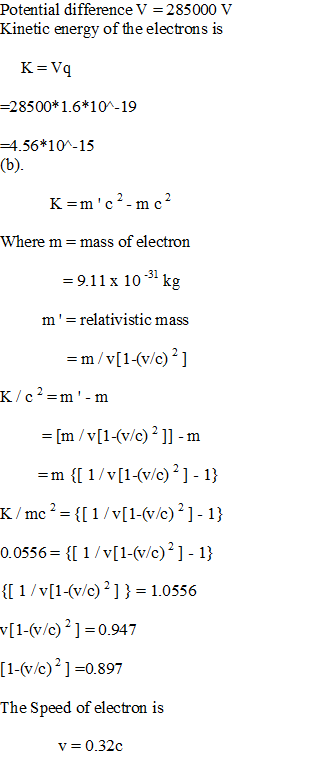
1.) Electrons are accelerated through a voltage difference of 285 kV inside a high voltage accelerator tube. What is the final kinetic energy of the electrons?
2.85E5 eV
2.)What is the speed of these electrons in terms of the speed of the light? (Remember that the electrons will be relativistic.)
???
Homework Answers
Add Answer to:
1.) Electrons are accelerated through a voltage difference of
285 kV inside a high voltage accelerator...
Electrons are accelerated through a voltage difference of 170 kV inside a high voltage accelerator tube....
 Electrons are accelerated through a voltage difference of 170 kV inside a high voltage accelerator tube. What is the final kinetic energy of the electrons? Tries 0/20 Submit Answer What is the speed of these electrons in terms of the speed of the light? (Remember that the electrons will be relativistic.) Submit Answer Tries 0/20
Electrons are accelerated through a voltage difference of 265 kV inside a high voltage accelerator tube....
Electrons are accelerated through a voltage difference of 265 kV inside a high voltage accelerator tube. What is the final kinetic energy of the electrons? What is the speed of these electrons in terms of the speed of the light? Please explain calculations very thoroughly!!
I ONLY need help with B. Please show work. Thank you! A) Electrons are accelerated through...
I ONLY need help with B. Please show work. Thank you! A) Electrons are accelerated through a voltage difference of 275 kV inside a high voltage accelerator tube. What is the final kinetic energy of the electrons? B) What is the speed of these electrons in terms of the speed of the light? (Remember that the electrons will be relativistic.)?
An electron is a accelerated through a potential difference of 750.0 kV so that it leaves...
 An electron is a accelerated through a potential difference of 750.0 kV so that it leaves this region with a kinetic energy of 750.0 keV. a) Calculate the mass of the electron in units of eV/c^2 correct to 4 decimal places. b) Calculate the total energy E of the electron in Joules and electron-Volts. c) Calculate the speed of the electron using the relativistic kinetic energy, and the non-relativistic kinetic energy. Express your answer as a fraction times c. d)...
Problem 16. Find the maximum energy in eV of an x-ray photon produced by electrons accelerated...
 Problem 16. Find the maximum energy in eV of an x-ray photon produced by electrons accelerated through a potential difference of 50.0 kV in a CRT like the one show below. Metal target X rays High- voltage source Vacuum Electrons Heated filament Filament voltage X rays are produced when energetic electrons strike the copper anode of this cathode ray tube (CRT). Electrons (shown here as separate particles) interact individually with the material they strike, sometimes producing photons of EM radiation.
An electron in a cathode ray tube is accelerated through a potential difference of 8.0 kV....
An electron in a cathode ray tube is accelerated through a potential difference of 8.0 kV. What kinetic energy does the electron gain in the process? (e = 1.6 × 10⁻¹⁹ C) 1.3E–15 J 1.0E–21 J 1.0E–15 J 5.0E–16 J 1.3E–21 J
Electrons are accelerated from rest in an electron gun. They move through a potential difference of...
Electrons are accelerated from rest in an electron gun. They move through a potential difference of 15.0 kV. Determine the resulting kinetic energy of each electron. 11.0 kJ 2.40 × 10⁻¹⁵ J 1.45 × 10⁻²³ J 1.76 × 10⁻¹⁵ J
An electron is accelerated from rest through a potential difference that has a magnitude of 2.70...
An electron is accelerated from rest through a potential difference that has a magnitude of 2.70 × 10⁷ V. The mass of the electron is 9.11 × 10⁻³¹ kg, and the negative charge of the electron has a magnitude of 1.60 × 10⁻¹⁹ C. (a) What is the relativistic kinetic energy (in joules) of the electron? (b) What is the speed of the electron? Express your answer as a multiple of c, the speed of light in a vacuum.
A beam of electrons is accelerated through a potential difference of 10 kV before entering a...
A beam of electrons is accelerated through a potential difference of 10 kV before entering a region having uniform electric and magnetic fields that are perpendicular to each other and perpendicular to the direction in which the electron is moving. If the magnetic field in this region has a value of 0.010 T, what magnitude of the electric field is required if the particles are to be undeflected as they pass through the region?
A beam of electrons is accelerated through a potential difference of 11.0 kV before entering a...
A beam of electrons is accelerated through a potential difference of 11.0 kV before entering a velocity selector. If the B-field of the velocity selector is perpendicular to the velocity and has a value of 0.02 T, what value of the E-field is required (in the magnetic field region) if the particles are to be undeflected? answer in V/m
 Electrons are accelerated through a voltage difference of 170 kV inside a high voltage accelerator tube. What is the final kinetic energy of the electrons? Tries 0/20 Submit Answer What is the speed of these electrons in terms of the speed of the light? (Remember that the electrons will be relativistic.) Submit Answer Tries 0/20
 An electron is a accelerated through a potential difference of 750.0 kV so that it leaves this region with a kinetic energy of 750.0 keV. a) Calculate the mass of the electron in units of eV/c^2 correct to 4 decimal places. b) Calculate the total energy E of the electron in Joules and electron-Volts. c) Calculate the speed of the electron using the relativistic kinetic energy, and the non-relativistic kinetic energy. Express your answer as a fraction times c. d)...
 Problem 16. Find the maximum energy in eV of an x-ray photon produced by electrons accelerated through a potential difference of 50.0 kV in a CRT like the one show below. Metal target X rays High- voltage source Vacuum Electrons Heated filament Filament voltage X rays are produced when energetic electrons strike the copper anode of this cathode ray tube (CRT). Electrons (shown here as separate particles) interact individually with the material they strike, sometimes producing photons of EM radiation.
Most questions answered within 3 hours.
-
Where is the error in this code sequence?
String s1 = "Hello";
String s2 = "ello";...
asked 10 months ago -
Financial data for Joel de Paris, Inc., for last year
follow:
Joel de Paris, Inc.
Balance...
asked 10 months ago -
Consider this reaction:
Al2(SO4)3 (aq)+ BaCl3
(aq) Al2Cl6 (aq)- +
3BaSO4(s) . What is the...
asked 10 months ago -
Suppose that Savneet is considering increasing her
recent random sample from 20 car rentals to 40...
asked 10 months ago -
Trucks arrive at an unloading terminal at an average rate of 120
per hour.
Trucks arrive...
asked 10 months ago -
Why are methanol and ethanol completely soluble in water while
octanol is not very little soluble....
asked 10 months ago -
A facilities manager at a university reads in a research report
that the mean amount of...
asked 10 months ago -
When the CuSO4 is rehydrated by adding water to the anhydrous
compound, is this an endothermic...
asked 10 months ago -
A ray of sunlight is passing from diamond into crown glass; the
angle of incidence is...
asked 10 months ago -
A block of mass 0.249 kg is placed on top of a light, vertical
spring of...
asked 10 months ago -
how do the kidneys compensate in the presences of acidosis
a) trigger hyperventilate
b) reserve acid...
asked 10 months ago -
Question 501 pts
The rental rate of capital to the firm increases. Which of the
following...
asked 10 months ago