
Homework Answers
1. The one‐tailed testing is that you are testing a more extensive null hypothesis and so your ability to detect unexpected results (make inferences on the underlying biology) can be restricted when the null hypothesis is not rejected.
2. The confidence level is equivalent to 1 – the alpha level. So, if your significance level is 0.05, the corresponding confidence level is 95%. If the P-value is less than your significance (alpha) level, the hypothesis test is statistically significant.
3. The factors affecting sample sizes are study design, method of sampling, and outcome measures – effect size, standard deviation, study power, and significance level.
4. Generally, z-tests are used when we have large sample sizes (n > 30), whereas t-tests are most helpful with a smaller sample size (n < 30). Both methods assume a normal distribution of the data, but the z-tests are most useful when the standard deviation is known.
5. Right tail:
The curve is:
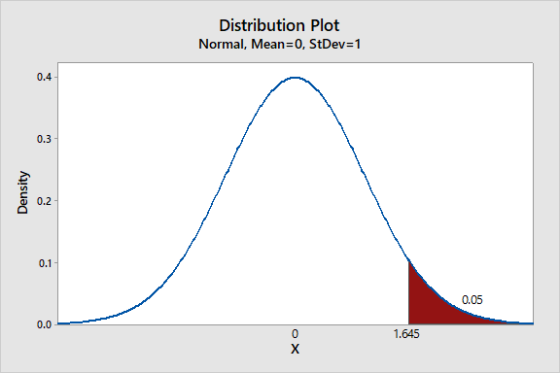
The hypothesis being tested is:
H0: µ =
Ha: µ >
Left tail:
The curve is:
The hypothesis being tested is:
H0: µ =
Ha: µ <
Thank you! :)
Add Answer to:
Q1) Why we sometimes get unexpected results during hypothesis testing? Q2) What is the relationship between...
1. In hypothesis testing, the hypothesis that is assumed to be true for the purpose of...
 1. In hypothesis testing, the hypothesis that is assumed to be true for the purpose of testing is called the hypothesis 2. (Circle the correct response) In hypothesis testing, critical values used to make a rejection decision regarding the null hypothesis are determined by the nature of the hypothesis test (two-tail vs. one-tail) and the d. significance level a. sample size b. population parameter c. target value 3. (Circle the correct response) In the process of hypothesis testing, the test...
Intro to Statistics: Q1: Q2: Q3: [8-1] Suppose we are testing the null hypothesis Ho: u...
 Intro to Statistics:
Q1:
Q2:
Q3:
[8-1] Suppose we are testing the null hypothesis Ho: u = 50 and the alternative Ha: u 50 for a normal population with o 6. We took an SRS sample of size 48 and obtained x-bar 53. The P-value for the test is: 0.05 <0.05 Question 2 (0.5 points) 8-2] When performing a one-sample t-test, if the sample size is 14, then of freedom should be used for determining the confidence interval from the...
Intro to Statistics:
Q1:
Q2:
Q3:
[8-1] Suppose we are testing the null hypothesis Ho: u = 50 and the alternative Ha: u 50 for a normal population with o 6. We took an SRS sample of size 48 and obtained x-bar 53. The P-value for the test is: 0.05 <0.05 Question 2 (0.5 points) 8-2] When performing a one-sample t-test, if the sample size is 14, then of freedom should be used for determining the confidence interval from the...
1. Using the traditional hypothesis testing approach, calculate the critical value for testing the null hypothesis...
1. Using the traditional hypothesis testing approach, calculate the critical value for testing the null hypothesis that the population mean is greater than or equal to 12, given a sample size of 49, a population standard deviation 6.06, and a significance level of 0.05. Round to two decimals. K = 2. The manager of a paint supply store wants to determine if the mean amount of paint contained in 1- gallon cans purchased from a nationally known manufacturer is actually...
In hypothesis testing, what is the difference between the critical value method and the P-value method?...
In hypothesis testing, what is the difference between the critical value method and the P-value method? A. In the critical value method the calculated value of the test statistic is multiplied by two in order to find the P-value. B. In the P-value method the calculated value of the test statistic determines the cutoff between the rejection region and the non-rejection region, while the critical value is one-half of the P-value. C. In the critical value method the cutoff between...
Please help with these 4 questions Check True/False: Q1- [0.5 point] A one-tail hypothesis test is...
 Please help with these 4 questions
Check True/False: Q1- [0.5 point] A one-tail hypothesis test is used whenever the alternative hypothesis is express as = O True O False Q2-10.5 point) A two-tail hypothesis test is used when the alternative hypothesis is stated as or > with the rejection area on the same side as the inequality points. O True O False Q3- [0.5 point] If the p-value is greater than a, we do not reject the null hypothesis. Otherwise,...
Please help with these 4 questions
Check True/False: Q1- [0.5 point] A one-tail hypothesis test is used whenever the alternative hypothesis is express as = O True O False Q2-10.5 point) A two-tail hypothesis test is used when the alternative hypothesis is stated as or > with the rejection area on the same side as the inequality points. O True O False Q3- [0.5 point] If the p-value is greater than a, we do not reject the null hypothesis. Otherwise,...
You are testing the null hypothesis that there is no linear relationship between two variables, X...
You are testing the null hypothesis that there is no linear relationship between two variables, X and Y. You are given the following regression results, where the sample size is 10., Coefficients Standard Error Intercept -1.2 1 X 2 2 a) What is the value of the t test statistic? b) At the α = 0.05 level of significance, what are the critical values? c) Based on your answer to (a) and (b), what statistical decision should you make?
1. For the standardized test statistic approach to hypothesis testing, calculate the test statistic for testing...
1. For the standardized test statistic approach to hypothesis testing, calculate the test statistic for testing the null hypothesis that the population mean is less than or equal to 9.94, given a sample mean of 15.20, a sample size of 49, and a population standard deviation of 3.25. Round to two decimals. 2. The manager of a paint supply store wants to determine if the mean amount of paint contained in 1- gallon cans purchased from a nationally known manufacturer...
7. You are testing the null hypothesis that there is no linear relationship between two variables,...
7. You are testing the null hypothesis that there is no linear relationship between two variables, X and Y. From your sample of n=18, you determine that b1=4.4 and Sb1=1.7. a. What is the value of tSTAT? b. At the α=0.05 level of significance, what are the critical values? c. Based on your answers to (a) and (b), what statistical decision should you make? d. Construct a 95% confidence interval estimate of the population slope, β1. 8. You are testing...
10) (a) In a hypothesis testing procedure explain the difference between a type 1 and type...
10) (a) In a hypothesis testing procedure explain the difference between a type 1 and type 2 error (b) Explain the difference between a point estimate and an interval estimate? What is a confidence interval? (c) A poll service indicates that 74% of the public is opposed to a certain piece of legislation but there is a 95% margin of sampling error of 3.1%. Express these findings as a confidence interval. (d) You read in the paper that in a...
Hypothesis Testing Method A = ADKAR Framework (column A) Method B = Prosci Change Management Methodology...
Hypothesis Testing Method A = ADKAR Framework (column A) Method B = Prosci Change Management Methodology (column B) Null hypothesis is H0: Method A = Method B Research (Alternative) hypothesis is H1:Method A < Method B Sample size: 30 One-tailed test: Direction stated in the hypothesis is determine more effective (greater or less than). Level of Significance (a): .05 t-test is used because standard deviation of population is unknown, sample size is less than 30 Cutoff Sample Score (critical value)...
 1. In hypothesis testing, the hypothesis that is assumed to be true for the purpose of testing is called the hypothesis 2. (Circle the correct response) In hypothesis testing, critical values used to make a rejection decision regarding the null hypothesis are determined by the nature of the hypothesis test (two-tail vs. one-tail) and the d. significance level a. sample size b. population parameter c. target value 3. (Circle the correct response) In the process of hypothesis testing, the test...
 Intro to Statistics:
Q1:
Q2:
Q3:
[8-1] Suppose we are testing the null hypothesis Ho: u = 50 and the alternative Ha: u 50 for a normal population with o 6. We took an SRS sample of size 48 and obtained x-bar 53. The P-value for the test is: 0.05 <0.05 Question 2 (0.5 points) 8-2] When performing a one-sample t-test, if the sample size is 14, then of freedom should be used for determining the confidence interval from the...
Intro to Statistics:
Q1:
Q2:
Q3:
[8-1] Suppose we are testing the null hypothesis Ho: u = 50 and the alternative Ha: u 50 for a normal population with o 6. We took an SRS sample of size 48 and obtained x-bar 53. The P-value for the test is: 0.05 <0.05 Question 2 (0.5 points) 8-2] When performing a one-sample t-test, if the sample size is 14, then of freedom should be used for determining the confidence interval from the...
 Please help with these 4 questions
Check True/False: Q1- [0.5 point] A one-tail hypothesis test is used whenever the alternative hypothesis is express as = O True O False Q2-10.5 point) A two-tail hypothesis test is used when the alternative hypothesis is stated as or > with the rejection area on the same side as the inequality points. O True O False Q3- [0.5 point] If the p-value is greater than a, we do not reject the null hypothesis. Otherwise,...
Please help with these 4 questions
Check True/False: Q1- [0.5 point] A one-tail hypothesis test is used whenever the alternative hypothesis is express as = O True O False Q2-10.5 point) A two-tail hypothesis test is used when the alternative hypothesis is stated as or > with the rejection area on the same side as the inequality points. O True O False Q3- [0.5 point] If the p-value is greater than a, we do not reject the null hypothesis. Otherwise,...
Most questions answered within 3 hours.
-
Where is the error in this code sequence?
String s1 = "Hello";
String s2 = "ello";...
asked 10 months ago -
Financial data for Joel de Paris, Inc., for last year
follow:
Joel de Paris, Inc.
Balance...
asked 10 months ago -
Consider this reaction:
Al2(SO4)3 (aq)+ BaCl3
(aq) Al2Cl6 (aq)- +
3BaSO4(s) . What is the...
asked 10 months ago -
Suppose that Savneet is considering increasing her
recent random sample from 20 car rentals to 40...
asked 10 months ago -
Trucks arrive at an unloading terminal at an average rate of 120
per hour.
Trucks arrive...
asked 10 months ago -
Why are methanol and ethanol completely soluble in water while
octanol is not very little soluble....
asked 10 months ago -
A facilities manager at a university reads in a research report
that the mean amount of...
asked 10 months ago -
When the CuSO4 is rehydrated by adding water to the anhydrous
compound, is this an endothermic...
asked 10 months ago -
A ray of sunlight is passing from diamond into crown glass; the
angle of incidence is...
asked 10 months ago -
A block of mass 0.249 kg is placed on top of a light, vertical
spring of...
asked 10 months ago -
how do the kidneys compensate in the presences of acidosis
a) trigger hyperventilate
b) reserve acid...
asked 10 months ago -
Question 501 pts
The rental rate of capital to the firm increases. Which of the
following...
asked 10 months ago