Please help elaborate the given solutions for the following problem
Solutions:
Homework Answers


Add Answer to:
Please help elaborate the given solutions for the following
problem
Solutions:
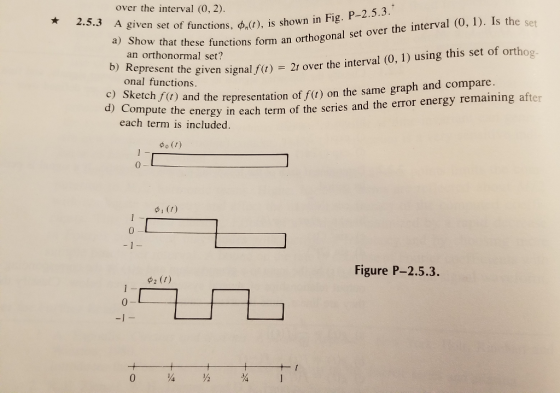
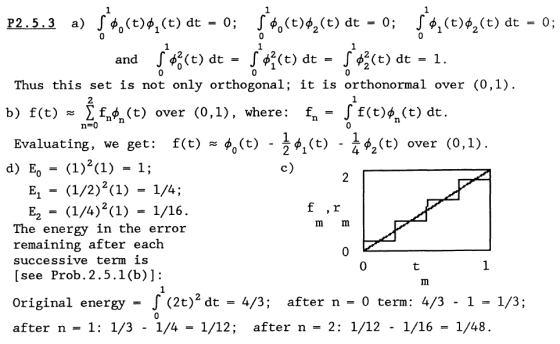
over the interval (0, 2)....
10.3.4 You are given (a) a set of functions un (x)--x", n = 0, 1, 2, (b) an interval (0, oo), (c)...
 From Arfken
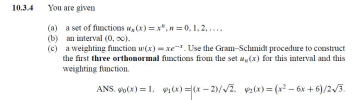
10.3.4 You are given (a) a set of functions un (x)--x", n = 0, 1, 2, (b) an interval (0, oo), (c) a weighting function w(x)-xe. Use the Gram-Schmidt procedure to construct the first three orthonormal functions from the set un(x) for this interval and this weighting function.
10.3.4 You are given (a) a set of functions un (x)--x", n = 0, 1, 2, (b) an interval (0, oo), (c) a weighting function w(x)-xe. Use the Gram-Schmidt procedure...
From Arfken
10.3.4 You are given (a) a set of functions un (x)--x", n = 0, 1, 2, (b) an interval (0, oo), (c) a weighting function w(x)-xe. Use the Gram-Schmidt procedure to construct the first three orthonormal functions from the set un(x) for this interval and this weighting function.
10.3.4 You are given (a) a set of functions un (x)--x", n = 0, 1, 2, (b) an interval (0, oo), (c) a weighting function w(x)-xe. Use the Gram-Schmidt procedure...
Verify that the given function form a fundamental set of solutions on the interval (0, 0),...
 Verify that the given function form a fundamental set of solutions on the interval (0, 0), compute the Wronskian, and form the general solution. xy'' – 6xy' +12y = 0 x?; x+ I verified the solution. ONo Yes Find the Wronskian and verify that the functions are linearly independent on the interval (0, 0). W(x", x4) = 0 Preview I found the general solution. OYes ONO
here is the solution for the question but i need someone help to understand part b please. ф1(t) 2(t) 0. -1 Figure 7: Set of orthonormal basis functions in Problem 4 The signals si(t) and s2(t) a...
 here is the solution for the question but i need someone help
to understand part b please.
ф1(t) 2(t) 0. -1 Figure 7: Set of orthonormal basis functions in Problem 4 The signals si(t) and s2(t) are given by 201 (t) +dy(t) s2(t) h2(t) hi(t) (a) Design and draw the matched filter for the system using the above orthonormal basis functions to minimize the BER Result is in Fig. 8. (b) Design and draw the receiver for the system using...
here is the solution for the question but i need someone help
to understand part b please.
ф1(t) 2(t) 0. -1 Figure 7: Set of orthonormal basis functions in Problem 4 The signals si(t) and s2(t) are given by 201 (t) +dy(t) s2(t) h2(t) hi(t) (a) Design and draw the matched filter for the system using the above orthonormal basis functions to minimize the BER Result is in Fig. 8. (b) Design and draw the receiver for the system using...
Please show show the steps :) Solve the equation for exact solutions over the interval [0°,360°)....
 Please show show the steps :)
Solve the equation for exact solutions over the interval [0°,360°). 273 sin 20 = -3 Select the correct choice below and, if necessary, fill in the answer box to complete your choice. A. The solution set is { }. (Type an integer or a decimal. Type your answer in degrees. Do not include the degree symbol in your answer. Use a comma to separate answers as needed.) B. The solution is the empty set.
Please show show the steps :)
Solve the equation for exact solutions over the interval [0°,360°). 273 sin 20 = -3 Select the correct choice below and, if necessary, fill in the answer box to complete your choice. A. The solution set is { }. (Type an integer or a decimal. Type your answer in degrees. Do not include the degree symbol in your answer. Use a comma to separate answers as needed.) B. The solution is the empty set.
Solve the equation for exact solutions over the interval [0, 21). -2 cos²x = 3 cOS...
 Solve the equation for exact solutions over the interval [0, 21). -2 cos²x = 3 cOS X+1 Select the correct choice below and, if necessary, fill in the answer box to complete your choice. O A. The solution set is (Type an exact answer, using a as needed. Type your answer in radians. Use integers or fractions for any numbers in the expe answers as needed.) B. The solution is the empty set.
Solve the equation for exact solutions over the interval [0, 21). -2 sin ?x= 3 sin...
 Solve the equation for exact solutions over the interval [0, 21). -2 sin ?x= 3 sin x + 1 Select the correct choice below and, if necessary, fill in the answer box to complete your choice. O A. The solution set is (Type an exact answer, using a as needed. Type your answer in radians. Use integers or fractions for any numbers in the expression. Use a comma to separate answers as needed.) OB. The solution is the empty set.
Given the following set of three waveforms.s,(0),,(),s,(),,(0), and the set of functions )..), respectively, represented below...
 Given the following set of three waveforms.s,(0),,(),s,(),,(0), and the set of functions )..), respectively, represented below , 1SIS 0, otherwise O otherwise 0 0, otherwise MITTED PAUL C e 12 - W)-0, otherwise Upints) Plot the signals (0,50), sf,M(,),and the functions甿 σ points) Calculate the energy of each signal s,(r),,,U), s,(n,(r). Ơ points) What is the dimensionality of the set ,(ns, (r), sto..(,) ?
Please show work Required information Consider the initial value problem over the interval from x=0 to...
 Please show work
Required information Consider the initial value problem over the interval from x=0 to 1: dy dir = = (1+23) Vy Consider a step size of 0.25. Solve the given problem using Euler's method. Given, 10) = 1. (Round the final answers to four decimal places.) The solutions are as follows: y 1.6693 0.25 0.5 2.3153 0.75 3.2663 1 4.0000
Please show work
Required information Consider the initial value problem over the interval from x=0 to 1: dy dir = = (1+23) Vy Consider a step size of 0.25. Solve the given problem using Euler's method. Given, 10) = 1. (Round the final answers to four decimal places.) The solutions are as follows: y 1.6693 0.25 0.5 2.3153 0.75 3.2663 1 4.0000
Q1) Consider an LTI system with frequency response (u) given by (a) Find the impulse response h(0) for this system. [Hint: In case of polynomial over pohnomial frequency domain representation, we...
 Q1) Consider an LTI system with frequency response (u) given by (a) Find the impulse response h(0) for this system. [Hint: In case of polynomial over pohnomial frequency domain representation, we analyce the denominator and use partial fraction expansion to write H() in the form Then we notice that each of these fraction terms is the Fourier of an exponentiol multiplied by a unit step as per the Table J (b) What is the output y(t) from the system if...
17. The following system is used to sample and reconstruct the signal x(t)-1-cos(15π) with a sampling interval T-0.1 sec. p(t) xIn] y(t) x(t) -0.5 0.5 1B 1B X.(o) X (o) [2 Marks each] Given that the...
 17. The following system is used to sample and reconstruct the signal x(t)-1-cos(15π) with a sampling interval T-0.1 sec. p(t) xIn] y(t) x(t) -0.5 0.5 1B 1B X.(o) X (o) [2 Marks each] Given that the input signal, x(t) -1+cos(15rt) Sketch |X(a) The sampling interval is set to T= 0, 1 ec. SketchXs(o) where x(t) = p(t)x(t). Determine the expression for y(t). Is y(t) a reconstruction of x()? Does aliasing occur? explain
17. The following system is used to sample...
17. The following system is used to sample and reconstruct the signal x(t)-1-cos(15π) with a sampling interval T-0.1 sec. p(t) xIn] y(t) x(t) -0.5 0.5 1B 1B X.(o) X (o) [2 Marks each] Given that the input signal, x(t) -1+cos(15rt) Sketch |X(a) The sampling interval is set to T= 0, 1 ec. SketchXs(o) where x(t) = p(t)x(t). Determine the expression for y(t). Is y(t) a reconstruction of x()? Does aliasing occur? explain
17. The following system is used to sample...
 From Arfken
10.3.4 You are given (a) a set of functions un (x)--x", n = 0, 1, 2, (b) an interval (0, oo), (c) a weighting function w(x)-xe. Use the Gram-Schmidt procedure to construct the first three orthonormal functions from the set un(x) for this interval and this weighting function.
10.3.4 You are given (a) a set of functions un (x)--x", n = 0, 1, 2, (b) an interval (0, oo), (c) a weighting function w(x)-xe. Use the Gram-Schmidt procedure...
From Arfken
10.3.4 You are given (a) a set of functions un (x)--x", n = 0, 1, 2, (b) an interval (0, oo), (c) a weighting function w(x)-xe. Use the Gram-Schmidt procedure to construct the first three orthonormal functions from the set un(x) for this interval and this weighting function.
10.3.4 You are given (a) a set of functions un (x)--x", n = 0, 1, 2, (b) an interval (0, oo), (c) a weighting function w(x)-xe. Use the Gram-Schmidt procedure...
 Verify that the given function form a fundamental set of solutions on the interval (0, 0), compute the Wronskian, and form the general solution. xy'' – 6xy' +12y = 0 x?; x+ I verified the solution. ONo Yes Find the Wronskian and verify that the functions are linearly independent on the interval (0, 0). W(x", x4) = 0 Preview I found the general solution. OYes ONO
 here is the solution for the question but i need someone help
to understand part b please.
ф1(t) 2(t) 0. -1 Figure 7: Set of orthonormal basis functions in Problem 4 The signals si(t) and s2(t) are given by 201 (t) +dy(t) s2(t) h2(t) hi(t) (a) Design and draw the matched filter for the system using the above orthonormal basis functions to minimize the BER Result is in Fig. 8. (b) Design and draw the receiver for the system using...
here is the solution for the question but i need someone help
to understand part b please.
ф1(t) 2(t) 0. -1 Figure 7: Set of orthonormal basis functions in Problem 4 The signals si(t) and s2(t) are given by 201 (t) +dy(t) s2(t) h2(t) hi(t) (a) Design and draw the matched filter for the system using the above orthonormal basis functions to minimize the BER Result is in Fig. 8. (b) Design and draw the receiver for the system using...
 Please show show the steps :)
Solve the equation for exact solutions over the interval [0°,360°). 273 sin 20 = -3 Select the correct choice below and, if necessary, fill in the answer box to complete your choice. A. The solution set is { }. (Type an integer or a decimal. Type your answer in degrees. Do not include the degree symbol in your answer. Use a comma to separate answers as needed.) B. The solution is the empty set.
Please show show the steps :)
Solve the equation for exact solutions over the interval [0°,360°). 273 sin 20 = -3 Select the correct choice below and, if necessary, fill in the answer box to complete your choice. A. The solution set is { }. (Type an integer or a decimal. Type your answer in degrees. Do not include the degree symbol in your answer. Use a comma to separate answers as needed.) B. The solution is the empty set.
 Solve the equation for exact solutions over the interval [0, 21). -2 cos²x = 3 cOS X+1 Select the correct choice below and, if necessary, fill in the answer box to complete your choice. O A. The solution set is (Type an exact answer, using a as needed. Type your answer in radians. Use integers or fractions for any numbers in the expe answers as needed.) B. The solution is the empty set.
 Solve the equation for exact solutions over the interval [0, 21). -2 sin ?x= 3 sin x + 1 Select the correct choice below and, if necessary, fill in the answer box to complete your choice. O A. The solution set is (Type an exact answer, using a as needed. Type your answer in radians. Use integers or fractions for any numbers in the expression. Use a comma to separate answers as needed.) OB. The solution is the empty set.
 Given the following set of three waveforms.s,(0),,(),s,(),,(0), and the set of functions )..), respectively, represented below , 1SIS 0, otherwise O otherwise 0 0, otherwise MITTED PAUL C e 12 - W)-0, otherwise Upints) Plot the signals (0,50), sf,M(,),and the functions甿 σ points) Calculate the energy of each signal s,(r),,,U), s,(n,(r). Ơ points) What is the dimensionality of the set ,(ns, (r), sto..(,) ?
 Please show work
Required information Consider the initial value problem over the interval from x=0 to 1: dy dir = = (1+23) Vy Consider a step size of 0.25. Solve the given problem using Euler's method. Given, 10) = 1. (Round the final answers to four decimal places.) The solutions are as follows: y 1.6693 0.25 0.5 2.3153 0.75 3.2663 1 4.0000
Please show work
Required information Consider the initial value problem over the interval from x=0 to 1: dy dir = = (1+23) Vy Consider a step size of 0.25. Solve the given problem using Euler's method. Given, 10) = 1. (Round the final answers to four decimal places.) The solutions are as follows: y 1.6693 0.25 0.5 2.3153 0.75 3.2663 1 4.0000
 Q1) Consider an LTI system with frequency response (u) given by (a) Find the impulse response h(0) for this system. [Hint: In case of polynomial over pohnomial frequency domain representation, we analyce the denominator and use partial fraction expansion to write H() in the form Then we notice that each of these fraction terms is the Fourier of an exponentiol multiplied by a unit step as per the Table J (b) What is the output y(t) from the system if...
 17. The following system is used to sample and reconstruct the signal x(t)-1-cos(15π) with a sampling interval T-0.1 sec. p(t) xIn] y(t) x(t) -0.5 0.5 1B 1B X.(o) X (o) [2 Marks each] Given that the input signal, x(t) -1+cos(15rt) Sketch |X(a) The sampling interval is set to T= 0, 1 ec. SketchXs(o) where x(t) = p(t)x(t). Determine the expression for y(t). Is y(t) a reconstruction of x()? Does aliasing occur? explain
17. The following system is used to sample...
17. The following system is used to sample and reconstruct the signal x(t)-1-cos(15π) with a sampling interval T-0.1 sec. p(t) xIn] y(t) x(t) -0.5 0.5 1B 1B X.(o) X (o) [2 Marks each] Given that the input signal, x(t) -1+cos(15rt) Sketch |X(a) The sampling interval is set to T= 0, 1 ec. SketchXs(o) where x(t) = p(t)x(t). Determine the expression for y(t). Is y(t) a reconstruction of x()? Does aliasing occur? explain
17. The following system is used to sample...
Most questions answered within 3 hours.
-
Where is the error in this code sequence?
String s1 = "Hello";
String s2 = "ello";...
asked 10 months ago -
Financial data for Joel de Paris, Inc., for last year
follow:
Joel de Paris, Inc.
Balance...
asked 10 months ago -
Consider this reaction:
Al2(SO4)3 (aq)+ BaCl3
(aq) Al2Cl6 (aq)- +
3BaSO4(s) . What is the...
asked 10 months ago -
Suppose that Savneet is considering increasing her
recent random sample from 20 car rentals to 40...
asked 10 months ago -
Trucks arrive at an unloading terminal at an average rate of 120
per hour.
Trucks arrive...
asked 10 months ago -
Why are methanol and ethanol completely soluble in water while
octanol is not very little soluble....
asked 10 months ago -
A facilities manager at a university reads in a research report
that the mean amount of...
asked 10 months ago -
When the CuSO4 is rehydrated by adding water to the anhydrous
compound, is this an endothermic...
asked 10 months ago -
A ray of sunlight is passing from diamond into crown glass; the
angle of incidence is...
asked 10 months ago -
A block of mass 0.249 kg is placed on top of a light, vertical
spring of...
asked 10 months ago -
how do the kidneys compensate in the presences of acidosis
a) trigger hyperventilate
b) reserve acid...
asked 10 months ago -
Question 501 pts
The rental rate of capital to the firm increases. Which of the
following...
asked 10 months ago