
Homework Answers
Answer:
The Reaction are occur or not is defined according to oxidation series.
First we recognise to the salt in each eqation is a stronge electrolytes.the Important things to identify the metal cation in the salt.
If the metal cation are appears Lower in oxidation series table then solid metal, so Metal will be oxidised Reaction will be occur.
If the metal cation are appears Higher in oxidation series table then solid metal, so Metal will not be oxidised, Reaction will not occur.
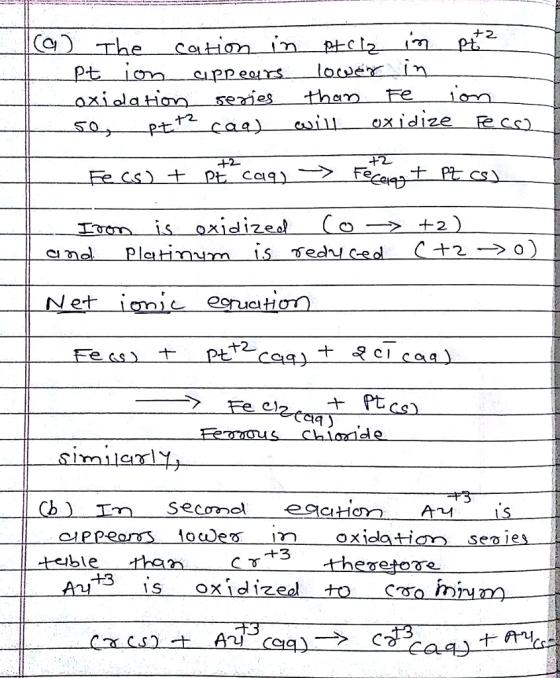
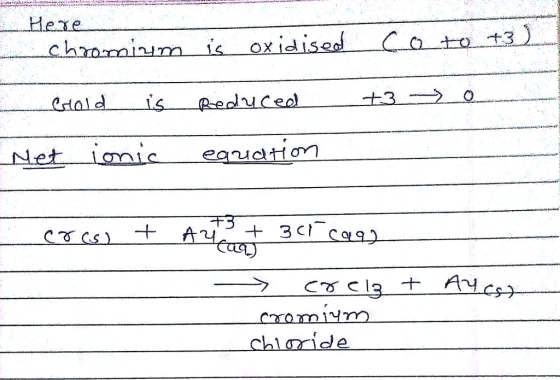
To More information About OXIDATION ACTIVITY SERIES please search on web you get easily list of this it is better to understand to you.
Add Answer to:
12. Predict which of the following reactions will occur, and for those that will occur, write...
5) Determine which element is oxidized and which element is reduced in the following redox reactions....
5) Determine which element is oxidized and which element is reduced in the following redox reactions. (4) Fe2O3 + CO ® Fe + CO2 Element oxidized ____________________ Element reduced _________________ Cr2O72- + H2C2O4 ® Cr3+ + CO2 Element oxidized ____________________ Element reduced ___________________ 6) Determine the balanced molecular, ionic and net ionic equations for the following single displacement (replacement) reaction. (9) (ME) Al(s) + HCl(aq) ® (IE) (NIE)
Biochemistry For the following reactions which specie(s) are getting reduced in the reactions. * Zn(s) +...
 Biochemistry
For the following reactions which specie(s) are getting reduced in the reactions. * Zn(s) + Cu2+ (aq) --> Zn2+(aq) + Cu(s) C6H12O6 (glucose) + O2 --> 6H2O + 6CO2 Zn(s) Cu2+ O Glucose O 02
Biochemistry
For the following reactions which specie(s) are getting reduced in the reactions. * Zn(s) + Cu2+ (aq) --> Zn2+(aq) + Cu(s) C6H12O6 (glucose) + O2 --> 6H2O + 6CO2 Zn(s) Cu2+ O Glucose O 02
Consider the following reaction at 298 K. 3 Cr3(a) Cr(s)>3 Cr(aq) Cr (aq) Which of the...
 Consider the following reaction at 298 K. 3 Cr3(a) Cr(s)>3 Cr(aq) Cr (aq) Which of the following statements are correct? Choose all that apply. E cell0 The reaction is reactant-favored. n 3 mol electrons Odelta Go0 Consider the following reaction at 298K. 2 Cr3+ (a Zn (s2 Cr2* (aq)+ Zn2* (aq) Which of the following statements are correct? Choose all that apply O K<1 cell 0 Odelta Go0 OThe reaction is product-favored On-5 mol electrons
The following standard reduction potentials have been determined for the aqueous chemistry of iron: Fe3 (a)e>Fe2-(aq...
 The following standard reduction potentials have been determined for the aqueous chemistry of iron: Fe3 (a)e>Fe2-(aq 0.770 V Fe2 (aq) 2e>Fe(s E°-0.409 v Calculate the equilibrium constant (K) for the disproportionation of Fe2(aq) at 25 °C. Submit Answer 5 question attempts remaining
dela E? Which of the following reactions would ΔΗ = ΔΕ? Multiple Choice O C(s) +...
 dela E?
Which of the following reactions would ΔΗ = ΔΕ? Multiple Choice O C(s) + O2(9) --> CO2(g) Zn+2(aq) + 2OH(aq) --> Zn(OH)2(s) C3H4(g) + 402(g) --> 3CO2(g) + 2H2O(1) CaCO3(s) --> CaO(s) + CO2(g) 2Al(s) + 6HCl(aq) --> 2AlCl3(aq) + 3H2(g)
dela E?
Which of the following reactions would ΔΗ = ΔΕ? Multiple Choice O C(s) + O2(9) --> CO2(g) Zn+2(aq) + 2OH(aq) --> Zn(OH)2(s) C3H4(g) + 402(g) --> 3CO2(g) + 2H2O(1) CaCO3(s) --> CaO(s) + CO2(g) 2Al(s) + 6HCl(aq) --> 2AlCl3(aq) + 3H2(g)
1 Write the balanced half reactions of the following reactions: a. NiO2 + 2 H20+ Fe...
 1 Write the balanced half reactions of the following reactions: a. NiO2 + 2 H20+ Fe >Ni (OH)2 + Fe(OH)2 in basic solution b. CO2 + 2 NH2OHCO + N2 + 3 H2O in basic solution c. 2 H+ + H202 +2 Fe2+2 Fe3+ + 2 H2O in acidic solution d. H+ + 2 H2O + 2 MnO4 + 5 SO2 → Mn2+ + 5 HSO4 in acidic solution
4. (6 pts.) Oxidation-Reduction Reactions: write out two ways you can identify the species that has...
 4. (6 pts.) Oxidation-Reduction Reactions: write out two ways you can identify the species that has been oxidized in a redox reaction: b. Identify the element reduced and the element oxidized in the following oxidation- reduction reactions. Fe(s) + CuCl2(aq) FeCl2(aq) + Cu(s) Element Oxidized: Element Reduced: C(s) + O2(g) → C02(g) Element Oxidized: Element Reduced:
Part A Which of the following redox reactions do you expect to occur spontaneously in the...
 Part A Which of the following redox reactions do you expect to occur spontaneously in the fowd dreetiont Check all that apply. O Cd2+ (aq) +Co(a)-Co2+ (aq) +Cd(a) O Fe+ (aq)+Zn(s)-+Fe (s) + Zn2+ (aq) O Cr(s)+3Ag (aq)Cr3 (aq) + 3Ag(s) O Fe (aq) +Cd(a)-+Fe(s) + Cd2+ (aq) Request Answer Submit ovide Feedback
1. Predict if the following reactions will occur. If the reaction will occur, write out the...
 1. Predict if the following reactions will occur. If the reaction will occur, write out the products. If a reaction will not occur, write "NR” for no reaction. Reactants Result Justification Ce3+(aq) + Cl2(g) NR Ce3+(aq) is higher than Cl2(g) Sn(s) + Ni2+(aq) Ag+(aq) + Au(s) Au3+(aq) + Ag(s) ce Li(s) + Ce4+(aq)
4.51 Which element is , and which is reduced in the fol reactions (a) N 3...
 4.51 Which element is , and which is reduced in the fol
reactions (a) N 3 (s)+3H 2 (s) 2NH 3 (s) (b 3 le(NO 1 ) 2 (a 1 )+2
M(s) 3 Fe(N)+2 Al(NO 1 ) 1 (aq) ( PbS(s)+4 H 3 O 2 (aq) PrSO 4
(s)+4H 2 O(l)
4.51 Which element is oxidized, and which is reduced in the fol- lowing reactions? (a) N2(g) + 3H2(8) — 2 NH3(g) (b) 3 Fe(NO3)2(aq) + 2 Al(s) — 3...
4.51 Which element is , and which is reduced in the fol
reactions (a) N 3 (s)+3H 2 (s) 2NH 3 (s) (b 3 le(NO 1 ) 2 (a 1 )+2
M(s) 3 Fe(N)+2 Al(NO 1 ) 1 (aq) ( PbS(s)+4 H 3 O 2 (aq) PrSO 4
(s)+4H 2 O(l)
4.51 Which element is oxidized, and which is reduced in the fol- lowing reactions? (a) N2(g) + 3H2(8) — 2 NH3(g) (b) 3 Fe(NO3)2(aq) + 2 Al(s) — 3...
 Biochemistry
For the following reactions which specie(s) are getting reduced in the reactions. * Zn(s) + Cu2+ (aq) --> Zn2+(aq) + Cu(s) C6H12O6 (glucose) + O2 --> 6H2O + 6CO2 Zn(s) Cu2+ O Glucose O 02
Biochemistry
For the following reactions which specie(s) are getting reduced in the reactions. * Zn(s) + Cu2+ (aq) --> Zn2+(aq) + Cu(s) C6H12O6 (glucose) + O2 --> 6H2O + 6CO2 Zn(s) Cu2+ O Glucose O 02
 Consider the following reaction at 298 K. 3 Cr3(a) Cr(s)>3 Cr(aq) Cr (aq) Which of the following statements are correct? Choose all that apply. E cell0 The reaction is reactant-favored. n 3 mol electrons Odelta Go0 Consider the following reaction at 298K. 2 Cr3+ (a Zn (s2 Cr2* (aq)+ Zn2* (aq) Which of the following statements are correct? Choose all that apply O K<1 cell 0 Odelta Go0 OThe reaction is product-favored On-5 mol electrons
 The following standard reduction potentials have been determined for the aqueous chemistry of iron: Fe3 (a)e>Fe2-(aq 0.770 V Fe2 (aq) 2e>Fe(s E°-0.409 v Calculate the equilibrium constant (K) for the disproportionation of Fe2(aq) at 25 °C. Submit Answer 5 question attempts remaining
 dela E?
Which of the following reactions would ΔΗ = ΔΕ? Multiple Choice O C(s) + O2(9) --> CO2(g) Zn+2(aq) + 2OH(aq) --> Zn(OH)2(s) C3H4(g) + 402(g) --> 3CO2(g) + 2H2O(1) CaCO3(s) --> CaO(s) + CO2(g) 2Al(s) + 6HCl(aq) --> 2AlCl3(aq) + 3H2(g)
dela E?
Which of the following reactions would ΔΗ = ΔΕ? Multiple Choice O C(s) + O2(9) --> CO2(g) Zn+2(aq) + 2OH(aq) --> Zn(OH)2(s) C3H4(g) + 402(g) --> 3CO2(g) + 2H2O(1) CaCO3(s) --> CaO(s) + CO2(g) 2Al(s) + 6HCl(aq) --> 2AlCl3(aq) + 3H2(g)
 1 Write the balanced half reactions of the following reactions: a. NiO2 + 2 H20+ Fe >Ni (OH)2 + Fe(OH)2 in basic solution b. CO2 + 2 NH2OHCO + N2 + 3 H2O in basic solution c. 2 H+ + H202 +2 Fe2+2 Fe3+ + 2 H2O in acidic solution d. H+ + 2 H2O + 2 MnO4 + 5 SO2 → Mn2+ + 5 HSO4 in acidic solution
 4. (6 pts.) Oxidation-Reduction Reactions: write out two ways you can identify the species that has been oxidized in a redox reaction: b. Identify the element reduced and the element oxidized in the following oxidation- reduction reactions. Fe(s) + CuCl2(aq) FeCl2(aq) + Cu(s) Element Oxidized: Element Reduced: C(s) + O2(g) → C02(g) Element Oxidized: Element Reduced:
 Part A Which of the following redox reactions do you expect to occur spontaneously in the fowd dreetiont Check all that apply. O Cd2+ (aq) +Co(a)-Co2+ (aq) +Cd(a) O Fe+ (aq)+Zn(s)-+Fe (s) + Zn2+ (aq) O Cr(s)+3Ag (aq)Cr3 (aq) + 3Ag(s) O Fe (aq) +Cd(a)-+Fe(s) + Cd2+ (aq) Request Answer Submit ovide Feedback
 1. Predict if the following reactions will occur. If the reaction will occur, write out the products. If a reaction will not occur, write "NR” for no reaction. Reactants Result Justification Ce3+(aq) + Cl2(g) NR Ce3+(aq) is higher than Cl2(g) Sn(s) + Ni2+(aq) Ag+(aq) + Au(s) Au3+(aq) + Ag(s) ce Li(s) + Ce4+(aq)
 4.51 Which element is , and which is reduced in the fol
reactions (a) N 3 (s)+3H 2 (s) 2NH 3 (s) (b 3 le(NO 1 ) 2 (a 1 )+2
M(s) 3 Fe(N)+2 Al(NO 1 ) 1 (aq) ( PbS(s)+4 H 3 O 2 (aq) PrSO 4
(s)+4H 2 O(l)
4.51 Which element is oxidized, and which is reduced in the fol- lowing reactions? (a) N2(g) + 3H2(8) — 2 NH3(g) (b) 3 Fe(NO3)2(aq) + 2 Al(s) — 3...
4.51 Which element is , and which is reduced in the fol
reactions (a) N 3 (s)+3H 2 (s) 2NH 3 (s) (b 3 le(NO 1 ) 2 (a 1 )+2
M(s) 3 Fe(N)+2 Al(NO 1 ) 1 (aq) ( PbS(s)+4 H 3 O 2 (aq) PrSO 4
(s)+4H 2 O(l)
4.51 Which element is oxidized, and which is reduced in the fol- lowing reactions? (a) N2(g) + 3H2(8) — 2 NH3(g) (b) 3 Fe(NO3)2(aq) + 2 Al(s) — 3...
Most questions answered within 3 hours.
-
Where is the error in this code sequence?
String s1 = "Hello";
String s2 = "ello";...
asked 10 months ago -
Financial data for Joel de Paris, Inc., for last year
follow:
Joel de Paris, Inc.
Balance...
asked 10 months ago -
Consider this reaction:
Al2(SO4)3 (aq)+ BaCl3
(aq) Al2Cl6 (aq)- +
3BaSO4(s) . What is the...
asked 10 months ago -
Suppose that Savneet is considering increasing her
recent random sample from 20 car rentals to 40...
asked 10 months ago -
Trucks arrive at an unloading terminal at an average rate of 120
per hour.
Trucks arrive...
asked 10 months ago -
Why are methanol and ethanol completely soluble in water while
octanol is not very little soluble....
asked 10 months ago -
A facilities manager at a university reads in a research report
that the mean amount of...
asked 10 months ago -
When the CuSO4 is rehydrated by adding water to the anhydrous
compound, is this an endothermic...
asked 10 months ago -
A ray of sunlight is passing from diamond into crown glass; the
angle of incidence is...
asked 10 months ago -
A block of mass 0.249 kg is placed on top of a light, vertical
spring of...
asked 10 months ago -
how do the kidneys compensate in the presences of acidosis
a) trigger hyperventilate
b) reserve acid...
asked 10 months ago -
Question 501 pts
The rental rate of capital to the firm increases. Which of the
following...
asked 10 months ago