research methods and ethics
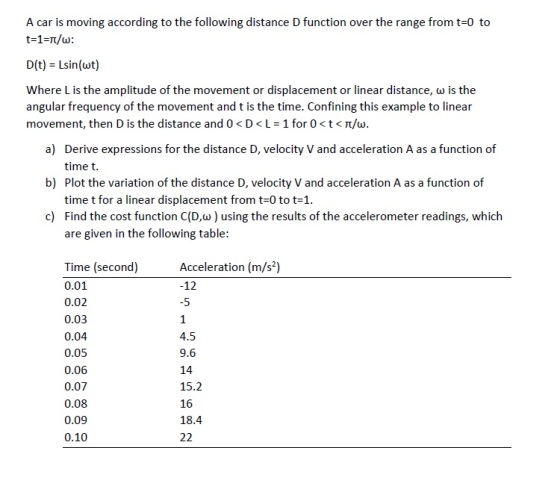
A car is moving according to the following distance D function over the range from \(\mathrm{t}=0\) to
$$ \begin{array}{l} t=1=\pi / \omega \\ D(t)=L\sin (\omega t) \end{array} $$
Where \(L\) is the amplitude of the movement or displacement or linear distance, \(\omega\) is the angular frequency of the movement and \(t\) is the time. Confining this example to linear movement, then \(\mathrm{D}\) is the distance and \(0<\mathrm{D}<\mathrm{L}=1\) for \(0<\mathrm{t}<\pi / \omega\).
a) Derive expressions for the distance \(\mathrm{D},\) velocity \(\mathrm{V}\) and acceleration \(\mathrm{A}\) as a function of
time t.
b) Plot the variation of the distance \(D\), velocity \(V\) and acceleration \(A\) as a function of
time t for a linear displacement from \(\mathrm{t}=0\) to \(\mathrm{t}=1\).
c) Find the cost function \(\mathrm{C}(\mathrm{D}, \omega)\) using the results of the accelerometer readings, which are given in the following table:
Homework Answers
Request Answer!
10 have requested this problem solution
The more requests, the faster the answer.
Physics 2010 Spring 2019 Rotational motion 2. When talking about rotational motion, instead of linear distance...
 Physics 2010 Spring 2019 Rotational motion 2. When talking about rotational motion, instead of linear distance we talk about angular distance (also oros eros called angular displacement) Angular displacement is marked by either 0 or ф and is measured in radians. (a) How many radians is one trip around a circle? (b) Angular velocity is represented by the symbol o (omega, NOT w), How would you find angular velocity o(t) from the angular displacement 00? Hint: Find parallels to linear...
Physics 2010 Spring 2019 Rotational motion 2. When talking about rotational motion, instead of linear distance...
 Physics 2010 Spring 2019 Rotational motion 2. When talking about rotational motion, instead of linear distance we talk about angular distance (also oros eros called angular displacement) Angular displacement is marked by either 0 or ф and is measured in radians. (a) How many radians is one trip around a circle? (b) Angular velocity is represented by the symbol o (omega, NOT w), How would you find angular velocity o(t) from the angular displacement 00? Hint: Find parallels to linear...
The given input signal for 2.7.2 is: x(t) = 3 cos(2 π t) + 6 sin(5 π t). Plz explain ...
 The given input signal for 2.7.2 is: x(t) = 3 cos(2
π t) + 6 sin(5 π t).Plz explain steps.Given a causal LTI system described by the differential equation find \(H(s),\) the \(\mathrm{ROC}\) of \(H(s),\) and the impulse response \(h(t)\) of the system. Classify the system as stable/unstable. List the poles of \(H(s) .\) You should the Matlab residue command for this problem.(a) \(y^{\prime \prime \prime}+3 y^{\prime \prime}+2 y^{\prime}=x^{\prime \prime}+6 x^{\prime}+6 x\)2.7.2 The signal \(x(t)\) in the previous problem is...
The given input signal for 2.7.2 is: x(t) = 3 cos(2
π t) + 6 sin(5 π t).Plz explain steps.Given a causal LTI system described by the differential equation find \(H(s),\) the \(\mathrm{ROC}\) of \(H(s),\) and the impulse response \(h(t)\) of the system. Classify the system as stable/unstable. List the poles of \(H(s) .\) You should the Matlab residue command for this problem.(a) \(y^{\prime \prime \prime}+3 y^{\prime \prime}+2 y^{\prime}=x^{\prime \prime}+6 x^{\prime}+6 x\)2.7.2 The signal \(x(t)\) in the previous problem is...
A mass m = 3 kg is attached to a spring with spring constant k =...
A mass m = 3 kg is attached to a spring with spring constant k = 3 N/m and oscillates with simple harmonic motion along the x-axis with an amplitude A = 0.10 m. (a) What is the angular frequency of this oscillation? (b) What is the period T and the frequency f of the oscillation? (c) If the phase constant = 0, write down expressions for the displacement, velocity and acceleration of the mass as a function...
A particle is travelling along a 1D axis (s-axis) and it's velocity is given as a...
 A particle is travelling along a 1D axis (s-axis) and it's velocity is given as a function of time as, v(t) 3t2-5 in m/s. The initial position of the particle is so 10 m, at time t 0 seconds a) Derive expressions for acceleration, a(t), and position, s(t), using the integral/derivative relationships for acceleration, velocity, and position as functions of time. b) Using your formulas from part a, calculate the velocity, acceleration, and position of the particle for every 1...
2012 AP PHYSICS C: MECHANICS FREE-RESPONSE QUESTIONS Sliding Only Sliding and Rotating Rotating with No Sliding...
 2012 AP PHYSICS C: MECHANICS FREE-RESPONSE QUESTIONS Sliding Only Sliding and Rotating Rotating with No Sliding No Friction Friction with Coefficient μ 1-0 Mech. 3. A ring of mass M, radius R, and rotational inertia MR is initially sliding on a frictionless surface at constant velocity uo to the right, as shown above. At time 10 it encounters a surface with coefficient of friction μ and begins sliding and rotating. After traveling a distance L the ring begins rolling without...
Given A position of a particle which moves along a straight line is defined by the...
 Given A position of a particle which moves along a straight line is defined by the relation'小64-m» 40, where s is expressed in feet and t in seconds Find a) O b) Or derive the equation of the particle's acceleration as a c) The time at which the velocity will be zero. d) The position of the particle when the velocity is zero. e) The acceleration of the particle when the velocity is zero. t) The displacement of the particle...
Can you please solve the problem with explaining the concepts used because I’m having trouble understanding...
 Can you please solve the problem with explaining the concepts
used because I’m having trouble understanding the question and how
to solve it
2012 AP PHYSICS C: MECHANICS FREE-RESPONSE QUESTIONS Sliding Only Sliding and Rotating Rotating with No Sliding No Friction Friction with Coefficient μ 1-0 Mech. 3. A ring of mass M, radius R, and rotational inertia MR is initially sliding on a frictionless surface at constant velocity uo to the right, as shown above. At time 10 it...
Can you please solve the problem with explaining the concepts
used because I’m having trouble understanding the question and how
to solve it
2012 AP PHYSICS C: MECHANICS FREE-RESPONSE QUESTIONS Sliding Only Sliding and Rotating Rotating with No Sliding No Friction Friction with Coefficient μ 1-0 Mech. 3. A ring of mass M, radius R, and rotational inertia MR is initially sliding on a frictionless surface at constant velocity uo to the right, as shown above. At time 10 it...
In an engine, a piston oscillates with simple harmonic motion so that its position varies according...
 In an engine, a piston oscillates with simple harmonic motion so that its position varies according to the expression, x = 7.00 cos (4t + ) where x is in centimeters and t is in seconds. (a) At t = 0, find the position of the piston. 6.30 cm (b) At t = 0, find velocity of the piston. -9.11 How do you find the velocity v(t) of an object if you know the position as a function of time,...
A wheel with radius 0.50 meters starts rotating at a constant angular acceleration of 0.5 rad/s^2....
 A wheel with radius 0.50 meters starts rotating at a constant angular acceleration of 0.5 rad/s^2. a) What is the angular velocity of the wheel after 15 seconds? b) The angle through which the wheel rotates during this time? c) The number of revolutions made by the wheel during this time? d) What is the linear velocity of the wheel after 20 seconds? e) What is linear acceleration of the wheel after 20 seconds? omega = omega_0 + alpha t...
 Physics 2010 Spring 2019 Rotational motion 2. When talking about rotational motion, instead of linear distance we talk about angular distance (also oros eros called angular displacement) Angular displacement is marked by either 0 or ф and is measured in radians. (a) How many radians is one trip around a circle? (b) Angular velocity is represented by the symbol o (omega, NOT w), How would you find angular velocity o(t) from the angular displacement 00? Hint: Find parallels to linear...
 Physics 2010 Spring 2019 Rotational motion 2. When talking about rotational motion, instead of linear distance we talk about angular distance (also oros eros called angular displacement) Angular displacement is marked by either 0 or ф and is measured in radians. (a) How many radians is one trip around a circle? (b) Angular velocity is represented by the symbol o (omega, NOT w), How would you find angular velocity o(t) from the angular displacement 00? Hint: Find parallels to linear...
 The given input signal for 2.7.2 is: x(t) = 3 cos(2
π t) + 6 sin(5 π t).Plz explain steps.Given a causal LTI system described by the differential equation find \(H(s),\) the \(\mathrm{ROC}\) of \(H(s),\) and the impulse response \(h(t)\) of the system. Classify the system as stable/unstable. List the poles of \(H(s) .\) You should the Matlab residue command for this problem.(a) \(y^{\prime \prime \prime}+3 y^{\prime \prime}+2 y^{\prime}=x^{\prime \prime}+6 x^{\prime}+6 x\)2.7.2 The signal \(x(t)\) in the previous problem is...
The given input signal for 2.7.2 is: x(t) = 3 cos(2
π t) + 6 sin(5 π t).Plz explain steps.Given a causal LTI system described by the differential equation find \(H(s),\) the \(\mathrm{ROC}\) of \(H(s),\) and the impulse response \(h(t)\) of the system. Classify the system as stable/unstable. List the poles of \(H(s) .\) You should the Matlab residue command for this problem.(a) \(y^{\prime \prime \prime}+3 y^{\prime \prime}+2 y^{\prime}=x^{\prime \prime}+6 x^{\prime}+6 x\)2.7.2 The signal \(x(t)\) in the previous problem is...
 A particle is travelling along a 1D axis (s-axis) and it's velocity is given as a function of time as, v(t) 3t2-5 in m/s. The initial position of the particle is so 10 m, at time t 0 seconds a) Derive expressions for acceleration, a(t), and position, s(t), using the integral/derivative relationships for acceleration, velocity, and position as functions of time. b) Using your formulas from part a, calculate the velocity, acceleration, and position of the particle for every 1...
 2012 AP PHYSICS C: MECHANICS FREE-RESPONSE QUESTIONS Sliding Only Sliding and Rotating Rotating with No Sliding No Friction Friction with Coefficient μ 1-0 Mech. 3. A ring of mass M, radius R, and rotational inertia MR is initially sliding on a frictionless surface at constant velocity uo to the right, as shown above. At time 10 it encounters a surface with coefficient of friction μ and begins sliding and rotating. After traveling a distance L the ring begins rolling without...
 Given A position of a particle which moves along a straight line is defined by the relation'小64-m» 40, where s is expressed in feet and t in seconds Find a) O b) Or derive the equation of the particle's acceleration as a c) The time at which the velocity will be zero. d) The position of the particle when the velocity is zero. e) The acceleration of the particle when the velocity is zero. t) The displacement of the particle...
 Can you please solve the problem with explaining the concepts
used because I’m having trouble understanding the question and how
to solve it
2012 AP PHYSICS C: MECHANICS FREE-RESPONSE QUESTIONS Sliding Only Sliding and Rotating Rotating with No Sliding No Friction Friction with Coefficient μ 1-0 Mech. 3. A ring of mass M, radius R, and rotational inertia MR is initially sliding on a frictionless surface at constant velocity uo to the right, as shown above. At time 10 it...
Can you please solve the problem with explaining the concepts
used because I’m having trouble understanding the question and how
to solve it
2012 AP PHYSICS C: MECHANICS FREE-RESPONSE QUESTIONS Sliding Only Sliding and Rotating Rotating with No Sliding No Friction Friction with Coefficient μ 1-0 Mech. 3. A ring of mass M, radius R, and rotational inertia MR is initially sliding on a frictionless surface at constant velocity uo to the right, as shown above. At time 10 it...
 In an engine, a piston oscillates with simple harmonic motion so that its position varies according to the expression, x = 7.00 cos (4t + ) where x is in centimeters and t is in seconds. (a) At t = 0, find the position of the piston. 6.30 cm (b) At t = 0, find velocity of the piston. -9.11 How do you find the velocity v(t) of an object if you know the position as a function of time,...
 A wheel with radius 0.50 meters starts rotating at a constant angular acceleration of 0.5 rad/s^2. a) What is the angular velocity of the wheel after 15 seconds? b) The angle through which the wheel rotates during this time? c) The number of revolutions made by the wheel during this time? d) What is the linear velocity of the wheel after 20 seconds? e) What is linear acceleration of the wheel after 20 seconds? omega = omega_0 + alpha t...
Most questions answered within 3 hours.
-
Where is the error in this code sequence?
String s1 = "Hello";
String s2 = "ello";...
asked 10 months ago -
Financial data for Joel de Paris, Inc., for last year
follow:
Joel de Paris, Inc.
Balance...
asked 10 months ago -
Consider this reaction:
Al2(SO4)3 (aq)+ BaCl3
(aq) Al2Cl6 (aq)- +
3BaSO4(s) . What is the...
asked 10 months ago -
Suppose that Savneet is considering increasing her
recent random sample from 20 car rentals to 40...
asked 10 months ago -
Trucks arrive at an unloading terminal at an average rate of 120
per hour.
Trucks arrive...
asked 10 months ago -
Why are methanol and ethanol completely soluble in water while
octanol is not very little soluble....
asked 10 months ago -
A facilities manager at a university reads in a research report
that the mean amount of...
asked 10 months ago -
When the CuSO4 is rehydrated by adding water to the anhydrous
compound, is this an endothermic...
asked 10 months ago -
A ray of sunlight is passing from diamond into crown glass; the
angle of incidence is...
asked 10 months ago -
A block of mass 0.249 kg is placed on top of a light, vertical
spring of...
asked 10 months ago -
how do the kidneys compensate in the presences of acidosis
a) trigger hyperventilate
b) reserve acid...
asked 10 months ago -
Question 501 pts
The rental rate of capital to the firm increases. Which of the
following...
asked 10 months ago