Explain the difference between Final Goods and Intermediate Goods and explain why only final goods are...
- Explain the difference between Final Goods and Intermediate Goods and explain why only final goods are included in Gross Domestic Product. (10 points)
Homework Answers
Final goods are those goods and services which are directly consumed by the consumer. These goods are not used for resale. These are also not used as raw material in the production of other commodities. For example, shirt in the store, snacks in the supermarket etc.
Intermediate goods, on the other hand, are those which are used as raw material in the production of other goods and services. These are not directly consumed by the consumers. For example, wood used by carpenter, iron used by a firm etc.
One point to note is that same good can be a final good or intermediate good depending on the stage the good is in. For example, the bread sold at the grocery store is a final good. However, bread at the bakery used for making cakes in not final good. It will be intermediary good.
Only final goods are included in the calculation of gross domestic product to avoid to problem of double counting. This is why intermediate goods are eliminated as their value is reflected in the final goods only.
For example, let us suppose that the bakery used the bread for $19 to make the cake whose value is $30. Now, the value of cake already includes the value of bread used in it. If we add the value of both bread as well as cake, this will inflate the value of gross domestic product and GDP will nlt remain a true indicator. Due to this, we only account for final goods in the calculation of GDP.
Add Answer to:
Explain the difference between Final Goods and Intermediate
Goods and explain why only final goods are...
7. The difference between nominal Gross Domestic Product and real Gross Domestic Product a.is that nominal...
7. The difference between nominal Gross Domestic Product and real Gross Domestic Product a.is that nominal Gross Domestic Product includes only the values of final goods and services, while real Gross Domestic Product includes the values of both final and intermediate goods and services. b. is that real Gross Domestic Product includes the value of all goods sold in the country (whenever they were produced) during the period, while nominal Gross Domestic Product includes the value of all goods produced...
a) Explain the difference between: (a) the demand for domestic goods; and (b) the domestic demand for goods. In your answer, write down equations which describe (a) and (b). b) Explain the determinan...
 a) Explain the difference between: (a) the demand for domestic goods; and (b) the domestic demand for goods. In your answer, write down equations which describe (a) and (b). b) Explain the determinants of (a) exports and (b) imports. Write an algebraic expression for each. c) Explain why the demand for domestic goods curve (ZZ) has a different slope than the domestic demand curve (DD). Explain what the difference between these two curves represents and why.
a) Explain the difference...
a) Explain the difference between: (a) the demand for domestic goods; and (b) the domestic demand for goods. In your answer, write down equations which describe (a) and (b). b) Explain the determinants of (a) exports and (b) imports. Write an algebraic expression for each. c) Explain why the demand for domestic goods curve (ZZ) has a different slope than the domestic demand curve (DD). Explain what the difference between these two curves represents and why.
a) Explain the difference...
Question 22 (15 marks) (a) Explain the difference between the demand for domestic goods and the...
 Question 22 (15 marks) (a) Explain the difference between the demand for domestic goods and the domestic demand for goods. Explain why the demand for domestic goods curve (ZZ) has a different shape from the domestic demand curve (DD). (6 marks)
Question 22 (15 marks) (a) Explain the difference between the demand for domestic goods and the...
 Question 22 (15 marks) (a) Explain the difference between the demand for domestic goods and the domestic demand for goods. Explain why the demand for domestic goods curve (ZZ) has a different shape from the domestic demand curve (DD). (6 marks) (b) Using the open economy goods market diagram, illustrate graphically and explain what effect a decrease in foreign output (Y*) will have on output, exports, imports, and net exports. Clearly label all curves and the initial and new equilibria....
Is the value of intermediate goods and services produced during the year included in Gross Domestic...
 Is the value of intermediate goods and services produced during the year included in Gross Domestic Product (GDP)? For example, is aluminum used to produce a new mountain bike included in GDP? (Note that this question does not ask whether aluminum is directly counted in GDP but rather whether the production is included in GDP) O A. No. There is no value added in the production of aluminum. Therefore, production is not included in the value-added method of measuring GDP...
I 1) Gross Domestic Product (GDP) is A) the total wholesale value of all final goods...
 I 1) Gross Domestic Product (GDP) is A) the total wholesale value of all final goods and services produced by factors of production owned by citizens of a nation B) the total market value of all services produced by factors of production located within a nation's borders. C) the total market value of all goods produced within a nation's borders D) the total market value of all final goods and services produced by factors of production located within a nation's...
To avoid double counting in the national income product accounts: primary, intermediate, and final goods and services...
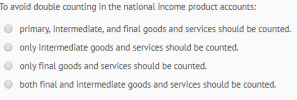 To avoid double counting in the national income product accounts: primary, intermediate, and final goods and services should be counted. only intermediate goods and services should be counted. only final goods and services should be counted. both final and intermediate goods and services should be counted.
10) Gross domestic product is A) the market value of all the final goods and services...
 10) Gross domestic product is A) the market value of all the final goods and services produced in a country during a given time period. B) the market value of all goods and services produced in a country during a given time period. C) the final value of all goods produced in a country in a given time period. D) the market value of all the intermediate goods and services produced in a country during a given time period. E)...
QUESTION 33 Which of the following is not a final good? ( ) a. A new...
QUESTION 33 Which of the following is not a final good? ( ) a. A new computer sold to a USC student. ( ) b. A new car sold to Avis for use in their fleet of rental cars. ( ) c. A purse sold to a foreign visitor. ( ) d. A hot dog sold to a spectator at a USC football game. 1 points [Save Answer] QUESTION 34 When calculating the compensation of employees component of GDP (...
Gross domestic product is - final market value of all goods and services by domestic producers...
Gross domestic product is - final market value of all goods and services by domestic producers both here and abroad - total market value of all final goods and services produced by resources in the U.S -TOTAL MARKET VALUE OF ALL GOODS AND SERVICES produced by resources in the U.S.
 a) Explain the difference between: (a) the demand for domestic goods; and (b) the domestic demand for goods. In your answer, write down equations which describe (a) and (b). b) Explain the determinants of (a) exports and (b) imports. Write an algebraic expression for each. c) Explain why the demand for domestic goods curve (ZZ) has a different slope than the domestic demand curve (DD). Explain what the difference between these two curves represents and why.
a) Explain the difference...
a) Explain the difference between: (a) the demand for domestic goods; and (b) the domestic demand for goods. In your answer, write down equations which describe (a) and (b). b) Explain the determinants of (a) exports and (b) imports. Write an algebraic expression for each. c) Explain why the demand for domestic goods curve (ZZ) has a different slope than the domestic demand curve (DD). Explain what the difference between these two curves represents and why.
a) Explain the difference...
 Question 22 (15 marks) (a) Explain the difference between the demand for domestic goods and the domestic demand for goods. Explain why the demand for domestic goods curve (ZZ) has a different shape from the domestic demand curve (DD). (6 marks)
 Question 22 (15 marks) (a) Explain the difference between the demand for domestic goods and the domestic demand for goods. Explain why the demand for domestic goods curve (ZZ) has a different shape from the domestic demand curve (DD). (6 marks) (b) Using the open economy goods market diagram, illustrate graphically and explain what effect a decrease in foreign output (Y*) will have on output, exports, imports, and net exports. Clearly label all curves and the initial and new equilibria....
 Is the value of intermediate goods and services produced during the year included in Gross Domestic Product (GDP)? For example, is aluminum used to produce a new mountain bike included in GDP? (Note that this question does not ask whether aluminum is directly counted in GDP but rather whether the production is included in GDP) O A. No. There is no value added in the production of aluminum. Therefore, production is not included in the value-added method of measuring GDP...
 I 1) Gross Domestic Product (GDP) is A) the total wholesale value of all final goods and services produced by factors of production owned by citizens of a nation B) the total market value of all services produced by factors of production located within a nation's borders. C) the total market value of all goods produced within a nation's borders D) the total market value of all final goods and services produced by factors of production located within a nation's...
 To avoid double counting in the national income product accounts: primary, intermediate, and final goods and services should be counted. only intermediate goods and services should be counted. only final goods and services should be counted. both final and intermediate goods and services should be counted.
 10) Gross domestic product is A) the market value of all the final goods and services produced in a country during a given time period. B) the market value of all goods and services produced in a country during a given time period. C) the final value of all goods produced in a country in a given time period. D) the market value of all the intermediate goods and services produced in a country during a given time period. E)...
Most questions answered within 3 hours.
-
Where is the error in this code sequence?
String s1 = "Hello";
String s2 = "ello";...
asked 11 months ago -
Financial data for Joel de Paris, Inc., for last year
follow:
Joel de Paris, Inc.
Balance...
asked 11 months ago -
Consider this reaction:
Al2(SO4)3 (aq)+ BaCl3
(aq) Al2Cl6 (aq)- +
3BaSO4(s) . What is the...
asked 11 months ago -
Suppose that Savneet is considering increasing her
recent random sample from 20 car rentals to 40...
asked 11 months ago -
Trucks arrive at an unloading terminal at an average rate of 120
per hour.
Trucks arrive...
asked 11 months ago -
Why are methanol and ethanol completely soluble in water while
octanol is not very little soluble....
asked 11 months ago -
A facilities manager at a university reads in a research report
that the mean amount of...
asked 11 months ago -
When the CuSO4 is rehydrated by adding water to the anhydrous
compound, is this an endothermic...
asked 11 months ago -
A ray of sunlight is passing from diamond into crown glass; the
angle of incidence is...
asked 11 months ago -
A block of mass 0.249 kg is placed on top of a light, vertical
spring of...
asked 11 months ago -
how do the kidneys compensate in the presences of acidosis
a) trigger hyperventilate
b) reserve acid...
asked 11 months ago -
Question 501 pts
The rental rate of capital to the firm increases. Which of the
following...
asked 11 months ago