![(2) For X,Y E U(H) show that (X, Y] E U(H), showing that u(H) is indeed an algebra with the multiplication given by the commu](http://img.homeworklib.com/questions/3a501000-6217-11eb-98c6-5bf944350fc1.png?x-oss-process=image/resize,w_560)
For a general Hilbert space, define the Unitary group U(H) := {U ∈ End(H) | |Uv| = |v| ∀|vi ∈ H}.
Homework Answers
Add Answer to:
For a general Hilbert space, define the Unitary group U(H) := {U
∈ End(H) | |Uv|...
Let H be a complex Hilbert space. 6. (a) Let φ, ψ E H \ {0} . Define the linear operator T on H by Using the Cauchy...
 Let H be a complex Hilbert space. 6. (a) Let φ, ψ E H \ {0} . Define the linear operator T on H by Using the Cauchy-Schwarz inequality, show that llll = Hell ll [4 marks] (b) A bounded linear operator A is said to have rank one if there exists v e H [0 such that for any u E H we have Au cu, where cu E C is a constant depending on u. (i) Show that...
Let H be a separable Hilbert space with basis {en}neN and define P2 as the orthogonal...
 Let H be a separable Hilbert space with basis {en}neN and define P2 as the orthogonal projection onto spanfe1,., e,}. Show that, for any T E B (H), the sequence PTP converges strongly to T HINT: A sequence of operators Tn E B (H) converges strongly to T if ||Th - Tnh|| converges to 0 Vh E H.
Let H be a separable Hilbert space with basis {en}neN and define P2 as the orthogonal projection onto spanfe1,., e,}. Show that,...
Let H be a separable Hilbert space with basis {en}neN and define P2 as the orthogonal projection onto spanfe1,., e,}. Show that, for any T E B (H), the sequence PTP converges strongly to T HINT: A sequence of operators Tn E B (H) converges strongly to T if ||Th - Tnh|| converges to 0 Vh E H.
Let H be a separable Hilbert space with basis {en}neN and define P2 as the orthogonal projection onto spanfe1,., e,}. Show that,...
Problem 3. (1) Let H be a Hilbert space and S, TE B(HH). Then, prove that...
 Problem 3. (1) Let H be a Hilbert space and S, TE B(HH). Then, prove that ||ST|| ||||||||| (2) Let X, Y be Hilbert spaces and Te B(X,Y). Then, prove that ||1||| sup ||T3|1 TEX=1 Let X, Y be Banach spaces. Definition (review) We denote by B(X, Y) a set of all bounded linear operators T:X + Y with D(T) = X. B(X, Y) is a vector space. Definition (review) A linear operator T:X + Y is said to be...
Let H be a separable Hilbert space with basis en]nen and define P as the orthogonal projection onto span(e,... ,en)...
 Let H be a separable Hilbert space with basis en]nen and define P as the orthogonal projection onto span(e,... ,en) (a) A sequence of operators T, E B(H) is said to converge strongly to T if |Th-Tnhl converges to 0 for all h EH (note that strong convergence is actually weaker than operator norm convergence-think of this as the difference between pointwise and uniform convergence). Show that, for any T E B(H), the sequence P,T Pn converges strongly to T....
b) 16 marks Assume that each set Vi, j = 1, 2, ...k, is a compact...
 b) 16 marks Assume that each set Vi, j = 1, 2, ...k, is a compact set in a metric space X. Prove that the (finite union) set V = V1 U V2 U... U Vk is a compact set. c) [7 marks] Let H be a Hilbert space with inner product < x, y > and the induced norm ||2|= << x, x >. (i) Show that ||* + y|l2 + ||* – y|l2 = 2(1|x1|2 + ||4||2) for...
Let (E,E, u) be a measure space. Let De E (a) Define (A) = u(AnD), A...
 Let (E,E, u) be a measure space. Let De E (a) Define (A) = u(AnD), A E E. Show that v is a measure on (E,E); it is called the trace of u on D. (b) Let D be the trace of E on D (see last homework). Define v(A) is a measure on (D, D); it is called the restriction of u to D (A) for A e D. Show that v
Let (E,E, u) be a measure space....
Let (E,E, u) be a measure space. Let De E (a) Define (A) = u(AnD), A E E. Show that v is a measure on (E,E); it is called the trace of u on D. (b) Let D be the trace of E on D (see last homework). Define v(A) is a measure on (D, D); it is called the restriction of u to D (A) for A e D. Show that v
Let (E,E, u) be a measure space....
(b) If y = uv, where u and v are functions of x, show that the...
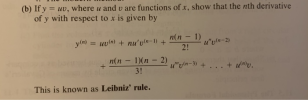 (b) If y = uv, where u and v are functions of x, show that the nth derivative of y with respect to x is given by nn - 1) yn) = uv(n) + nu'v(n-1) + - u"un-2) 2! non - 1)(n-2)...",(n-3) + + umu. 31 This is known as Leibniz' rule.
in this problem I have a problem understanding the exact steps, can they be solved and...
 in this problem I have a problem understanding the
exact steps, can they be solved and simplified in a clearer and
smoother wayTo understand it .
Q/ How can I prove (in detailes) that the following examples match their definitions mentioned with each of them? 1. Definition 1.4[42]: (G-algebra) Let X be a nonempty set. Then, a family A of subsets of X is called a o-algebra if (1) XE 4. (2) if A € A, then A = X...
in this problem I have a problem understanding the
exact steps, can they be solved and simplified in a clearer and
smoother wayTo understand it .
Q/ How can I prove (in detailes) that the following examples match their definitions mentioned with each of them? 1. Definition 1.4[42]: (G-algebra) Let X be a nonempty set. Then, a family A of subsets of X is called a o-algebra if (1) XE 4. (2) if A € A, then A = X...
I need a quick solution please :( 1 points Save Answer Let U, VER. Define addition...
 I need a quick solution please :(
1 points Save Answer Let U, VER. Define addition and scalar multiplication on u =(x.y), v = (4.b) by u + v = (x+0.y+b), ku =(ky,box). Then V =R? with the defined addition and scalar multiplication, fails to be a vector space as A. It is not closed under scalar multiplication BU+V V+U c. 1uu D. There is no element, such that U+0=0+ U
I need a quick solution please :(
1 points Save Answer Let U, VER. Define addition and scalar multiplication on u =(x.y), v = (4.b) by u + v = (x+0.y+b), ku =(ky,box). Then V =R? with the defined addition and scalar multiplication, fails to be a vector space as A. It is not closed under scalar multiplication BU+V V+U c. 1uu D. There is no element, such that U+0=0+ U
Show that the skyscraper sheaf is indeed a sheaf: Let X be a topological space, pE...
 Show that the skyscraper sheaf is indeed a sheaf:
Let X be a topological space, pE Xa point, UcXan open subset covered by UieIUi, and S a set (or an abelian group). I'm trying to show that the skyscraper sheaf iS given by if pE U {e} ipS(U) else is indeed a sheaf.
Let X be a topological space, pE Xa point, UcXan open subset covered by UieIUi, and S a set (or an abelian group). I'm trying to show...
Show that the skyscraper sheaf is indeed a sheaf:
Let X be a topological space, pE Xa point, UcXan open subset covered by UieIUi, and S a set (or an abelian group). I'm trying to show that the skyscraper sheaf iS given by if pE U {e} ipS(U) else is indeed a sheaf.
Let X be a topological space, pE Xa point, UcXan open subset covered by UieIUi, and S a set (or an abelian group). I'm trying to show...
 Let H be a complex Hilbert space. 6. (a) Let φ, ψ E H \ {0} . Define the linear operator T on H by Using the Cauchy-Schwarz inequality, show that llll = Hell ll [4 marks] (b) A bounded linear operator A is said to have rank one if there exists v e H [0 such that for any u E H we have Au cu, where cu E C is a constant depending on u. (i) Show that...
 Let H be a separable Hilbert space with basis {en}neN and define P2 as the orthogonal projection onto spanfe1,., e,}. Show that, for any T E B (H), the sequence PTP converges strongly to T HINT: A sequence of operators Tn E B (H) converges strongly to T if ||Th - Tnh|| converges to 0 Vh E H.
Let H be a separable Hilbert space with basis {en}neN and define P2 as the orthogonal projection onto spanfe1,., e,}. Show that,...
Let H be a separable Hilbert space with basis {en}neN and define P2 as the orthogonal projection onto spanfe1,., e,}. Show that, for any T E B (H), the sequence PTP converges strongly to T HINT: A sequence of operators Tn E B (H) converges strongly to T if ||Th - Tnh|| converges to 0 Vh E H.
Let H be a separable Hilbert space with basis {en}neN and define P2 as the orthogonal projection onto spanfe1,., e,}. Show that,...
 Problem 3. (1) Let H be a Hilbert space and S, TE B(HH). Then, prove that ||ST|| ||||||||| (2) Let X, Y be Hilbert spaces and Te B(X,Y). Then, prove that ||1||| sup ||T3|1 TEX=1 Let X, Y be Banach spaces. Definition (review) We denote by B(X, Y) a set of all bounded linear operators T:X + Y with D(T) = X. B(X, Y) is a vector space. Definition (review) A linear operator T:X + Y is said to be...
 Let H be a separable Hilbert space with basis en]nen and define P as the orthogonal projection onto span(e,... ,en) (a) A sequence of operators T, E B(H) is said to converge strongly to T if |Th-Tnhl converges to 0 for all h EH (note that strong convergence is actually weaker than operator norm convergence-think of this as the difference between pointwise and uniform convergence). Show that, for any T E B(H), the sequence P,T Pn converges strongly to T....
 b) 16 marks Assume that each set Vi, j = 1, 2, ...k, is a compact set in a metric space X. Prove that the (finite union) set V = V1 U V2 U... U Vk is a compact set. c) [7 marks] Let H be a Hilbert space with inner product < x, y > and the induced norm ||2|= << x, x >. (i) Show that ||* + y|l2 + ||* – y|l2 = 2(1|x1|2 + ||4||2) for...
 Let (E,E, u) be a measure space. Let De E (a) Define (A) = u(AnD), A E E. Show that v is a measure on (E,E); it is called the trace of u on D. (b) Let D be the trace of E on D (see last homework). Define v(A) is a measure on (D, D); it is called the restriction of u to D (A) for A e D. Show that v
Let (E,E, u) be a measure space....
Let (E,E, u) be a measure space. Let De E (a) Define (A) = u(AnD), A E E. Show that v is a measure on (E,E); it is called the trace of u on D. (b) Let D be the trace of E on D (see last homework). Define v(A) is a measure on (D, D); it is called the restriction of u to D (A) for A e D. Show that v
Let (E,E, u) be a measure space....
 (b) If y = uv, where u and v are functions of x, show that the nth derivative of y with respect to x is given by nn - 1) yn) = uv(n) + nu'v(n-1) + - u"un-2) 2! non - 1)(n-2)...",(n-3) + + umu. 31 This is known as Leibniz' rule.
 in this problem I have a problem understanding the
exact steps, can they be solved and simplified in a clearer and
smoother wayTo understand it .
Q/ How can I prove (in detailes) that the following examples match their definitions mentioned with each of them? 1. Definition 1.4[42]: (G-algebra) Let X be a nonempty set. Then, a family A of subsets of X is called a o-algebra if (1) XE 4. (2) if A € A, then A = X...
in this problem I have a problem understanding the
exact steps, can they be solved and simplified in a clearer and
smoother wayTo understand it .
Q/ How can I prove (in detailes) that the following examples match their definitions mentioned with each of them? 1. Definition 1.4[42]: (G-algebra) Let X be a nonempty set. Then, a family A of subsets of X is called a o-algebra if (1) XE 4. (2) if A € A, then A = X...
 I need a quick solution please :(
1 points Save Answer Let U, VER. Define addition and scalar multiplication on u =(x.y), v = (4.b) by u + v = (x+0.y+b), ku =(ky,box). Then V =R? with the defined addition and scalar multiplication, fails to be a vector space as A. It is not closed under scalar multiplication BU+V V+U c. 1uu D. There is no element, such that U+0=0+ U
I need a quick solution please :(
1 points Save Answer Let U, VER. Define addition and scalar multiplication on u =(x.y), v = (4.b) by u + v = (x+0.y+b), ku =(ky,box). Then V =R? with the defined addition and scalar multiplication, fails to be a vector space as A. It is not closed under scalar multiplication BU+V V+U c. 1uu D. There is no element, such that U+0=0+ U
 Show that the skyscraper sheaf is indeed a sheaf:
Let X be a topological space, pE Xa point, UcXan open subset covered by UieIUi, and S a set (or an abelian group). I'm trying to show that the skyscraper sheaf iS given by if pE U {e} ipS(U) else is indeed a sheaf.
Let X be a topological space, pE Xa point, UcXan open subset covered by UieIUi, and S a set (or an abelian group). I'm trying to show...
Show that the skyscraper sheaf is indeed a sheaf:
Let X be a topological space, pE Xa point, UcXan open subset covered by UieIUi, and S a set (or an abelian group). I'm trying to show that the skyscraper sheaf iS given by if pE U {e} ipS(U) else is indeed a sheaf.
Let X be a topological space, pE Xa point, UcXan open subset covered by UieIUi, and S a set (or an abelian group). I'm trying to show...
Most questions answered within 3 hours.
-
Where is the error in this code sequence?
String s1 = "Hello";
String s2 = "ello";...
asked 10 months ago -
Financial data for Joel de Paris, Inc., for last year
follow:
Joel de Paris, Inc.
Balance...
asked 10 months ago -
Consider this reaction:
Al2(SO4)3 (aq)+ BaCl3
(aq) Al2Cl6 (aq)- +
3BaSO4(s) . What is the...
asked 10 months ago -
Suppose that Savneet is considering increasing her
recent random sample from 20 car rentals to 40...
asked 10 months ago -
Trucks arrive at an unloading terminal at an average rate of 120
per hour.
Trucks arrive...
asked 10 months ago -
Why are methanol and ethanol completely soluble in water while
octanol is not very little soluble....
asked 10 months ago -
A facilities manager at a university reads in a research report
that the mean amount of...
asked 10 months ago -
When the CuSO4 is rehydrated by adding water to the anhydrous
compound, is this an endothermic...
asked 10 months ago -
A ray of sunlight is passing from diamond into crown glass; the
angle of incidence is...
asked 10 months ago -
A block of mass 0.249 kg is placed on top of a light, vertical
spring of...
asked 10 months ago -
how do the kidneys compensate in the presences of acidosis
a) trigger hyperventilate
b) reserve acid...
asked 10 months ago -
Question 501 pts
The rental rate of capital to the firm increases. Which of the
following...
asked 10 months ago