solve for x: 1+2sinx=0 Domain[-pi,pi]
Homework Answers
![Salution - ceis on 1+2 Sinx =0, nefn] Implenes sinx= -1 og Sina=- sinh v Sinn = 1) or Sinx = sin( I) 0 (Because Sint-O) =-Sin](http://img.homeworklib.com/questions/337bc560-628a-11eb-a09e-8fe2b17eb765.png?x-oss-process=image/resize,w_560)
![For n=2, we have from @ = 27 + (-1)^(-7) = 27-I = 115 & [-7, 7] Hence 1+2 sinx=0, RE[-n, T] 57. The Completres 6 the Salution](http://img.homeworklib.com/questions/344a26d0-628a-11eb-a1aa-9d0d4d111f13.png?x-oss-process=image/resize,w_560)
Solve the wave equation on the domain 0 < x < , t > 0 ?...
 Solve the wave equation on the domain 0 < x < , t > 0 ? uxx Utt = with the boundary condition u (0, t) = 0 and the initial conditions u (x,0) = x2 u (x,0) = x
4. Solve for x, 0 SX < 360° a) 2 sinx + 3 = 0 b)...
 4. Solve for x, 0 SX < 360° a) 2 sinx + 3 = 0 b) 7cosx + 2 = 0 c) 2sinx - sinx = 0 d) 2cos2x - cosx - 1 = 0
3. 2sinx- COSI-1=0 find all solutions, in radians 4. sin(2x) + V3 cos x = 0...
 3. 2sinx- COSI-1=0 find all solutions, in radians 4. sin(2x) + V3 cos x = 0 find values 0 SX S2
The solution of y" + y = 2sinx + 3cos x + 1
The solution of y" + y = 2sinx + 3cos x + 1
Solve e^x dy/dx = x sec (y) y (0) = pi
Solve e^x dy/dx = x sec (y) y (0) = pi
Let f(x)=2sinx/2sinx+4cosx. Then f′(x)= . The equation of the tangent line to y=f(x) at a=π/2 can...
Let f(x)=2sinx/2sinx+4cosx. Then f′(x)= . The equation of the tangent line to y=f(x) at a=π/2 can be written in the form y=mx+b where m= b=
7.17 (a) Solve the equation u, 2u, in the domain 0< x<T, t>0 under the initial...
 7.17 (a) Solve the equation u, 2u, in the domain 0< x<T, t>0 under the initial boundary value conditions u(0,t)= u(r, t) 0, u(x, 0) = f(x) = x(x2 -n2). (b) Use the maximum principle to prove that the solution in (a) is a classical solution. 7.18 Prove that the formulas (7.72)-(7.75) describe solutions of (7.70)-(7.71) that are
7.17 (a) Solve the equation u, 2u, in the domain 0
7.17 (a) Solve the equation u, 2u, in the domain 0< x<T, t>0 under the initial boundary value conditions u(0,t)= u(r, t) 0, u(x, 0) = f(x) = x(x2 -n2). (b) Use the maximum principle to prove that the solution in (a) is a classical solution. 7.18 Prove that the formulas (7.72)-(7.75) describe solutions of (7.70)-(7.71) that are
7.17 (a) Solve the equation u, 2u, in the domain 0
Solve the IBVP wave equation. d^2/dt^2=16d^2/dx^2 0<x<pi u(x,0)=sinx du(x,0)/dt=0 u(0,t)=u(pi,t) =0 t>0
Solve the IBVP wave equation. d^2/dt^2=16d^2/dx^2 0<x<pi u(x,0)=sinx du(x,0)/dt=0 u(0,t)=u(pi,t) =0 t>0
Solve this initial value problem a) 1/2 dy/dx = rad(y+1) cos x, y(pi)=0
Solve this initial value problem a) 1/2 dy/dx = rad(y+1) cos x, y(pi)=0
1. Solve for x in the following problems. If an answer is not in the domain...
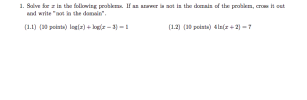 1. Solve for x in the following problems. If an answer is not in the domain of the problem, cross it out and write "not in the domain (1.1) (10 points) log(x) + log(x -3) 1 (1.2) (10 points) 4ln(x +2) 7
 Solve the wave equation on the domain 0 < x < , t > 0 ? uxx Utt = with the boundary condition u (0, t) = 0 and the initial conditions u (x,0) = x2 u (x,0) = x
 4. Solve for x, 0 SX < 360° a) 2 sinx + 3 = 0 b) 7cosx + 2 = 0 c) 2sinx - sinx = 0 d) 2cos2x - cosx - 1 = 0
 3. 2sinx- COSI-1=0 find all solutions, in radians 4. sin(2x) + V3 cos x = 0 find values 0 SX S2
 7.17 (a) Solve the equation u, 2u, in the domain 0< x<T, t>0 under the initial boundary value conditions u(0,t)= u(r, t) 0, u(x, 0) = f(x) = x(x2 -n2). (b) Use the maximum principle to prove that the solution in (a) is a classical solution. 7.18 Prove that the formulas (7.72)-(7.75) describe solutions of (7.70)-(7.71) that are
7.17 (a) Solve the equation u, 2u, in the domain 0
7.17 (a) Solve the equation u, 2u, in the domain 0< x<T, t>0 under the initial boundary value conditions u(0,t)= u(r, t) 0, u(x, 0) = f(x) = x(x2 -n2). (b) Use the maximum principle to prove that the solution in (a) is a classical solution. 7.18 Prove that the formulas (7.72)-(7.75) describe solutions of (7.70)-(7.71) that are
7.17 (a) Solve the equation u, 2u, in the domain 0
 1. Solve for x in the following problems. If an answer is not in the domain of the problem, cross it out and write "not in the domain (1.1) (10 points) log(x) + log(x -3) 1 (1.2) (10 points) 4ln(x +2) 7
Most questions answered within 3 hours.
-
Where is the error in this code sequence?
String s1 = "Hello";
String s2 = "ello";...
asked 10 months ago -
Financial data for Joel de Paris, Inc., for last year
follow:
Joel de Paris, Inc.
Balance...
asked 10 months ago -
Consider this reaction:
Al2(SO4)3 (aq)+ BaCl3
(aq) Al2Cl6 (aq)- +
3BaSO4(s) . What is the...
asked 10 months ago -
Suppose that Savneet is considering increasing her
recent random sample from 20 car rentals to 40...
asked 10 months ago -
Trucks arrive at an unloading terminal at an average rate of 120
per hour.
Trucks arrive...
asked 10 months ago -
Why are methanol and ethanol completely soluble in water while
octanol is not very little soluble....
asked 10 months ago -
A facilities manager at a university reads in a research report
that the mean amount of...
asked 10 months ago -
When the CuSO4 is rehydrated by adding water to the anhydrous
compound, is this an endothermic...
asked 10 months ago -
A ray of sunlight is passing from diamond into crown glass; the
angle of incidence is...
asked 10 months ago -
A block of mass 0.249 kg is placed on top of a light, vertical
spring of...
asked 10 months ago -
how do the kidneys compensate in the presences of acidosis
a) trigger hyperventilate
b) reserve acid...
asked 10 months ago -
Question 501 pts
The rental rate of capital to the firm increases. Which of the
following...
asked 10 months ago