
Homework Answers
increase in oxidation number - oxidation
decrease in oxidation number - reduction
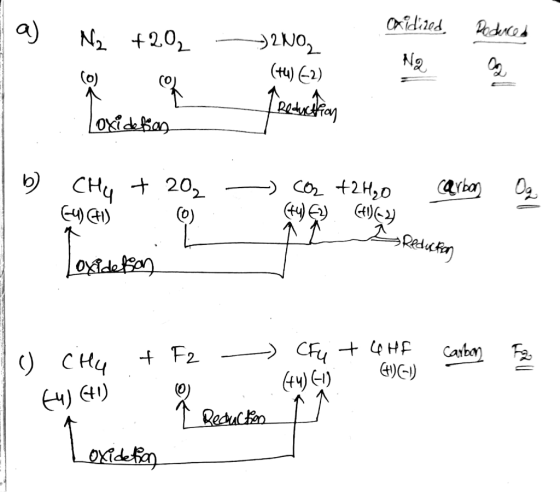
Add Answer to:
Problem 2: Below are several chemical equations. For each equation, identify which atoms are oxidized and...
for the following reaction: CH4+2O2--->CO2+2H20 a) identify the elements oxidized and reduced b) indicate the oxidation...
 for the following reaction: CH4+2O2--->CO2+2H20
a) identify the elements oxidized and reduced
b) indicate the oxidation numbers for these elements on both
sides of the equation
8. For the following reaction: (6 points) CH4 + 202 CO2 + 2H2O a) Identify the elements oxidized and reduced. b) Indicate the oxidation numbers for these elements on both sides of the equation. is the element oxidized from oxidation No. to oxidation No. is the element reduced from oxidation No. to oxidation No.
for the following reaction: CH4+2O2--->CO2+2H20
a) identify the elements oxidized and reduced
b) indicate the oxidation numbers for these elements on both
sides of the equation
8. For the following reaction: (6 points) CH4 + 202 CO2 + 2H2O a) Identify the elements oxidized and reduced. b) Indicate the oxidation numbers for these elements on both sides of the equation. is the element oxidized from oxidation No. to oxidation No. is the element reduced from oxidation No. to oxidation No.
2. Assign the oxidation state for all atoms in the reaction below and indicate which substance(s)...
 2. Assign the oxidation state for all atoms in the reaction below and indicate which substance(s) is/are oxidized and which is/are reduced? 3 NO2- + Cr2O72- + 8 H → 2 Cr3+ + 3 NO3 + 4H20
For each chemical reaction listed in the table below, decide whether the highlighted atom is being...
For each chemical reaction listed in the table below, decide whether the highlighted atom is being oxidized, reduced, or none. 1.) N2(g) +3H2(g)= 2NH3(g) 2.) 2Cl-(aq) +2H2O(l)= 2OH-(aq) +H2(g) +Cl2(g) 3.) H2S(aq) + 2NaOH(aq)= Na2S(aq) + 2H2O(l) 4.) CH4(g) +2H2O(g)= 4H2(g) + CO2(g)
For each chemical reaction listed in the table below, decide whether the highlighted atom is being...
 For each chemical reaction listed in the table below, decide whether the highlighted atom is being oxidized or reduced highlighted atom is being... reaction neither oxidized reduced oxidized nor alo reduced 41 IF() + SiO2(s) → SiF4(g)+ 2 H 20(9) Cu SO 4(aq) + Zn(s) → ZnSO4(aq)+ Cu(s) CH4(g)+ H2O(g) → CO(g) +3 H2(g) 2 H 2(g)+02(g) → 2 H2O(g) Ar
For each chemical reaction listed in the table below, decide whether the highlighted atom is being...
 For each chemical reaction listed in the table below, decide whether the highlighted atom is being oxidized or reduced. highlighted atom is being... reaction neither oxidized reduced oxidized nor reduced 4KI()+ 2 CuCl2)- 2 Culs)2a)+4 KCl (aa) (s)+02(9)-CO2(9) 2H20+02(9) 2H20() NH 3(aq)+ 202(g) HNO3(aq)+ H2O(η
For each reaction below, identify which reactant is oxidized and which is reduced. a) 2 Fe3+...
 For each reaction below, identify which reactant is oxidized and which is reduced. a) 2 Fe3+ (aq) + 3 Ni (s) - 2 Fe (s) + 3 Ni2+ (aq) b) CH4 (9) + 2 O2 (g) - CO2 (g) + 2 H20 (9)
For each reaction below, identify the atom oxidized, the atom reduced, the oxidizing agent, the reducing...
 For each reaction below, identify the atom oxidized, the atom
reduced, the oxidizing agent, the reducing agent, the oxidation
half reaction, the reduction half reaction, and then balance the
equation by the method of oxidation-reduction showing all electrons
transfers.
KMnO4 NaClH2SO4 à Cl2 K2SO4 MnSO4 H20 Na2SO4 5. Cr2O3 6. K2CR2O7 H20 + S à SO2 + KOH KCIO3 C12H22011 à KCI + H20 + CO2 7 H2C204+K2MnO4 à CO2 K20 Mn203 H20 8. 9. Mn(NO3) 2 NaBiO3 HNO3 à...
For each reaction below, identify the atom oxidized, the atom
reduced, the oxidizing agent, the reducing agent, the oxidation
half reaction, the reduction half reaction, and then balance the
equation by the method of oxidation-reduction showing all electrons
transfers.
KMnO4 NaClH2SO4 à Cl2 K2SO4 MnSO4 H20 Na2SO4 5. Cr2O3 6. K2CR2O7 H20 + S à SO2 + KOH KCIO3 C12H22011 à KCI + H20 + CO2 7 H2C204+K2MnO4 à CO2 K20 Mn203 H20 8. 9. Mn(NO3) 2 NaBiO3 HNO3 à...
For each reaction below, identify the atom oxidized, the atom reduced, the oxidizing agent, the reducing...
 For each reaction below, identify the atom oxidized, the atom reduced, the oxidizing agent, the reducing agent, the oxidation half reaction, the reduction half reaction, and Then balance the equation by the method of reactions. All are in acid 1. Mg +H" Mg + H2 2. MnO + Cl + Cl2 + Mn? 3. MnOr+NO; Mn? + NO; 4. CIO; + C12H2O1 Cl' + CO2
Below is a set of redox reactions. Assign oxidation numbers below each atom. Also determine the...
Below is a set of redox reactions. Assign oxidation numbers below each atom. Also determine the substance that is reduced, the substance that is oxidized, the oxidizing agent, and the reducing agent. (Note: Don’t worry about the stoichiometric coefficients; they don’t affect your calculation of oxidation states.) Atom/s that is/are reduced: Atom/s that is/are oxidized: Reducing agent: Oxidizing agent: Reactions Given: 2 C2H6(g) + 7 O2(g) → 4 CO2(g) + 6 H2O(g) C2H4(g) + 3O2(g) → 2 CO2(g) + 2...
QUESTION 10 Which is NOT an oxidation reduction equation? Edit: This question was inadvertently difficult. It's...
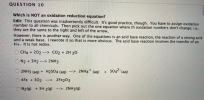 QUESTION 10 Which is NOT an oxidation reduction equation? Edit: This question was inadvertently difficult. It's good practice, though. You have to assign oxidation number to all chemicals. Then pick out the one equation where th oxidation numbers don't change; i.e., they are the same to the right and left of the arrow.. However, there is another way. One of the equations is an acid base reaction, the reaction of a strong acid and a weak base. I rewrote it...
 for the following reaction: CH4+2O2--->CO2+2H20
a) identify the elements oxidized and reduced
b) indicate the oxidation numbers for these elements on both
sides of the equation
8. For the following reaction: (6 points) CH4 + 202 CO2 + 2H2O a) Identify the elements oxidized and reduced. b) Indicate the oxidation numbers for these elements on both sides of the equation. is the element oxidized from oxidation No. to oxidation No. is the element reduced from oxidation No. to oxidation No.
for the following reaction: CH4+2O2--->CO2+2H20
a) identify the elements oxidized and reduced
b) indicate the oxidation numbers for these elements on both
sides of the equation
8. For the following reaction: (6 points) CH4 + 202 CO2 + 2H2O a) Identify the elements oxidized and reduced. b) Indicate the oxidation numbers for these elements on both sides of the equation. is the element oxidized from oxidation No. to oxidation No. is the element reduced from oxidation No. to oxidation No.
 2. Assign the oxidation state for all atoms in the reaction below and indicate which substance(s) is/are oxidized and which is/are reduced? 3 NO2- + Cr2O72- + 8 H → 2 Cr3+ + 3 NO3 + 4H20
 For each chemical reaction listed in the table below, decide whether the highlighted atom is being oxidized or reduced highlighted atom is being... reaction neither oxidized reduced oxidized nor alo reduced 41 IF() + SiO2(s) → SiF4(g)+ 2 H 20(9) Cu SO 4(aq) + Zn(s) → ZnSO4(aq)+ Cu(s) CH4(g)+ H2O(g) → CO(g) +3 H2(g) 2 H 2(g)+02(g) → 2 H2O(g) Ar
 For each chemical reaction listed in the table below, decide whether the highlighted atom is being oxidized or reduced. highlighted atom is being... reaction neither oxidized reduced oxidized nor reduced 4KI()+ 2 CuCl2)- 2 Culs)2a)+4 KCl (aa) (s)+02(9)-CO2(9) 2H20+02(9) 2H20() NH 3(aq)+ 202(g) HNO3(aq)+ H2O(η
 For each reaction below, identify which reactant is oxidized and which is reduced. a) 2 Fe3+ (aq) + 3 Ni (s) - 2 Fe (s) + 3 Ni2+ (aq) b) CH4 (9) + 2 O2 (g) - CO2 (g) + 2 H20 (9)
 For each reaction below, identify the atom oxidized, the atom
reduced, the oxidizing agent, the reducing agent, the oxidation
half reaction, the reduction half reaction, and then balance the
equation by the method of oxidation-reduction showing all electrons
transfers.
KMnO4 NaClH2SO4 à Cl2 K2SO4 MnSO4 H20 Na2SO4 5. Cr2O3 6. K2CR2O7 H20 + S à SO2 + KOH KCIO3 C12H22011 à KCI + H20 + CO2 7 H2C204+K2MnO4 à CO2 K20 Mn203 H20 8. 9. Mn(NO3) 2 NaBiO3 HNO3 à...
For each reaction below, identify the atom oxidized, the atom
reduced, the oxidizing agent, the reducing agent, the oxidation
half reaction, the reduction half reaction, and then balance the
equation by the method of oxidation-reduction showing all electrons
transfers.
KMnO4 NaClH2SO4 à Cl2 K2SO4 MnSO4 H20 Na2SO4 5. Cr2O3 6. K2CR2O7 H20 + S à SO2 + KOH KCIO3 C12H22011 à KCI + H20 + CO2 7 H2C204+K2MnO4 à CO2 K20 Mn203 H20 8. 9. Mn(NO3) 2 NaBiO3 HNO3 à...
 For each reaction below, identify the atom oxidized, the atom reduced, the oxidizing agent, the reducing agent, the oxidation half reaction, the reduction half reaction, and Then balance the equation by the method of reactions. All are in acid 1. Mg +H" Mg + H2 2. MnO + Cl + Cl2 + Mn? 3. MnOr+NO; Mn? + NO; 4. CIO; + C12H2O1 Cl' + CO2
 QUESTION 10 Which is NOT an oxidation reduction equation? Edit: This question was inadvertently difficult. It's good practice, though. You have to assign oxidation number to all chemicals. Then pick out the one equation where th oxidation numbers don't change; i.e., they are the same to the right and left of the arrow.. However, there is another way. One of the equations is an acid base reaction, the reaction of a strong acid and a weak base. I rewrote it...
Most questions answered within 3 hours.
-
Where is the error in this code sequence?
String s1 = "Hello";
String s2 = "ello";...
asked 1 year ago -
Financial data for Joel de Paris, Inc., for last year
follow:
Joel de Paris, Inc.
Balance...
asked 1 year ago -
Consider this reaction:
Al2(SO4)3 (aq)+ BaCl3
(aq) Al2Cl6 (aq)- +
3BaSO4(s) . What is the...
asked 1 year ago -
Suppose that Savneet is considering increasing her
recent random sample from 20 car rentals to 40...
asked 1 year ago -
Trucks arrive at an unloading terminal at an average rate of 120
per hour.
Trucks arrive...
asked 1 year ago -
Why are methanol and ethanol completely soluble in water while
octanol is not very little soluble....
asked 1 year ago -
A facilities manager at a university reads in a research report
that the mean amount of...
asked 1 year ago -
When the CuSO4 is rehydrated by adding water to the anhydrous
compound, is this an endothermic...
asked 1 year ago -
A ray of sunlight is passing from diamond into crown glass; the
angle of incidence is...
asked 1 year ago -
A block of mass 0.249 kg is placed on top of a light, vertical
spring of...
asked 1 year ago -
how do the kidneys compensate in the presences of acidosis
a) trigger hyperventilate
b) reserve acid...
asked 1 year ago -
Question 501 pts
The rental rate of capital to the firm increases. Which of the
following...
asked 1 year ago