
Homework Answers
Screenshot
 Program
.text
.globl main
main:
#parameter1 value
addi $t0,$0,2
#parameter2 value
addi $t1,$0,3
#call function
jal CalcFunc
#End of the program
addi $v0,$0,10
syscall
#Function implementation
CalcFunc:
#aVal*40
mul $t0,$t0,40
#bVal+(aVal*40)
add $t2,$t1,$t0
#retur from function
jr $ra
Add Answer to:
please help
Convert the C to assembly. Assume first parameter is in $to, second parameter is...
Convert the following C/C++ fragment into equivalent MIPS assembly language. Assume that the variables a, b,...
Convert the following C/C++ fragment into equivalent MIPS assembly language. Assume that the variables a, b, c, d, i and x are assigned to registers $t1, $t2, $t3, $t4, $s0 and $s1 respectively. if ((a<b && (c == 0) d = 1;
Convert the following C fragment to equivalent MIPS assembly language. Assume that the variables a, b,...
Convert the following C fragment to equivalent MIPS assembly language. Assume that the variables a, b, c, d, i and x are assigened to registers $t1, $t2, $t3, $t4, $s0 and $s1 respectively. Assume that the base address of the array A and B is in register $a0 and $a1 respectively. if (a > 0) b = a + 10; else b = a - 10;
2.4 For the MIPS assembly instructions below, what is the corresponding C statement? Assume that the...
2.4 For the MIPS assembly instructions below, what is the corresponding C statement? Assume that the variables f, g, h, i, and j are assigned to registers $s0, $s1, $s2, $s3, and $s4, respectively. Assume that the base address of the arrays A and B are in registers $s6 and $s7, respectively. sll $t0, $s0, 2 # $t0 = f * 4 add $t0, $s6, $t0 # $t0 = &A[f] sll $t1, $s1, 2 # $t1 =...
1. For the MIPS assembly instructions below, what is the corresponding C statement? max: lw &
1. For the MIPS assembly instructions below, what is the corresponding C statement? max: lw $t0, 0($a0) #load the first array value into $t0 addi $t1, $0, 1 #intialize the counter to one loop: beq $t1, $a1, exit #exit if we reach the end of the array addi $a0, $a0, 4 #increment the pointer by one word addi $t1, $t1, 1 #increment the loop counter lw $t2, 0($a0) #store the next array value into $t2 slt $t3, $t0, $t2 beq ...
1. Modify larger.s to let the user to enter three numbers and output the largest value...
1. Modify larger.s to let the user to enter three numbers and output the largest value # larger.s-- prints the larger of two numbers specified # at runtime by the user. # Registers used: # $t0 - used to hold the first number. # $t1 - used to hold the second number. # $t2 - used to store the larger of $t1 and $t2. # $v0 - syscall parameter and return value. # $a0 - syscall parameter. .text main: ##...
I AM POSTING MY QUESTION 3RD TIME . FIRST TWO TIMES I DIDNOT GET THE PROPER...
I AM POSTING MY QUESTION 3RD TIME . FIRST TWO TIMES I DIDNOT GET THE PROPER ANSWER. PLEASE DO ALL STEPS BY LABELING THE EACH STEP. THIS IS THE ASSIGNMENT IN WHICH THE EACH STEP SHOULD BE LABEL . I MEAN EVERY THING SHOULD BE WRITTEN WHAT WE HAVE DONE IN OUR PROGRAM THIS IS THE REQUIREMENT OF TEACHER , PLEASE DO IT PROPERLY 1) MIPS to C. Assume that the variables f, g, h, i, and j are assigned...
Please answer the following questions involving MIPS assembly code: A) For the C statement below, what...
Please answer the following questions involving MIPS assembly code: A) For the C statement below, what is the corresponding MIPS assembly code? Assume f, g are stored in S1 and S2. f = g + (-f -5) B) For the C statement below, what is the corresponding MIPS assembly code? Assume i and j are assigned in registers S1 and S2 respectively and base of address of arrays A and B are in registers S6 and S7. B[8] = A[i...
Please help me to answer those three questions. 15. A third degree polynomial equation (a cubic...
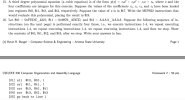 Please help me to answer those
three questions.
15. A third degree polynomial equation (a cubic equation) is of the form p(a) caz chac Co, where r and the into registers $t0, $t1, St2, and St3, respectively. Suppose the value of z is in $17. Write the MIPS32 instructions that would evaluate this polynomial, placing the result in St9. 16. Let $to 0xFEDC 4321, $t1 0x9876 ABCD, and St2 AAAA AAAA. Suppose the following sequence of in structions (on the...
Please help me to answer those
three questions.
15. A third degree polynomial equation (a cubic equation) is of the form p(a) caz chac Co, where r and the into registers $t0, $t1, St2, and St3, respectively. Suppose the value of z is in $17. Write the MIPS32 instructions that would evaluate this polynomial, placing the result in St9. 16. Let $to 0xFEDC 4321, $t1 0x9876 ABCD, and St2 AAAA AAAA. Suppose the following sequence of in structions (on the...
1. (15 pts) For the following C statement, what is the corresponding MIPS assembly code? Assume...
 1. (15 pts) For the following C statement, what is the corresponding MIPS assembly code? Assume f, g, h correspond to $80, $s1, and $s2, respectively. f=g+(h-5) 2. (15 pts) For the following pseudo-MIPS assembly instructions, what is the corresponding C code? add f, g, h add f,i, f 3. (30 pts) Provide the instruction type, assembly language instruction, and binary representation of the instruction described by the following MIPS fields: a. op = 0, rs = 18, rt=9, rd...
The relative time ratings of exercises are shown in square brackets after each exercise number. On average, an exercise...
 The relative time ratings of exercises are shown in square brackets after each exercise number. On average, an exercise rated [10] will take you twice as long as one rated [5]. Sections of the text that should be read before attempting an exercise will be given in angled brackets; for example, <1.3> means you should have read Section 1.3, Under the Covers, to help you solve this exercise. 2.1 [5] For the following C statement, what is the corresponding MIPS...
 Please help me to answer those
three questions.
15. A third degree polynomial equation (a cubic equation) is of the form p(a) caz chac Co, where r and the into registers $t0, $t1, St2, and St3, respectively. Suppose the value of z is in $17. Write the MIPS32 instructions that would evaluate this polynomial, placing the result in St9. 16. Let $to 0xFEDC 4321, $t1 0x9876 ABCD, and St2 AAAA AAAA. Suppose the following sequence of in structions (on the...
Please help me to answer those
three questions.
15. A third degree polynomial equation (a cubic equation) is of the form p(a) caz chac Co, where r and the into registers $t0, $t1, St2, and St3, respectively. Suppose the value of z is in $17. Write the MIPS32 instructions that would evaluate this polynomial, placing the result in St9. 16. Let $to 0xFEDC 4321, $t1 0x9876 ABCD, and St2 AAAA AAAA. Suppose the following sequence of in structions (on the...
 1. (15 pts) For the following C statement, what is the corresponding MIPS assembly code? Assume f, g, h correspond to $80, $s1, and $s2, respectively. f=g+(h-5) 2. (15 pts) For the following pseudo-MIPS assembly instructions, what is the corresponding C code? add f, g, h add f,i, f 3. (30 pts) Provide the instruction type, assembly language instruction, and binary representation of the instruction described by the following MIPS fields: a. op = 0, rs = 18, rt=9, rd...
 The relative time ratings of exercises are shown in square brackets after each exercise number. On average, an exercise rated [10] will take you twice as long as one rated [5]. Sections of the text that should be read before attempting an exercise will be given in angled brackets; for example, <1.3> means you should have read Section 1.3, Under the Covers, to help you solve this exercise. 2.1 [5] For the following C statement, what is the corresponding MIPS...
Most questions answered within 3 hours.
-
Where is the error in this code sequence?
String s1 = "Hello";
String s2 = "ello";...
asked 10 months ago -
Financial data for Joel de Paris, Inc., for last year
follow:
Joel de Paris, Inc.
Balance...
asked 10 months ago -
Consider this reaction:
Al2(SO4)3 (aq)+ BaCl3
(aq) Al2Cl6 (aq)- +
3BaSO4(s) . What is the...
asked 10 months ago -
Suppose that Savneet is considering increasing her
recent random sample from 20 car rentals to 40...
asked 10 months ago -
Trucks arrive at an unloading terminal at an average rate of 120
per hour.
Trucks arrive...
asked 10 months ago -
Why are methanol and ethanol completely soluble in water while
octanol is not very little soluble....
asked 10 months ago -
A facilities manager at a university reads in a research report
that the mean amount of...
asked 10 months ago -
When the CuSO4 is rehydrated by adding water to the anhydrous
compound, is this an endothermic...
asked 10 months ago -
A ray of sunlight is passing from diamond into crown glass; the
angle of incidence is...
asked 10 months ago -
A block of mass 0.249 kg is placed on top of a light, vertical
spring of...
asked 10 months ago -
how do the kidneys compensate in the presences of acidosis
a) trigger hyperventilate
b) reserve acid...
asked 10 months ago -
Question 501 pts
The rental rate of capital to the firm increases. Which of the
following...
asked 10 months ago