
Homework Answers
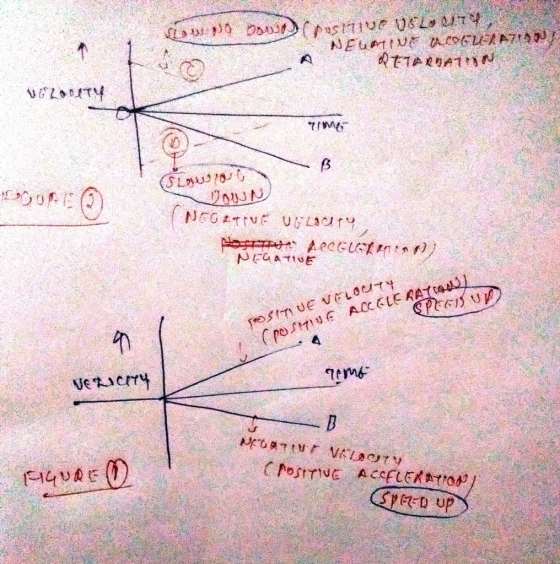
1) For graph A velocity is increasing on increasing the time positive slope. Hence graph A is speeding up.
2) For graph B velocity is still increasing in negative direction on increasing the time (positive slope, remember slope is scalar quantity) . Hence graph B is speeding up.
3) Both cases velocity is increasing on increasing time. Hence there is positive acceleration in both cases.
4) Both has same slope and hence have same magnitude of acceleration.
5) Figure 2 shows such a sketch.
6) Both same/opposite are incorrect. See figure 1 and 2. There are mix up cases of velocity and acceleration for speed up and speed down.
7) Yes possible. B is corresponding to this. See figure 1.
Add Answer to:
Reading Velocity Graphs motion diasrams to each s ons for Y and a Given the following...
For each of the velocity-time graphs shown below, draw the corresponding acceleration- time graph. 2-0 0...
 For each of the velocity-time graphs shown below, draw the corresponding acceleration- time graph. 2-0 0 2 46 8 I time (s) i time (s) I i time (s) 0 0 0 2 4 6 8 0 2 468 time (s) time (s) time (s) A car moves along a line (the positive x-axis). Fill in the table below with the sign (t or-) of the velocity and acceleration of the car for each of the motions described. 2 Acceleration...
PLEASE ANSWER ALL QUESTION WHICH ONE IS MISSING. THANK YOU SO MUCH. ロvelocity vs. nme Graph...
 PLEASE ANSWER ALL QUESTION WHICH ONE IS MISSING.
THANK YOU SO MUCH.
ロvelocity vs. nme Graph A ball is thrown straight up into the air and then, on the way back down, is caught at the same height it was released at. For the following graphs, UP IS POSITIVE & DOWN IS NEGATIVE. Assume there is no air drag. Which one of the following vy vs. t graphs best represents the motion of the ball the entire time it was...
PLEASE ANSWER ALL QUESTION WHICH ONE IS MISSING.
THANK YOU SO MUCH.
ロvelocity vs. nme Graph A ball is thrown straight up into the air and then, on the way back down, is caught at the same height it was released at. For the following graphs, UP IS POSITIVE & DOWN IS NEGATIVE. Assume there is no air drag. Which one of the following vy vs. t graphs best represents the motion of the ball the entire time it was...
I’m confused about how to graph the graphs using the graphs given and wanted an explanation...
 I’m confused about how to graph the graphs using the graphs
given and wanted an explanation on how to tell what to do.
Laberatory 3 Accalerated Motion IV. Conclusions Write a conclusion on a separate sheet of paper. It should be approximately one page in length and include brief discussions of what you did, your observations, your results, and an analysis of your data, including potential sources of error. 1. For each of the sets of graphs given in each...
I’m confused about how to graph the graphs using the graphs
given and wanted an explanation on how to tell what to do.
Laberatory 3 Accalerated Motion IV. Conclusions Write a conclusion on a separate sheet of paper. It should be approximately one page in length and include brief discussions of what you did, your observations, your results, and an analysis of your data, including potential sources of error. 1. For each of the sets of graphs given in each...
Which statement about the motion of an object depicted in the figure is correct? (a) x-t...
 Which statement about the motion of an object depicted in the figure is correct? (a) x-t graph (b) v-t graph x (m) 60- 40 20 % (m /s) 15 10- о r. 1 (s) -5-|//10 т 20 30 40 r 30 40 2010 -40- -60 15 0 At t = 5 s, acceleration is positive and the object is speeding up. 0 At t = 5 s, acceleration is negative and the object is slowing down. O At 5 s,...
Three objects move and their velocity vs time graphs are shown below The following questions refer...
 Three objects move and their velocity vs time graphs are shown
below
The following questions refer to the velocity vs time graphs
above.
1.Are any of the graphs shown representing objects that are
slowing down?
2.Do any of the objects have a negative acceleration? How can
you tell?
3.Which object’s motion(s) most likely is/are experiencing air
resistance? Explain your reasoning.
4.Sketch what the acceleration vs time graphs would look like
for each of the velocity graphs.
Three objects move and their velocity vs time graphs are shown
below
The following questions refer to the velocity vs time graphs
above.
1.Are any of the graphs shown representing objects that are
slowing down?
2.Do any of the objects have a negative acceleration? How can
you tell?
3.Which object’s motion(s) most likely is/are experiencing air
resistance? Explain your reasoning.
4.Sketch what the acceleration vs time graphs would look like
for each of the velocity graphs.
could u explain why 10b is AB and could you explain to me why we cant...
 could u explain why 10b is AB and could you explain to me why
we cant tell why acceleration has direction
10. Use the acceleration vs. time graph on the right to indicate where the line would be on the graph (somewhere in box A. somewhere in box B. either box AB, or at m/s) in the following situations. An object at rest. Acceleration vs. Time A positive velocity. A An object slowing down in the positive direction. I Time...
could u explain why 10b is AB and could you explain to me why
we cant tell why acceleration has direction
10. Use the acceleration vs. time graph on the right to indicate where the line would be on the graph (somewhere in box A. somewhere in box B. either box AB, or at m/s) in the following situations. An object at rest. Acceleration vs. Time A positive velocity. A An object slowing down in the positive direction. I Time...
Can you do 4,5,7,8 please Graph Practice Problems -v vs.t PHYS&114 Name: Use the graph below...
 Can you do 4,5,7,8 please
Graph Practice Problems -v vs.t PHYS&114 Name: Use the graph below to answer questions 1-11. The graph represents the velocity of a particle as a function of time. The positive direction is right and the negative direction is left. 25 20 15 10 7 8 9 o -5 -10 -15 -20 25 time (s) 1. What is the instantaneous velocity of the particle at t-3.00s? 2. What is the instantaneous velocity of the particle at...
Can you do 4,5,7,8 please
Graph Practice Problems -v vs.t PHYS&114 Name: Use the graph below to answer questions 1-11. The graph represents the velocity of a particle as a function of time. The positive direction is right and the negative direction is left. 25 20 15 10 7 8 9 o -5 -10 -15 -20 25 time (s) 1. What is the instantaneous velocity of the particle at t-3.00s? 2. What is the instantaneous velocity of the particle at...
Part 2: Velocity vs. Time 1. For each velocity vs. time graph (Graph 3 and 4), describe how you w...
 Part 2: Velocity vs. Time 1. For each velocity vs. time graph (Graph 3 and 4), describe how you would walk in order to replicate the 1-D motion graph. Use words such as away, toward, at rest, speeding up, slowing down, constant speed. Be specific with your time periods. 2. For each velocity vs. time graph, create the corresponding position and acceleration versus time graphs. Construct your graph on a computer program such as Microsoft ExcelB. If you do not...
You don’t have to do every single problem. I would just like help to get me...
 You don’t have to do every single problem. I would just like
help to get me started. So if there’s two or theee of almost the
same question then you can just do one of these. For an example for
the position graph; you only have to do problems: 1 , 2, 4, 6.
Thank you so much!
くBack Graphs-xt.pdfaビ山 Graph Practice Problems-x vs. t PHYS&114 Name: Complete all these problems on a separate sheet of paper. The graph represents...
You don’t have to do every single problem. I would just like
help to get me started. So if there’s two or theee of almost the
same question then you can just do one of these. For an example for
the position graph; you only have to do problems: 1 , 2, 4, 6.
Thank you so much!
くBack Graphs-xt.pdfaビ山 Graph Practice Problems-x vs. t PHYS&114 Name: Complete all these problems on a separate sheet of paper. The graph represents...
***This is Example how to work it*** This is the question case 13. Draw the graphs...
 ***This is Example how to work it***
This is the question case 13. Draw the graphs for position,
velocity and acceleration based on the word description
Constant Positive Acceleration Case 1 Word description of the motion: Object starts at rest from the origin and speeds up as it travels in the positive "x direction away from the origin. Strobe" photograph: x=0 Positive"X"direction Case 13 Word description of the motion: At some position x > 0 the object is traveling in...
***This is Example how to work it***
This is the question case 13. Draw the graphs for position,
velocity and acceleration based on the word description
Constant Positive Acceleration Case 1 Word description of the motion: Object starts at rest from the origin and speeds up as it travels in the positive "x direction away from the origin. Strobe" photograph: x=0 Positive"X"direction Case 13 Word description of the motion: At some position x > 0 the object is traveling in...
 For each of the velocity-time graphs shown below, draw the corresponding acceleration- time graph. 2-0 0 2 46 8 I time (s) i time (s) I i time (s) 0 0 0 2 4 6 8 0 2 468 time (s) time (s) time (s) A car moves along a line (the positive x-axis). Fill in the table below with the sign (t or-) of the velocity and acceleration of the car for each of the motions described. 2 Acceleration...
 PLEASE ANSWER ALL QUESTION WHICH ONE IS MISSING.
THANK YOU SO MUCH.
ロvelocity vs. nme Graph A ball is thrown straight up into the air and then, on the way back down, is caught at the same height it was released at. For the following graphs, UP IS POSITIVE & DOWN IS NEGATIVE. Assume there is no air drag. Which one of the following vy vs. t graphs best represents the motion of the ball the entire time it was...
PLEASE ANSWER ALL QUESTION WHICH ONE IS MISSING.
THANK YOU SO MUCH.
ロvelocity vs. nme Graph A ball is thrown straight up into the air and then, on the way back down, is caught at the same height it was released at. For the following graphs, UP IS POSITIVE & DOWN IS NEGATIVE. Assume there is no air drag. Which one of the following vy vs. t graphs best represents the motion of the ball the entire time it was...
 I’m confused about how to graph the graphs using the graphs
given and wanted an explanation on how to tell what to do.
Laberatory 3 Accalerated Motion IV. Conclusions Write a conclusion on a separate sheet of paper. It should be approximately one page in length and include brief discussions of what you did, your observations, your results, and an analysis of your data, including potential sources of error. 1. For each of the sets of graphs given in each...
I’m confused about how to graph the graphs using the graphs
given and wanted an explanation on how to tell what to do.
Laberatory 3 Accalerated Motion IV. Conclusions Write a conclusion on a separate sheet of paper. It should be approximately one page in length and include brief discussions of what you did, your observations, your results, and an analysis of your data, including potential sources of error. 1. For each of the sets of graphs given in each...
 Which statement about the motion of an object depicted in the figure is correct? (a) x-t graph (b) v-t graph x (m) 60- 40 20 % (m /s) 15 10- о r. 1 (s) -5-|//10 т 20 30 40 r 30 40 2010 -40- -60 15 0 At t = 5 s, acceleration is positive and the object is speeding up. 0 At t = 5 s, acceleration is negative and the object is slowing down. O At 5 s,...
 Three objects move and their velocity vs time graphs are shown
below
The following questions refer to the velocity vs time graphs
above.
1.Are any of the graphs shown representing objects that are
slowing down?
2.Do any of the objects have a negative acceleration? How can
you tell?
3.Which object’s motion(s) most likely is/are experiencing air
resistance? Explain your reasoning.
4.Sketch what the acceleration vs time graphs would look like
for each of the velocity graphs.
Three objects move and their velocity vs time graphs are shown
below
The following questions refer to the velocity vs time graphs
above.
1.Are any of the graphs shown representing objects that are
slowing down?
2.Do any of the objects have a negative acceleration? How can
you tell?
3.Which object’s motion(s) most likely is/are experiencing air
resistance? Explain your reasoning.
4.Sketch what the acceleration vs time graphs would look like
for each of the velocity graphs.
 could u explain why 10b is AB and could you explain to me why
we cant tell why acceleration has direction
10. Use the acceleration vs. time graph on the right to indicate where the line would be on the graph (somewhere in box A. somewhere in box B. either box AB, or at m/s) in the following situations. An object at rest. Acceleration vs. Time A positive velocity. A An object slowing down in the positive direction. I Time...
could u explain why 10b is AB and could you explain to me why
we cant tell why acceleration has direction
10. Use the acceleration vs. time graph on the right to indicate where the line would be on the graph (somewhere in box A. somewhere in box B. either box AB, or at m/s) in the following situations. An object at rest. Acceleration vs. Time A positive velocity. A An object slowing down in the positive direction. I Time...
 Can you do 4,5,7,8 please
Graph Practice Problems -v vs.t PHYS&114 Name: Use the graph below to answer questions 1-11. The graph represents the velocity of a particle as a function of time. The positive direction is right and the negative direction is left. 25 20 15 10 7 8 9 o -5 -10 -15 -20 25 time (s) 1. What is the instantaneous velocity of the particle at t-3.00s? 2. What is the instantaneous velocity of the particle at...
Can you do 4,5,7,8 please
Graph Practice Problems -v vs.t PHYS&114 Name: Use the graph below to answer questions 1-11. The graph represents the velocity of a particle as a function of time. The positive direction is right and the negative direction is left. 25 20 15 10 7 8 9 o -5 -10 -15 -20 25 time (s) 1. What is the instantaneous velocity of the particle at t-3.00s? 2. What is the instantaneous velocity of the particle at...
 Part 2: Velocity vs. Time 1. For each velocity vs. time graph (Graph 3 and 4), describe how you would walk in order to replicate the 1-D motion graph. Use words such as away, toward, at rest, speeding up, slowing down, constant speed. Be specific with your time periods. 2. For each velocity vs. time graph, create the corresponding position and acceleration versus time graphs. Construct your graph on a computer program such as Microsoft ExcelB. If you do not...
 You don’t have to do every single problem. I would just like
help to get me started. So if there’s two or theee of almost the
same question then you can just do one of these. For an example for
the position graph; you only have to do problems: 1 , 2, 4, 6.
Thank you so much!
くBack Graphs-xt.pdfaビ山 Graph Practice Problems-x vs. t PHYS&114 Name: Complete all these problems on a separate sheet of paper. The graph represents...
You don’t have to do every single problem. I would just like
help to get me started. So if there’s two or theee of almost the
same question then you can just do one of these. For an example for
the position graph; you only have to do problems: 1 , 2, 4, 6.
Thank you so much!
くBack Graphs-xt.pdfaビ山 Graph Practice Problems-x vs. t PHYS&114 Name: Complete all these problems on a separate sheet of paper. The graph represents...
 ***This is Example how to work it***
This is the question case 13. Draw the graphs for position,
velocity and acceleration based on the word description
Constant Positive Acceleration Case 1 Word description of the motion: Object starts at rest from the origin and speeds up as it travels in the positive "x direction away from the origin. Strobe" photograph: x=0 Positive"X"direction Case 13 Word description of the motion: At some position x > 0 the object is traveling in...
***This is Example how to work it***
This is the question case 13. Draw the graphs for position,
velocity and acceleration based on the word description
Constant Positive Acceleration Case 1 Word description of the motion: Object starts at rest from the origin and speeds up as it travels in the positive "x direction away from the origin. Strobe" photograph: x=0 Positive"X"direction Case 13 Word description of the motion: At some position x > 0 the object is traveling in...
Most questions answered within 3 hours.
-
Where is the error in this code sequence?
String s1 = "Hello";
String s2 = "ello";...
asked 10 months ago -
Financial data for Joel de Paris, Inc., for last year
follow:
Joel de Paris, Inc.
Balance...
asked 10 months ago -
Consider this reaction:
Al2(SO4)3 (aq)+ BaCl3
(aq) Al2Cl6 (aq)- +
3BaSO4(s) . What is the...
asked 10 months ago -
Suppose that Savneet is considering increasing her
recent random sample from 20 car rentals to 40...
asked 10 months ago -
Trucks arrive at an unloading terminal at an average rate of 120
per hour.
Trucks arrive...
asked 10 months ago -
Why are methanol and ethanol completely soluble in water while
octanol is not very little soluble....
asked 10 months ago -
A facilities manager at a university reads in a research report
that the mean amount of...
asked 10 months ago -
When the CuSO4 is rehydrated by adding water to the anhydrous
compound, is this an endothermic...
asked 10 months ago -
A ray of sunlight is passing from diamond into crown glass; the
angle of incidence is...
asked 10 months ago -
A block of mass 0.249 kg is placed on top of a light, vertical
spring of...
asked 10 months ago -
how do the kidneys compensate in the presences of acidosis
a) trigger hyperventilate
b) reserve acid...
asked 10 months ago -
Question 501 pts
The rental rate of capital to the firm increases. Which of the
following...
asked 10 months ago