
Homework Answers
ANS 1
a. i. Paisley will hear loud sound if the path difference
 between the sounds received from both the speakers is integral
multiple of wavelength
between the sounds received from both the speakers is integral
multiple of wavelength  of sound.
 , where v is the velocity and
  is frequency of
sound.
is frequency of
sound.
i.e.  , where
n = 1,2,3,.....
, where
n = 1,2,3,.....
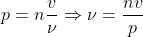
v = 343 m/s and for lowest frequencies n = 1,2
for n=1

for n=2

ii. for a quiet sound  where n = 0,1,2,......
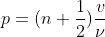

for n = 0


for n = 1

b. Changed frequency 
Therefore wavelength, 
Therefore,  i.e path difference in this case is integral multiple of .
Therefore Paisley will hear loud sound in this case.
i.e path difference in this case is integral multiple of .
Therefore Paisley will hear loud sound in this case.
ANS 2
Wavelength of sound in this case

For no sound path difference should be odd integral multiple
of 
i.e. 
maximum possible value of n for which x is positive is 4

ANS 3
a. In this case the path difference between the two sounds received by her is p=3.00 m
i. Minimum frequency for loud sound is:

ii. for no sound

b. As she moves further away from the speakers she will hear
loud sound which will keep on decreasing as she moves away till she
hear no sound after covering a distance of , if
she continue moving sound will again increase and becomes maximum
after covering a further distance equal to half the wavelength and
this will continue to happen i.e she will hear alternate loud and
quiet sound as she keep moving further away from the speakers.
Add Answer to:
Paisley stands in front of two speakers as shown which emit the same tone, in phase....
Two small identical speakers are connected (in phase) to the same source. The speakers are 3...
 Two small identical speakers are connected (in phase) to the same source. The speakers are 3 m apart and at ear level. An observer stands at X, 4 m in front of one speaker as shown. The sound she hears will be most intense if the wavelength is: 3m speakers . Ο Ο Ο Ο Ο
A person stands directly in front of two speakers that are emitting the same pure tone....
 A person stands directly in front of two speakers that are emitting the same pure tone. The person then moves to one side until no sound is heard. At that point, the person is 8.15 m from one of the speakers and 8.19 m from the other. What is the frequency (in Hz) of the tone being emitted? (Assume air temperature to be 20°C.)
A person stands directly in front of two speakers that are emitting the same pure tone....
A person stands directly in front of two speakers that are emitting the same pure tone. The person then moves to one side until no sound is heard. At that point, the person is 4.90 m from one of the speakers and 4.92 m from the other. What is the frequency (in Hz) of the tone being emitted? (Assume air temperature to be 20°c
Two loudspeakers, 1.3 m apart, emit sound waves with the same frequency along the positive x-axis....
Two loudspeakers, 1.3 m apart, emit sound waves with the same frequency along the positive x-axis. Victor, standing on the axis to the right of the speakers, hears no sound. As the frequency is slowly tripled, Victor hears the sound go through the sequence loud-soft-loud-soft-loud before becoming quiet again. What was the original sound frequency? Assume room temperature of 20∘C.
Two identical speakers (labeled 1 and 2) are playing a tone with a frequency of 225...
 Two identical speakers (labeled 1 and 2) are playing a tone with a frequency of 225 Hz, in phase. The centers of the speakers are located 6.00 m apart. Five observers are standing on a line that is 6.00 m in front of the speakers as shown in the figure. Each observer is separated by 1.00 m and Sue is directly in front of speaker 1. Determine which observer or observers will experience constructive interference from the sound emitted by...
A listener is standing in front of two speakers that are producingsound of the same freqencey...
A listener is standing in front of two speakers that are producingsound of the same freqencey and amplitude, except that they arevibrating out of phase. Initially, the distance between thelistener and each speaker is the same (see the drawing). As thelistener moves sideways, the sound intensity gradually changes.When the distance x in the drawing is 0.92m, the change reaches themaximum amount (either loud to soft, or soft to loud). Using thedata shown in the drawing and 343 m/s for the...
BLOCK 10: I.A listener is standing in front of two speakers that are producing sound of the same frequeney and amplitude, except that they are vibrating out of phase a. Initially, the listener is at...
 BLOCK 10: I.A listener is standing in front of two speakers that are producing sound of the same frequeney and amplitude, except that they are vibrating out of phase a. Initially, the listener is at the same distance from each speaker (see the drawing). So, Ax- Therefore ф- Midpoint0.92 m and we know A 4.00 m 1,50m 1.50m So, the soundwaves interfere (constructively/destructively) and the sound at the mid-point is (soft/loud) b. As the listener moves sideways, the sound intensity...
Two identical loudspeakers are placed on a wall 3.00 m apart. A listener stands 5.00 m...
 Two identical loudspeakers are placed on a wall 3.00 m apart. A listener stands 5.00 m from the wall directly in front of one of the speakers. A single oscillator is driving the speakers at a frequency of 300 Hz. (a) What is the phase difference in radians between the waves from the speakers when they reach the observer? (Your answer should be between 0 and 21.) rad (b) What is the frequency closest to 300 Hz to which the...
32. Two loudspeakers, A and B , are driven by the same amplifier and emit sinusoidal...
 32. Two loudspeakers, A and B , are driven by the same amplifier and emit sinusoidal waves in phase. Speaker B is 2.00 m to the right of speaker A. Consider point Q along the extension of the line connecting the speakers, 1.00 m to the right of speaker B. Both speak- ers emit sound waves that travel directly from the speaker to point Q. (see figure) (a) What is the lowest frequency for which constructive interference occurs at point...
Two small identical speakers are connected to the same sinusoidal source, as shown in figure 13....
 Two small identical speakers are connected to the same
sinusoidal source, as shown in figure 13. At a distance 40.0 m in
front of one speaker, the sound intensity is minimum at two
consecutive frequencies 4500 Hz and 7500 Hz. What is the distance X
between the speakers?
Press F11 to exit full screen Speaker Speaker 40.0 m Figure 13
Two small identical speakers are connected to the same
sinusoidal source, as shown in figure 13. At a distance 40.0 m in
front of one speaker, the sound intensity is minimum at two
consecutive frequencies 4500 Hz and 7500 Hz. What is the distance X
between the speakers?
Press F11 to exit full screen Speaker Speaker 40.0 m Figure 13
 Two small identical speakers are connected (in phase) to the same source. The speakers are 3 m apart and at ear level. An observer stands at X, 4 m in front of one speaker as shown. The sound she hears will be most intense if the wavelength is: 3m speakers . Ο Ο Ο Ο Ο
 A person stands directly in front of two speakers that are emitting the same pure tone. The person then moves to one side until no sound is heard. At that point, the person is 8.15 m from one of the speakers and 8.19 m from the other. What is the frequency (in Hz) of the tone being emitted? (Assume air temperature to be 20°C.)
 Two identical speakers (labeled 1 and 2) are playing a tone with a frequency of 225 Hz, in phase. The centers of the speakers are located 6.00 m apart. Five observers are standing on a line that is 6.00 m in front of the speakers as shown in the figure. Each observer is separated by 1.00 m and Sue is directly in front of speaker 1. Determine which observer or observers will experience constructive interference from the sound emitted by...
 BLOCK 10: I.A listener is standing in front of two speakers that are producing sound of the same frequeney and amplitude, except that they are vibrating out of phase a. Initially, the listener is at the same distance from each speaker (see the drawing). So, Ax- Therefore ф- Midpoint0.92 m and we know A 4.00 m 1,50m 1.50m So, the soundwaves interfere (constructively/destructively) and the sound at the mid-point is (soft/loud) b. As the listener moves sideways, the sound intensity...
 Two identical loudspeakers are placed on a wall 3.00 m apart. A listener stands 5.00 m from the wall directly in front of one of the speakers. A single oscillator is driving the speakers at a frequency of 300 Hz. (a) What is the phase difference in radians between the waves from the speakers when they reach the observer? (Your answer should be between 0 and 21.) rad (b) What is the frequency closest to 300 Hz to which the...
 32. Two loudspeakers, A and B , are driven by the same amplifier and emit sinusoidal waves in phase. Speaker B is 2.00 m to the right of speaker A. Consider point Q along the extension of the line connecting the speakers, 1.00 m to the right of speaker B. Both speak- ers emit sound waves that travel directly from the speaker to point Q. (see figure) (a) What is the lowest frequency for which constructive interference occurs at point...
 Two small identical speakers are connected to the same
sinusoidal source, as shown in figure 13. At a distance 40.0 m in
front of one speaker, the sound intensity is minimum at two
consecutive frequencies 4500 Hz and 7500 Hz. What is the distance X
between the speakers?
Press F11 to exit full screen Speaker Speaker 40.0 m Figure 13
Two small identical speakers are connected to the same
sinusoidal source, as shown in figure 13. At a distance 40.0 m in
front of one speaker, the sound intensity is minimum at two
consecutive frequencies 4500 Hz and 7500 Hz. What is the distance X
between the speakers?
Press F11 to exit full screen Speaker Speaker 40.0 m Figure 13
Most questions answered within 3 hours.
-
Where is the error in this code sequence?
String s1 = "Hello";
String s2 = "ello";...
asked 11 months ago -
Financial data for Joel de Paris, Inc., for last year
follow:
Joel de Paris, Inc.
Balance...
asked 11 months ago -
Consider this reaction:
Al2(SO4)3 (aq)+ BaCl3
(aq) Al2Cl6 (aq)- +
3BaSO4(s) . What is the...
asked 11 months ago -
Suppose that Savneet is considering increasing her
recent random sample from 20 car rentals to 40...
asked 11 months ago -
Trucks arrive at an unloading terminal at an average rate of 120
per hour.
Trucks arrive...
asked 11 months ago -
Why are methanol and ethanol completely soluble in water while
octanol is not very little soluble....
asked 11 months ago -
A facilities manager at a university reads in a research report
that the mean amount of...
asked 11 months ago -
When the CuSO4 is rehydrated by adding water to the anhydrous
compound, is this an endothermic...
asked 11 months ago -
A ray of sunlight is passing from diamond into crown glass; the
angle of incidence is...
asked 11 months ago -
A block of mass 0.249 kg is placed on top of a light, vertical
spring of...
asked 11 months ago -
how do the kidneys compensate in the presences of acidosis
a) trigger hyperventilate
b) reserve acid...
asked 11 months ago -
Question 501 pts
The rental rate of capital to the firm increases. Which of the
following...
asked 11 months ago