
Homework Answers
Answer:
![d) for (P=0; iº4n4; i++) for (iaitu jangjitt) ^ :. temp- Ali][j]; [1] [j].: AC3] [1]; Alj] li] = temp; liec, i loop gets isl,](http://img.homeworklib.com/questions/a8352ed0-6359-11eb-9e23-8bc8b3e7d07c.png?x-oss-process=image/resize,w_560)
Add Answer to:
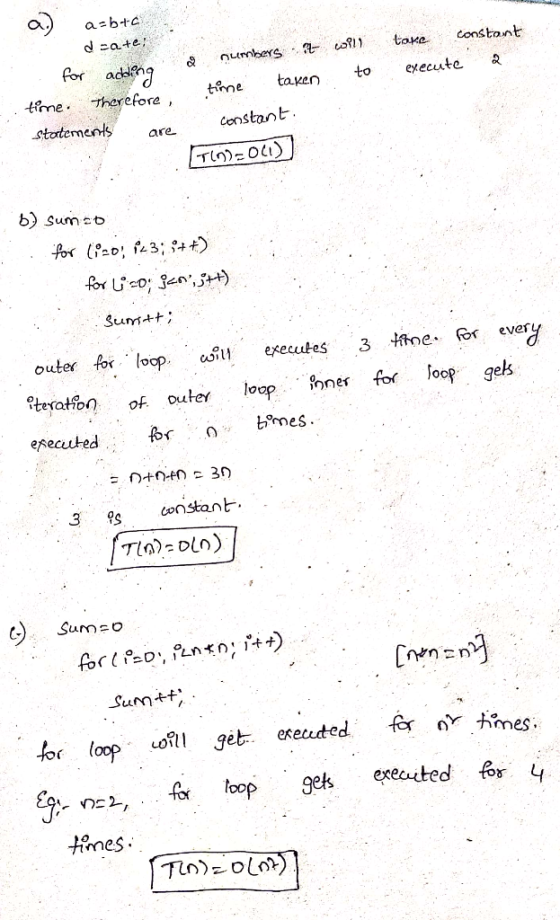
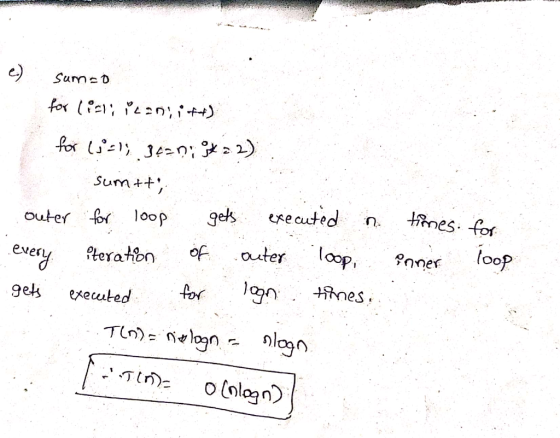
Exercises • Determine running time for the following code fragments: (a) a = b + c;...
For each of the following six program fragments: a. Give an analysis of the running time...
 For each of the following six program fragments: a. Give an analysis of the running time (Big-Oh will do). b. Implement the code in the language of your choice, and give the running time for several values of N. Pseudo Code Implementation Analysis of runtime time (Big-Oh) (1) sum = 0; for(i = 0; i < n; ++i) ++sum; (2) sum = 0; for(i = 0; i < n; ++i) for(j = 0; j<n; ++i) ++sum; (3) sum = 0;...
Using C++ please explain What is the Big-O time complexity of the following code: for (int...
 Using C++ please explain
What is the Big-O time complexity of the following code: for (int i=0; i<N; i+=2) { ... constant time operations... Select one: o a. O(n^2) O b. O(log n) c. O(n) O d. 0(1) What is the Big-O time complexity of the following code: for(int i=1; i<N; i*=2) { ... constant time operations... Select one: O O a. O(n^2) b. 0(1) c. O(n) d. O(log n) O What is the Big-O time complexity of the following...
Using C++ please explain
What is the Big-O time complexity of the following code: for (int i=0; i<N; i+=2) { ... constant time operations... Select one: o a. O(n^2) O b. O(log n) c. O(n) O d. 0(1) What is the Big-O time complexity of the following code: for(int i=1; i<N; i*=2) { ... constant time operations... Select one: O O a. O(n^2) b. 0(1) c. O(n) d. O(log n) O What is the Big-O time complexity of the following...
Expert G8A 1.4.6 Give the order of growth (as a function of N) of the running...
 Expert G8A 1.4.6 Give the order of growth (as a function of N) of the running times of each of the following code fragments: a. int sum -0 for (int n-N; 0: n / 2) for(int i 0; i < n; i++) sum+ b int sum-0 for (int i-li<N; i'-2) for Cint 3-0:3 i: j) sum++ 4Analysls of Algorithms int sum 0 for (int i-1i<N: i-2) for Cint i-0:3N: j) sum++
1.4.6 Give the order of growth (as a function of n) of the running times of...
 1.4.6 Give the order of growth (as a function of n) of the running times of each of the following code fragments: a, int sum=0; for (int k n: k > 0; k /= 2) for (int i 0; ǐ < k; İ++) sum++; b.int sum 0; for (int i = 1; i < n; i *= 2) for (int j = 0; j < i; j++) sum++; int sum = 0; for (int í = 1; i < n;...
Describe the worst case running time of the following pseudocode functions in Big-Oh notation in terms...
 Describe the worst case running time of the following
pseudocode functions in Big-Oh notation in terms of the variable n.
Show your work
b) void func(int n) { for (int i = 0; i < n; i = i + 10) { for (int j = 0; j < i; ++i) { System.out.println("i = " + i); System.out.println("j = " + j);
Describe the worst case running time of the following
pseudocode functions in Big-Oh notation in terms of the variable n.
Show your work
b) void func(int n) { for (int i = 0; i < n; i = i + 10) { for (int j = 0; j < i; ++i) { System.out.println("i = " + i); System.out.println("j = " + j);
Question 1 (25 pts) Find the running time complexity for the following code fragments. Express yo...
 Question 1 (25 pts)
Find the running time complexity for the following code
fragments. Express your answers using either the Big-O or Big-Θ
notations, and the tightest bound possible. Justify your
answers.
for(int count O , i -0; i < n* n; i++) for(int i0 ; j <i; j++) count++
for(int count O , i -0; i
Question 1 (25 pts)
Find the running time complexity for the following code
fragments. Express your answers using either the Big-O or Big-Θ
notations, and the tightest bound possible. Justify your
answers.
for(int count O , i -0; i < n* n; i++) for(int i0 ; j <i; j++) count++
for(int count O , i -0; i
Describe the order of magnitude of the following code section using Big(O) notation. k=0; for (i=...
 Describe the order of magnitude of the following code section using Big(O) notation. k=0; for (i= 0; i<N; i++)
Data Structures and Algorithms For each of the following program fragments, give an analysis of the...
Data Structures and Algorithms For each of the following program fragments, give an analysis of the running time using Big-Oh notation. Do not give formulas, but analyze every line to calculate the running time, e.g. sum = 0 is equal to 1 unit time ... b. sum = 0; for( i = 0; i < n; i++) for( j = 0; j < i*i; j++) for( k = 0; k < j; k++) sum++; c. sum =...
Give a big-Oh characterization, in terms of n,of the running time for each of the following...
 Give a big-Oh characterization, in terms of n,of the running time for each of the following code segments (use the drop-down): - public void func1(int n) { A. @(1). for (int i = n; i > 0; i--) { System.out.println(i); B. follogn). for (int j = 0; j <i; j++) System.out.println(j); c.e(n). System.out.println("Goodbye!"); D.@(nlogn). E.e(n). F.ein). public void func2 (int n) { for (int m=1; m <= n; m++) { system.out.println (m); i = n; while (i >0){ system.out.println(i); i...
Can you explane this quastion step by step 29) What is the output of the following...
 Can you explane this quastion step by step
29) What is the output of the following program? main () { int i,j,sum= 0, time 01 ; for (i-1;i<6; i++) { j-0; time*=i; while (j<i)(sum+=j;j++;) sumt=time;} printf ("%d 8d", sum, time); Je a) 20 173 b) 120 173 c) 173 20 d) 20 120 e) 173 120
Can you explane this quastion step by step
29) What is the output of the following program? main () { int i,j,sum= 0, time 01 ; for (i-1;i<6; i++) { j-0; time*=i; while (j<i)(sum+=j;j++;) sumt=time;} printf ("%d 8d", sum, time); Je a) 20 173 b) 120 173 c) 173 20 d) 20 120 e) 173 120
 For each of the following six program fragments: a. Give an analysis of the running time (Big-Oh will do). b. Implement the code in the language of your choice, and give the running time for several values of N. Pseudo Code Implementation Analysis of runtime time (Big-Oh) (1) sum = 0; for(i = 0; i < n; ++i) ++sum; (2) sum = 0; for(i = 0; i < n; ++i) for(j = 0; j<n; ++i) ++sum; (3) sum = 0;...
 Using C++ please explain
What is the Big-O time complexity of the following code: for (int i=0; i<N; i+=2) { ... constant time operations... Select one: o a. O(n^2) O b. O(log n) c. O(n) O d. 0(1) What is the Big-O time complexity of the following code: for(int i=1; i<N; i*=2) { ... constant time operations... Select one: O O a. O(n^2) b. 0(1) c. O(n) d. O(log n) O What is the Big-O time complexity of the following...
Using C++ please explain
What is the Big-O time complexity of the following code: for (int i=0; i<N; i+=2) { ... constant time operations... Select one: o a. O(n^2) O b. O(log n) c. O(n) O d. 0(1) What is the Big-O time complexity of the following code: for(int i=1; i<N; i*=2) { ... constant time operations... Select one: O O a. O(n^2) b. 0(1) c. O(n) d. O(log n) O What is the Big-O time complexity of the following...
 Expert G8A 1.4.6 Give the order of growth (as a function of N) of the running times of each of the following code fragments: a. int sum -0 for (int n-N; 0: n / 2) for(int i 0; i < n; i++) sum+ b int sum-0 for (int i-li<N; i'-2) for Cint 3-0:3 i: j) sum++ 4Analysls of Algorithms int sum 0 for (int i-1i<N: i-2) for Cint i-0:3N: j) sum++
 1.4.6 Give the order of growth (as a function of n) of the running times of each of the following code fragments: a, int sum=0; for (int k n: k > 0; k /= 2) for (int i 0; ǐ < k; İ++) sum++; b.int sum 0; for (int i = 1; i < n; i *= 2) for (int j = 0; j < i; j++) sum++; int sum = 0; for (int í = 1; i < n;...
 Describe the worst case running time of the following
pseudocode functions in Big-Oh notation in terms of the variable n.
Show your work
b) void func(int n) { for (int i = 0; i < n; i = i + 10) { for (int j = 0; j < i; ++i) { System.out.println("i = " + i); System.out.println("j = " + j);
Describe the worst case running time of the following
pseudocode functions in Big-Oh notation in terms of the variable n.
Show your work
b) void func(int n) { for (int i = 0; i < n; i = i + 10) { for (int j = 0; j < i; ++i) { System.out.println("i = " + i); System.out.println("j = " + j);
 Question 1 (25 pts)
Find the running time complexity for the following code
fragments. Express your answers using either the Big-O or Big-Θ
notations, and the tightest bound possible. Justify your
answers.
for(int count O , i -0; i < n* n; i++) for(int i0 ; j <i; j++) count++
for(int count O , i -0; i
Question 1 (25 pts)
Find the running time complexity for the following code
fragments. Express your answers using either the Big-O or Big-Θ
notations, and the tightest bound possible. Justify your
answers.
for(int count O , i -0; i < n* n; i++) for(int i0 ; j <i; j++) count++
for(int count O , i -0; i
 Describe the order of magnitude of the following code section using Big(O) notation. k=0; for (i= 0; i<N; i++)
 Give a big-Oh characterization, in terms of n,of the running time for each of the following code segments (use the drop-down): - public void func1(int n) { A. @(1). for (int i = n; i > 0; i--) { System.out.println(i); B. follogn). for (int j = 0; j <i; j++) System.out.println(j); c.e(n). System.out.println("Goodbye!"); D.@(nlogn). E.e(n). F.ein). public void func2 (int n) { for (int m=1; m <= n; m++) { system.out.println (m); i = n; while (i >0){ system.out.println(i); i...
 Can you explane this quastion step by step
29) What is the output of the following program? main () { int i,j,sum= 0, time 01 ; for (i-1;i<6; i++) { j-0; time*=i; while (j<i)(sum+=j;j++;) sumt=time;} printf ("%d 8d", sum, time); Je a) 20 173 b) 120 173 c) 173 20 d) 20 120 e) 173 120
Can you explane this quastion step by step
29) What is the output of the following program? main () { int i,j,sum= 0, time 01 ; for (i-1;i<6; i++) { j-0; time*=i; while (j<i)(sum+=j;j++;) sumt=time;} printf ("%d 8d", sum, time); Je a) 20 173 b) 120 173 c) 173 20 d) 20 120 e) 173 120
Most questions answered within 3 hours.
-
Where is the error in this code sequence?
String s1 = "Hello";
String s2 = "ello";...
asked 10 months ago -
Financial data for Joel de Paris, Inc., for last year
follow:
Joel de Paris, Inc.
Balance...
asked 10 months ago -
Consider this reaction:
Al2(SO4)3 (aq)+ BaCl3
(aq) Al2Cl6 (aq)- +
3BaSO4(s) . What is the...
asked 10 months ago -
Suppose that Savneet is considering increasing her
recent random sample from 20 car rentals to 40...
asked 10 months ago -
Trucks arrive at an unloading terminal at an average rate of 120
per hour.
Trucks arrive...
asked 10 months ago -
Why are methanol and ethanol completely soluble in water while
octanol is not very little soluble....
asked 10 months ago -
A facilities manager at a university reads in a research report
that the mean amount of...
asked 10 months ago -
When the CuSO4 is rehydrated by adding water to the anhydrous
compound, is this an endothermic...
asked 10 months ago -
A ray of sunlight is passing from diamond into crown glass; the
angle of incidence is...
asked 10 months ago -
A block of mass 0.249 kg is placed on top of a light, vertical
spring of...
asked 10 months ago -
how do the kidneys compensate in the presences of acidosis
a) trigger hyperventilate
b) reserve acid...
asked 10 months ago -
Question 501 pts
The rental rate of capital to the firm increases. Which of the
following...
asked 10 months ago