The mayor of a town has proposed a plan for the annexation of a new bridge....
The mayor of a town has proposed a plan for the annexation of a new bridge. A political study took a sample of 900 voters in the town and found that 61% of the residents favored annexation. Using the data, a political strategist wants to test the claim that the percentage of residents who favor annexation is above 57%. Determine the P-value of the test statistic. Round your answer to four decimal places.
Homework Answers
The following information is provided: The sample size is N =
900, the number of favorable cases is X = 549 , and the sample
proportion is  , and the significance level is α=0.05
(1) Null and Alternative Hypotheses
The following null and alternative hypotheses need to be tested:
Ho: p = 0.57
Ha: p > 0.57
This corresponds to a right-tailed test, for which a z-test for one population proportion needs to be used.
(2) Test Statistics
The z-statistic is computed as follows:
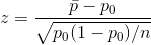

Using the P-value approach: The p-value is p = 0.0077
Add Answer to:
The mayor of a town has proposed a plan for the annexation of a
new bridge....
The mayor of a town has proposed a plan for the annexation of a new bridge....
 The mayor of a town has proposed a plan for the annexation of a new bridge. A political study took a sample of 900 voters in the town and found that 49 % of the residents favored annexation. Using the data, a political strategist wants to test the claim that the percentage of residents who favor annexation is over 45 %. Testing at the 0.05 level. Is there enough evidence to support the strategist's claim? Step 1 of 7: State...
The mayor of a town has proposed a plan for the annexation of a new bridge....
The mayor of a town has proposed a plan for the annexation of a new bridge. A political study took a sample of 900 voters in the town and found that 63% of the residents favored annexation. Using the data, a political strategist wants to test the claim that the percentage of residents who favor annexation is over 59%. Determine the P-value of the test statistic. Round your answer to four decimal places.
The mayor of a town has proposed a plan for the annexation of an adjoining bridge....
The mayor of a town has proposed a plan for the annexation of an adjoining bridge. A political study took a sample of 1500 voters in the town and found that 47% of the residents favored annexation. Using the data, a political strategist wants to test the claim that the percentage of residents who favor annexation is above 44%. Determine the P-value of the test statistic. Round your answer to four decimal places.
The mayor of a town has proposed a plan for the annexation of a new bridge....
The mayor of a town has proposed a plan for the annexation of a new bridge. A political study took a sample of 1000 voters in the town and found that 44% of the residents favored annexation. Using the data, a political strategist wants to test the claim that the percentage of residents who favor annexation is above 40% . State the null and alternative hypotheses.
The mayor of a town has proposed a plan for the annexation of an adjoining bridge....
The mayor of a town has proposed a plan for the annexation of an adjoining bridge. A political study took a sample of 1000 voters in the town and found that 73 % of the residents favored annexation. Using the data, a political strategist wants to test the claim that the percentage of residents who favor annexation is more than 70 % . Determine the P-value of the test statistic. Round your answer to four decimal places.
The mayor of a town has proposed a plan for the annexation of an adjoining bridge....
The mayor of a town has proposed a plan for the annexation of an adjoining bridge. A political study took a sample of 1000 voters in the town and found that 58% of the residents favored annexation. Using the data, a political strategist wants to test the claim that the percentage of residents who favor annexation is more than 55%. Find the value of the test statistic. Round your answer to two decimal places.
The mayor of a town has proposed a plan for the annexation of a new community....
The mayor of a town has proposed a plan for the annexation of a new community. A political study took a sample of 1000 voters in the town and found that 57% of the residents favored annexation. Using the data, a political strategist wants to test the claim that the percentage of residents who favor annexation is more than 53%. Determine the P-value of the test statistic. Round your answer to four decimal places.
The mayor of a town has proposed a plan for the annexation of an adjoining bridge....
The mayor of a town has proposed a plan for the annexation of an adjoining bridge. A political study took a sample of 1000 voters in the town and found that 29% of the residents favored annexation. Using the data, a political strategist wants to test the claim that the percentage of residents who favor annexation is more than 26%. State the null and alternative hypotheses. Ho:__________ Ha: __________
The mayor of a town has proposed a plan for the annexation of a new community....
The mayor of a town has proposed a plan for the annexation of a new community. A political study took a sample of 1800 voters in the town and found that 58% of the residents favored annexation. Using the data, a political strategist wants to test the claim that the percentage of residents who favor annexation is above 55% Determine the P-value of the test statistic. Round your answer to four decimal places.
The mayor of a town has proposed a plan for the annexation of an adjoining bridge....
 The mayor of a town has proposed a plan for the annexation of an adjoining bridge. A political study took a sample of 1500 voters in the town and found that 47 % of the residents favored annexation. Using the data, a political strategist wants to test the claim that the percentage of residents who favor annexation is above 44 %. Testing at the 0.02 level, Is there enough evidence to support the strategist's claim? Step 1 of 7: State...
 The mayor of a town has proposed a plan for the annexation of a new bridge. A political study took a sample of 900 voters in the town and found that 49 % of the residents favored annexation. Using the data, a political strategist wants to test the claim that the percentage of residents who favor annexation is over 45 %. Testing at the 0.05 level. Is there enough evidence to support the strategist's claim? Step 1 of 7: State...
 The mayor of a town has proposed a plan for the annexation of an adjoining bridge. A political study took a sample of 1500 voters in the town and found that 47 % of the residents favored annexation. Using the data, a political strategist wants to test the claim that the percentage of residents who favor annexation is above 44 %. Testing at the 0.02 level, Is there enough evidence to support the strategist's claim? Step 1 of 7: State...
Most questions answered within 3 hours.
-
Where is the error in this code sequence?
String s1 = "Hello";
String s2 = "ello";...
asked 11 months ago -
Financial data for Joel de Paris, Inc., for last year
follow:
Joel de Paris, Inc.
Balance...
asked 11 months ago -
Consider this reaction:
Al2(SO4)3 (aq)+ BaCl3
(aq) Al2Cl6 (aq)- +
3BaSO4(s) . What is the...
asked 11 months ago -
Suppose that Savneet is considering increasing her
recent random sample from 20 car rentals to 40...
asked 11 months ago -
Trucks arrive at an unloading terminal at an average rate of 120
per hour.
Trucks arrive...
asked 11 months ago -
Why are methanol and ethanol completely soluble in water while
octanol is not very little soluble....
asked 11 months ago -
A facilities manager at a university reads in a research report
that the mean amount of...
asked 11 months ago -
When the CuSO4 is rehydrated by adding water to the anhydrous
compound, is this an endothermic...
asked 11 months ago -
A ray of sunlight is passing from diamond into crown glass; the
angle of incidence is...
asked 11 months ago -
A block of mass 0.249 kg is placed on top of a light, vertical
spring of...
asked 11 months ago -
how do the kidneys compensate in the presences of acidosis
a) trigger hyperventilate
b) reserve acid...
asked 11 months ago -
Question 501 pts
The rental rate of capital to the firm increases. Which of the
following...
asked 11 months ago