Part A A group of students performed the same "Ohm's Law" experiment that you did in...
Part A
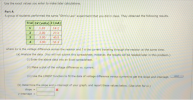
A group of students performed the same "Ohm's Law" experiment that
you did in class. They obtained the following results:
| Trial | ΔV (volts) | I (mA) |
|---|---|---|
| 1 | 1.00 | 20.5 |
| 2 | 2.10 | 42.0 |
| 3 | 2.90 | 57.5 |
| 4 | 3.90 | 78.0 |
| 5 | 4.90 | 98.0 |
where ΔV is the voltage difference across the resistor and I is the current traveling through the resistor at the same time.
(a) Analyze the data. (You will not submit this spreadsheet. However, the results will be needed later in this problem.)
(i) Enter the above data into an Excel spreadsheet.
(ii) Make a plot of the voltage difference vs. current.
(iii) Use the trendline option in Excel to fit the data of voltage
difference versus current to get the slope and intercept.
(b) Determine the slope and y-intercept of your graph, and
report these values below. (Use ohm for Ω.)
-----
| ΔV (volts) | I (mA) |
|---|---|
| 4.18 | 32.1 |
Part B
Your mischievous lab partner takes the resistor that you just
experimented with and assembles it in a network with one other
resistor and places them inside a black box. He challenges you to
tell him the configuration of the resistors inside the box. Being
an industrious physics student you connect the leads of the black
box to your power source, voltmeter (in parallel), and ammeter (in
series) and take the following simultaneous measurements.
Use the above measurements to find the equivalent
resistance of the arrangement. (Use ohm for Ω.)
Req =
Based on your value of the equivalent resistance, what must
the arrangement be?
in series or in parallel?
Part C
Now that you've answered his challenge, your lab partner asks you
to give the resistance of the resistor that he added to the one you
experimented with. Using the information you obtained in parts A
and B, predict this value of the resistance of the second
resistor.
Homework Answers


Add Answer to:
Part A
A group of students performed the same "Ohm's Law" experiment that
you did in...
Use the exact values you enter to make later calculations. Part A A group of students...
Use the exact values you enter to make later calculations. Part A A group of students performed the same "Ohm's Law" experiment that you did in class. They obtained the following results: Trial ΔV (volts) I (mA) 1 1.00 5.3 2 1.90 9.5 3 3.00 16.3 4 4.00 20.6 5 4.90 25.3 where ΔV is the voltage difference across the resistor and I is the current traveling through the resistor at the same time. (a) Analyze the data. (You will...
Use the exact values you enter to make later Part A class. They obtained the following...
 Use the exact values you enter to make later Part A class. They obtained the following results. A group of students performed the same "Ohm's Trial AV (volts) I (MA) 1 1 .10 14.2 2.00 27.2 3.00 40.5 3.90 51.5 ere resistor at the same time. where AV is the voltage difference across the resistor and I is the current traveling (a) Analyze the data. (You will not submit this spreadsheet. However, the results Enter the above data into an...
A resistor was connected to a variable voltage source and the current was measured for various...
A resistor was connected to a variable voltage source and the current was measured for various voltages.The following results were obtained: Trial Voltage (V) Current (mA) 1 1 3.3 2 1.96 7.1 3 3.03 10.9 4 3.98 13.7 where V is the voltage difference across the resistor and I is the current travelling through the resistor at the same time. Calculate the resistance for each trial and the average of the resistances. Determine the uncertainty in the average resistance. Report...
The voltage drop (V) across a resister is proportional to the current (I) through the resister. Ohm's Law: V = IR. Wednesday's laboratory expernnent attempts to verify Ohm's Law and...
 The voltage drop (V) across a resister is proportional to the current (I) through the resister. Ohm's Law: V = IR. Wednesday's laboratory expernnent attempts to verify Ohm's Law and measure the resistance (R) of a resister Ammeters and voltmeters potentially have offsets, resulting in a constant added to the equation: V = IR + VO If voltage satisfying this equation is plotted against current, the result is a line. With voltage on the y-axis and current on the r-axis,...
A group of students, performing the same "Uniform Circular Motion" experiment that you performed in lab,...
 A group of students, performing the same "Uniform Circular Motion" experiment that you performed in lab, obtained the following results. r(m) mh (kg) t (s) 0.1825 0.10335 62.11 0.2430 0.15054 56.99 0.2610 0.16458 56.49 0.2980 0.19344 55.68 0.3425 0.22815 54.96 For this table, r is the distance from the center of rotation to the radius indicator (i.e., the post that marks the position of the center of the bob during rotation), mh is the total hanging mass (including the hanger),...
can you sovle this problem, also I need the code for part d. thanks Problem #5 Ri Vy= Probe I R- 1502 o VOLTMETER IN...
 can you sovle this problem, also I need the code for part d.
thanks
Problem #5 Ri Vy= Probe I R- 1502 o VOLTMETER INPUT CIRCUIT Probe 2 Express resistance in ohms (2) and voltage in volts (V) Requirements-Part 1 (voltmeter not attached yet) a) Suppose you want to produce a voltage of 1 V across resistor R2 (i.e. Vor 1 V) Use the voltage divider equation to find the value of Ri that is needed to do this. b)...
can you sovle this problem, also I need the code for part d.
thanks
Problem #5 Ri Vy= Probe I R- 1502 o VOLTMETER INPUT CIRCUIT Probe 2 Express resistance in ohms (2) and voltage in volts (V) Requirements-Part 1 (voltmeter not attached yet) a) Suppose you want to produce a voltage of 1 V across resistor R2 (i.e. Vor 1 V) Use the voltage divider equation to find the value of Ri that is needed to do this. b)...
Use the exact values you enter to make later calculations. A group of students performed the...
Use the exact values you enter to make later calculations. A group of students performed the same "Newton's Second Law" experiment that you did in class. For this lab, assume g = 9.81 m/s2. They obtained the following results: m1(kg) t1(s) v1(m/s) t2(s) v2(m/s) 0.050 1.2000 0.2500 1.7279 0.5177 0.100 1.2300 0.3240 1.6064 0.7186 0.150 1.1500 0.3820 1.4591 0.9120 0.200 1.1100 0.4240 1.3806 1.0839 where m1 is the value of the hanging mass (including the mass of the hanger), v1...
Use the exact values you enter to make later calculations. A group of students performed the...
Use the exact values you enter to make later calculations. A group of students performed the same "Newton's Second Law" experiment that you did in class. For this lab, assume g = 9.81 m/s2. They obtained the following results: m1(kg) t1(s) v1(m/s) t2(s) v2(m/s) 0.050 1.2000 0.2500 1.8108 0.3849 0.100 1.2300 0.3240 1.6360 0.6412 0.150 1.1500 0.3820 1.4768 0.8120 0.200 1.1100 0.4240 1.3935 1.0067 where m1 is the value of the hanging mass (including the mass of the hanger), v1...
A group of students, performing the same "Uniform Circular Motion experiment that you performed in lab,...
 A group of students, performing the same "Uniform Circular Motion experiment that you performed in lab, obtained the f following results r (m) linh (kg) t (s) 0.1825 0.08215 69.67 0.2430 0.11966 63.35 0.2980 015376 83.92 0.3425 0.18135 60.38 For this table,r is the distance from the center of rotation to the radius indicator (i.e., the post that marks the position of the center of the bob during rotation), m is the total hanging mass (including the hanger), and t...
Notes for lab dc02-Resistors and the Color Code will skip are Part 2 e, g: Part 4; Exercises 2, 4,5,6 an...
 Notes for lab dc02-Resistors and the Color Code will skip are Part 2 e, g: Part 4; Exercises 2, 4,5,6 and 3. It is important to answer the exercises correctly in each labl you should include the appropriate prefix for the unit in the Numerical Value We will not be Volt using the Volt-Ohm meter (VOM) for this lab, so skip the parts that ask for VOM measurements. The parts we You do need to complete Exercises1 Note that in...
 Use the exact values you enter to make later Part A class. They obtained the following results. A group of students performed the same "Ohm's Trial AV (volts) I (MA) 1 1 .10 14.2 2.00 27.2 3.00 40.5 3.90 51.5 ere resistor at the same time. where AV is the voltage difference across the resistor and I is the current traveling (a) Analyze the data. (You will not submit this spreadsheet. However, the results Enter the above data into an...
 The voltage drop (V) across a resister is proportional to the current (I) through the resister. Ohm's Law: V = IR. Wednesday's laboratory expernnent attempts to verify Ohm's Law and measure the resistance (R) of a resister Ammeters and voltmeters potentially have offsets, resulting in a constant added to the equation: V = IR + VO If voltage satisfying this equation is plotted against current, the result is a line. With voltage on the y-axis and current on the r-axis,...
 A group of students, performing the same "Uniform Circular Motion" experiment that you performed in lab, obtained the following results. r(m) mh (kg) t (s) 0.1825 0.10335 62.11 0.2430 0.15054 56.99 0.2610 0.16458 56.49 0.2980 0.19344 55.68 0.3425 0.22815 54.96 For this table, r is the distance from the center of rotation to the radius indicator (i.e., the post that marks the position of the center of the bob during rotation), mh is the total hanging mass (including the hanger),...
 can you sovle this problem, also I need the code for part d.
thanks
Problem #5 Ri Vy= Probe I R- 1502 o VOLTMETER INPUT CIRCUIT Probe 2 Express resistance in ohms (2) and voltage in volts (V) Requirements-Part 1 (voltmeter not attached yet) a) Suppose you want to produce a voltage of 1 V across resistor R2 (i.e. Vor 1 V) Use the voltage divider equation to find the value of Ri that is needed to do this. b)...
can you sovle this problem, also I need the code for part d.
thanks
Problem #5 Ri Vy= Probe I R- 1502 o VOLTMETER INPUT CIRCUIT Probe 2 Express resistance in ohms (2) and voltage in volts (V) Requirements-Part 1 (voltmeter not attached yet) a) Suppose you want to produce a voltage of 1 V across resistor R2 (i.e. Vor 1 V) Use the voltage divider equation to find the value of Ri that is needed to do this. b)...
 A group of students, performing the same "Uniform Circular Motion experiment that you performed in lab, obtained the f following results r (m) linh (kg) t (s) 0.1825 0.08215 69.67 0.2430 0.11966 63.35 0.2980 015376 83.92 0.3425 0.18135 60.38 For this table,r is the distance from the center of rotation to the radius indicator (i.e., the post that marks the position of the center of the bob during rotation), m is the total hanging mass (including the hanger), and t...
 Notes for lab dc02-Resistors and the Color Code will skip are Part 2 e, g: Part 4; Exercises 2, 4,5,6 and 3. It is important to answer the exercises correctly in each labl you should include the appropriate prefix for the unit in the Numerical Value We will not be Volt using the Volt-Ohm meter (VOM) for this lab, so skip the parts that ask for VOM measurements. The parts we You do need to complete Exercises1 Note that in...
Most questions answered within 3 hours.
-
Where is the error in this code sequence?
String s1 = "Hello";
String s2 = "ello";...
asked 10 months ago -
Financial data for Joel de Paris, Inc., for last year
follow:
Joel de Paris, Inc.
Balance...
asked 10 months ago -
Consider this reaction:
Al2(SO4)3 (aq)+ BaCl3
(aq) Al2Cl6 (aq)- +
3BaSO4(s) . What is the...
asked 10 months ago -
Suppose that Savneet is considering increasing her
recent random sample from 20 car rentals to 40...
asked 10 months ago -
Trucks arrive at an unloading terminal at an average rate of 120
per hour.
Trucks arrive...
asked 10 months ago -
Why are methanol and ethanol completely soluble in water while
octanol is not very little soluble....
asked 10 months ago -
A facilities manager at a university reads in a research report
that the mean amount of...
asked 10 months ago -
When the CuSO4 is rehydrated by adding water to the anhydrous
compound, is this an endothermic...
asked 10 months ago -
A ray of sunlight is passing from diamond into crown glass; the
angle of incidence is...
asked 10 months ago -
A block of mass 0.249 kg is placed on top of a light, vertical
spring of...
asked 10 months ago -
how do the kidneys compensate in the presences of acidosis
a) trigger hyperventilate
b) reserve acid...
asked 10 months ago -
Question 501 pts
The rental rate of capital to the firm increases. Which of the
following...
asked 10 months ago