 Please help with these
thanks
Please help with these
thanksHomework Answers
Add Answer to:
Please help with these
thanks
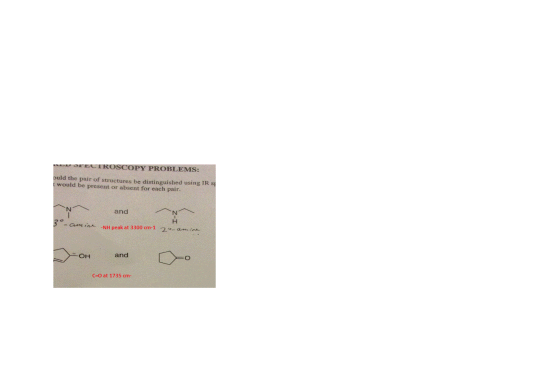
How could the pair of structures be distinguished using IR spectroscopy?...
113 pts) consider the molecules shown below. Briefly explain how you could use IR spectroscopy to...
 113 pts) consider the molecules shown below. Briefly explain how you could use IR spectroscopy to distinguish between each pair of compounds. Give approximate frequencies for any diagnostic peaks you would expect (or not expect) to observe. Focus on the key signal(s) that would allow you to tell the two apart.
IR spectroscopy 1. Match the following six compounds to the IR spectra shown below. Draw the...
 IR spectroscopy 1. Match the following six compounds to the IR spectra shown below. Draw the structure in the box. On the spectra, mark all important peaks with arrows or circles, and label them with corresponding bonds. NH2 orte de Structure: IR Spectrum lould film) 1723 V 4000 2000 3000 1200 1600 V (cm ) Structure: IR Spectrum fiquld fam) 4000 2000 V (cm 16001200800 ) Exp - 119- Exp. 100 Structure: 3600-2500 IR Spectrum liguld fm) U 1715 4000...
explain the questions very well. Thanks! the spectrum as to how they correspond to the structure...
 explain the questions very well. Thanks!
the spectrum as to how they correspond to the structure of the given compound. Br 2. IR spectroscopy: Consider the following compound, Circle the IR spectrum that best corresponds to this compound. Label at least two pieces of information the in the spectrum as to how they correspond to the structure of the given compound.
explain the questions very well. Thanks!
the spectrum as to how they correspond to the structure of the given compound. Br 2. IR spectroscopy: Consider the following compound, Circle the IR spectrum that best corresponds to this compound. Label at least two pieces of information the in the spectrum as to how they correspond to the structure of the given compound.
3. [8 marks) How could IR spectroscopy be used to distinguish between the following pair of compounds for each prob...
 3. [8 marks) How could IR spectroscopy be used to distinguish between the following pair of compounds for each problem? and and and and
IR Spectroscopy Worksheet Name: Station: Section: CH 4511. Problem #1: Below are three IR spectra for...
 IR Spectroscopy Worksheet Name: Station: Section: CH 4511. Problem #1: Below are three IR spectra for the following compounds. Determine which IRs belong to which structures. Indicate the diagnostic bands (feel free to draw on the IRs). Draw your answer in the box provided and include the reasoning for your choice. NO2 ОСНЫ HO Transmittance IR SPECTROSCOPY WORKSHEET 2000 Wavenumber(cm) Structure Reasoning 115 Page % Transmittance 1500 Wavenumber(cm) Structure Reasoning IR SPECTROSCOPY WORKSHEET 116 Page % Transmittance Wevenumber om Structure...
LOD 50 1500 1000 S00 3000 2000 4000 HAVENUMBERI- TANSHETTANCEI% Data Analysis: IR Spectra The below...
 LOD 50 1500 1000 S00 3000 2000 4000 HAVENUMBERI- TANSHETTANCEI% Data Analysis: IR Spectra The below information is what I have so far. I am having |difficulty in figuring out the structure that fits the provided IR spectra. The IR spectra provided literally matches exactly to 2-methylhexane (C7H16), but that does not match the molecular formula given to me by my professor. Any help would be greatly appreciated! Name 1. Unknown code Molecular formula C7H14 2 (2(7)+2-14)/2 = 1 DoU...
Name: Question 11 Four compounds are shown below. Circle which compound is represented by the IR...
 Name: Question 11 Four compounds are shown below. Circle which compound is represented by the IR spectrum above. n is in Briefly explain your reasoning (Think about what is present in the spectrum and what is not present) Structure VENURSER Structure Name: Structure Structure Structure Structure Question 12 1. On the following pages, you will find six IR spectra labeled A-F. Match each of the spectra with one of the following seven compounds (write the letter of the spectrum in...
could IR spectroscopy be used to distinguish between the following pair of compounds? You 6. How...
 could IR spectroscopy be used to distinguish between the following pair of compounds? You 6. How should also list all the major absorption bands in the IR spectra of each of compound А СНзОСНСН, and CH,CHCH,0H B HOCH,CH,CHO and CH,CH CO,H C CH,COCH-CHCH,CH, and CH,COCH,CH,CH-CH2 D CH,CH,CECH and CH,CECCH, E CH-CHCH,CH(CH,)2 and CH,CH,CH,CH(CHah
organic chemistry: use structure to match with IR spectroscopy 2. Match the follow Match the following...
 organic chemistry: use structure to match with IR
spectroscopy
2. Match the follow Match the following six compounds to the IR spectra shown below. Draw the structure in the box. on the spectra, mark all important peaks with arrows or circles, and label them with corresponding bonds. - C- CH.CH.CH Structure: Structure: Structure: Structure: Structure: AA Structure:
organic chemistry: use structure to match with IR
spectroscopy
2. Match the follow Match the following six compounds to the IR spectra shown below. Draw the structure in the box. on the spectra, mark all important peaks with arrows or circles, and label them with corresponding bonds. - C- CH.CH.CH Structure: Structure: Structure: Structure: Structure: AA Structure:
IR Spectroscopy of Aspirin 1. Draw the structure of aspirin and state the chemical name of...
 IR Spectroscopy of Aspirin 1. Draw the structure of aspirin and state the chemical name of aspirin. 2. Indicate the regions (circle and label on your IR spectrum) of your spectrum that correspond to a carbonyl and a hydroxyl functional group. Identify two other regions that correlate with other functional groups/structural features. Indicate these regions on your spectrum (circle and label on your IR spectrum). 3. Use your IR spectrum, melting point data, and FeCly test results to characterize the...
 113 pts) consider the molecules shown below. Briefly explain how you could use IR spectroscopy to distinguish between each pair of compounds. Give approximate frequencies for any diagnostic peaks you would expect (or not expect) to observe. Focus on the key signal(s) that would allow you to tell the two apart.
 IR spectroscopy 1. Match the following six compounds to the IR spectra shown below. Draw the structure in the box. On the spectra, mark all important peaks with arrows or circles, and label them with corresponding bonds. NH2 orte de Structure: IR Spectrum lould film) 1723 V 4000 2000 3000 1200 1600 V (cm ) Structure: IR Spectrum fiquld fam) 4000 2000 V (cm 16001200800 ) Exp - 119- Exp. 100 Structure: 3600-2500 IR Spectrum liguld fm) U 1715 4000...
 explain the questions very well. Thanks!
the spectrum as to how they correspond to the structure of the given compound. Br 2. IR spectroscopy: Consider the following compound, Circle the IR spectrum that best corresponds to this compound. Label at least two pieces of information the in the spectrum as to how they correspond to the structure of the given compound.
explain the questions very well. Thanks!
the spectrum as to how they correspond to the structure of the given compound. Br 2. IR spectroscopy: Consider the following compound, Circle the IR spectrum that best corresponds to this compound. Label at least two pieces of information the in the spectrum as to how they correspond to the structure of the given compound.
 3. [8 marks) How could IR spectroscopy be used to distinguish between the following pair of compounds for each problem? and and and and
 IR Spectroscopy Worksheet Name: Station: Section: CH 4511. Problem #1: Below are three IR spectra for the following compounds. Determine which IRs belong to which structures. Indicate the diagnostic bands (feel free to draw on the IRs). Draw your answer in the box provided and include the reasoning for your choice. NO2 ОСНЫ HO Transmittance IR SPECTROSCOPY WORKSHEET 2000 Wavenumber(cm) Structure Reasoning 115 Page % Transmittance 1500 Wavenumber(cm) Structure Reasoning IR SPECTROSCOPY WORKSHEET 116 Page % Transmittance Wevenumber om Structure...
 LOD 50 1500 1000 S00 3000 2000 4000 HAVENUMBERI- TANSHETTANCEI% Data Analysis: IR Spectra The below information is what I have so far. I am having |difficulty in figuring out the structure that fits the provided IR spectra. The IR spectra provided literally matches exactly to 2-methylhexane (C7H16), but that does not match the molecular formula given to me by my professor. Any help would be greatly appreciated! Name 1. Unknown code Molecular formula C7H14 2 (2(7)+2-14)/2 = 1 DoU...
 Name: Question 11 Four compounds are shown below. Circle which compound is represented by the IR spectrum above. n is in Briefly explain your reasoning (Think about what is present in the spectrum and what is not present) Structure VENURSER Structure Name: Structure Structure Structure Structure Question 12 1. On the following pages, you will find six IR spectra labeled A-F. Match each of the spectra with one of the following seven compounds (write the letter of the spectrum in...
 could IR spectroscopy be used to distinguish between the following pair of compounds? You 6. How should also list all the major absorption bands in the IR spectra of each of compound А СНзОСНСН, and CH,CHCH,0H B HOCH,CH,CHO and CH,CH CO,H C CH,COCH-CHCH,CH, and CH,COCH,CH,CH-CH2 D CH,CH,CECH and CH,CECCH, E CH-CHCH,CH(CH,)2 and CH,CH,CH,CH(CHah
 organic chemistry: use structure to match with IR
spectroscopy
2. Match the follow Match the following six compounds to the IR spectra shown below. Draw the structure in the box. on the spectra, mark all important peaks with arrows or circles, and label them with corresponding bonds. - C- CH.CH.CH Structure: Structure: Structure: Structure: Structure: AA Structure:
organic chemistry: use structure to match with IR
spectroscopy
2. Match the follow Match the following six compounds to the IR spectra shown below. Draw the structure in the box. on the spectra, mark all important peaks with arrows or circles, and label them with corresponding bonds. - C- CH.CH.CH Structure: Structure: Structure: Structure: Structure: AA Structure:
 IR Spectroscopy of Aspirin 1. Draw the structure of aspirin and state the chemical name of aspirin. 2. Indicate the regions (circle and label on your IR spectrum) of your spectrum that correspond to a carbonyl and a hydroxyl functional group. Identify two other regions that correlate with other functional groups/structural features. Indicate these regions on your spectrum (circle and label on your IR spectrum). 3. Use your IR spectrum, melting point data, and FeCly test results to characterize the...
Most questions answered within 3 hours.
-
Where is the error in this code sequence?
String s1 = "Hello";
String s2 = "ello";...
asked 10 months ago -
Financial data for Joel de Paris, Inc., for last year
follow:
Joel de Paris, Inc.
Balance...
asked 10 months ago -
Consider this reaction:
Al2(SO4)3 (aq)+ BaCl3
(aq) Al2Cl6 (aq)- +
3BaSO4(s) . What is the...
asked 10 months ago -
Suppose that Savneet is considering increasing her
recent random sample from 20 car rentals to 40...
asked 10 months ago -
Trucks arrive at an unloading terminal at an average rate of 120
per hour.
Trucks arrive...
asked 10 months ago -
Why are methanol and ethanol completely soluble in water while
octanol is not very little soluble....
asked 10 months ago -
A facilities manager at a university reads in a research report
that the mean amount of...
asked 10 months ago -
When the CuSO4 is rehydrated by adding water to the anhydrous
compound, is this an endothermic...
asked 10 months ago -
A ray of sunlight is passing from diamond into crown glass; the
angle of incidence is...
asked 10 months ago -
A block of mass 0.249 kg is placed on top of a light, vertical
spring of...
asked 10 months ago -
how do the kidneys compensate in the presences of acidosis
a) trigger hyperventilate
b) reserve acid...
asked 10 months ago -
Question 501 pts
The rental rate of capital to the firm increases. Which of the
following...
asked 10 months ago