
Homework Answers
Add Answer to:
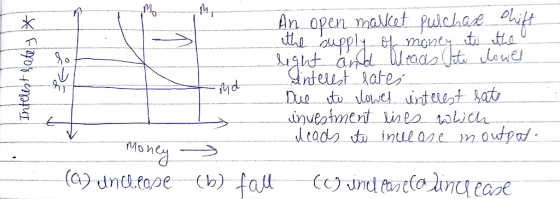
which w investment, which results in rin output row An open market purchase will y|the supply...
13) An open market purchase of bonds by the central bank will cause which of the following when a liquidity trap situati...
13) An open market purchase of bonds by the central bank will cause which of the following when a liquidity trap situation exists? A) The money supply, M, will not change. B) Output will increase. C) The interest rate will decrease. D) The interest rate will not change. E) none of the above 14) Which of the following is a liability on a bankʹs balance sheet? A) loans B) checkable deposits C) reserves D) all of the above E) none...
When the Fed conducts an open market purchase, the Fed buys securities from banks and the...
 When the Fed conducts an open market purchase, the Fed buys securities from banks and the money supply increases As a result of the open market purchase, the O A. 0 B. ° C. money demand curve will shift to the left. money supply curve will shift to the left. money supply curve will shift to the right. OD. money demand curve will tthe right The new equilibrium will be where O A. the new money supply curve intersects the...
13. If the Fed conducts Open Market Purchase, then: a. price of bonds increase, interest rates decrease and money supply...
13. If the Fed conducts Open Market Purchase, then: a. price of bonds increase, interest rates decrease and money supply decreases. b. price of bonds decrease, interest rates increase and money supply decreases. c. price of bonds increase, interest rates decrease and money supply increases. d. price of bonds decrease, interest rates decrease and money supply increases.
7. Suppose the goods market is at the equilibrium. Which of the following events will cause...
 7. Suppose the goods market is at the equilibrium. Which of the following events will cause the largest 1 increase in output? Hint: Y = Co +I+G - 1-o G-61] A. T decreases by 10 B. I increases by 10 C. G increases by 5 D. both A and B. E. both A and C. F. both B and C. 8. The interest rate will increase as a result of which of the following events? A. An increase in income...
An important way in which the Federal Reserve decreases the money supply is through open market...
An important way in which the Federal Reserve decreases the money supply is through open market sales—selling bonds in the secondary market to banks or the public. Using a supply and demand analysis of bondsexplain what happens to the interest rate. A graph is required for this part of the question. Make sure that youlabel the graph—axes, curves, and significant points—appropriately.
Which one of the following is the result of a contractionary open market operation by the...
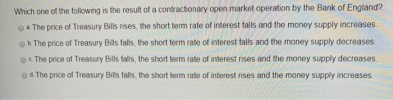 Which one of the following is the result of a contractionary open market operation by the Bank of England? a. The price of Treasury Bills rises, the short term rate of interest falls and the money supply increases b. The price of Treasury Bills falls, the short term rate of interest falls and the money supply decreases. c. The price of Treasury Bills falls, the short term rate of interest rises and the money supply decreases d. The price of...
Which of the following would reduce the money supply? Multiple Choice An open market sale of...
 Which of the following would reduce the money supply? Multiple Choice An open market sale of government bonds by the Fed. Commercial banks use excess reserves to buy government bonds from the public. Taasisi An open market purchase of government bonds by the Fed. A check clears from Bank A to Bank B.
Question 1 (1 point) An open market purchase of T-bills by the Fed will: have no...
 Question 1 (1 point) An open market purchase of T-bills by the Fed will: have no effect on the money supply. decrease the money supply. increase the money supply. O increase the amount of government bonds held at banks. Question 2 (1 point) Contractionary monetary policy _____ interest rates, causing aggregate demand to shift to the lowers; right Olowers; left O raises; right Oraises; left Which of the following aggregate demand - aggregate supply models illustrates the short-run effects of...
When the Fed increases the money supply through open market operations, it can take some time...
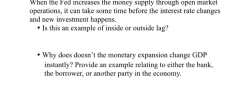 When the Fed increases the money supply through open market operations, it can take some time before the interest rate changes and new investment happens. • Is this an example of inside or outside lag? • Why does doesn't the monetary expansion change GDP instantly? Provide an example relating to either the bank, the borrower, or another party in the economy.
3. Assume that the money market is initially in equilibrium and that the money supply is then increased. Explain th...
 3. Assume that the money market is initially in equilibrium and that the money supply is then increased. Explain the adjustments toward a new equilibrium interest rate. Will bond prices be higher at the new equilibrium rate of interest? What effects would you expect that interest-rate change to have on the levels of output, employment, and prices? Answer the same questions for a decrease in the money supply 4. How is the chairperson of the Federal Reserve Board selected? Describe...
 When the Fed conducts an open market purchase, the Fed buys securities from banks and the money supply increases As a result of the open market purchase, the O A. 0 B. ° C. money demand curve will shift to the left. money supply curve will shift to the left. money supply curve will shift to the right. OD. money demand curve will tthe right The new equilibrium will be where O A. the new money supply curve intersects the...
 7. Suppose the goods market is at the equilibrium. Which of the following events will cause the largest 1 increase in output? Hint: Y = Co +I+G - 1-o G-61] A. T decreases by 10 B. I increases by 10 C. G increases by 5 D. both A and B. E. both A and C. F. both B and C. 8. The interest rate will increase as a result of which of the following events? A. An increase in income...
 Which one of the following is the result of a contractionary open market operation by the Bank of England? a. The price of Treasury Bills rises, the short term rate of interest falls and the money supply increases b. The price of Treasury Bills falls, the short term rate of interest falls and the money supply decreases. c. The price of Treasury Bills falls, the short term rate of interest rises and the money supply decreases d. The price of...
 Which of the following would reduce the money supply? Multiple Choice An open market sale of government bonds by the Fed. Commercial banks use excess reserves to buy government bonds from the public. Taasisi An open market purchase of government bonds by the Fed. A check clears from Bank A to Bank B.
 Question 1 (1 point) An open market purchase of T-bills by the Fed will: have no effect on the money supply. decrease the money supply. increase the money supply. O increase the amount of government bonds held at banks. Question 2 (1 point) Contractionary monetary policy _____ interest rates, causing aggregate demand to shift to the lowers; right Olowers; left O raises; right Oraises; left Which of the following aggregate demand - aggregate supply models illustrates the short-run effects of...
 When the Fed increases the money supply through open market operations, it can take some time before the interest rate changes and new investment happens. • Is this an example of inside or outside lag? • Why does doesn't the monetary expansion change GDP instantly? Provide an example relating to either the bank, the borrower, or another party in the economy.
 3. Assume that the money market is initially in equilibrium and that the money supply is then increased. Explain the adjustments toward a new equilibrium interest rate. Will bond prices be higher at the new equilibrium rate of interest? What effects would you expect that interest-rate change to have on the levels of output, employment, and prices? Answer the same questions for a decrease in the money supply 4. How is the chairperson of the Federal Reserve Board selected? Describe...
Most questions answered within 3 hours.
-
Where is the error in this code sequence?
String s1 = "Hello";
String s2 = "ello";...
asked 11 months ago -
Financial data for Joel de Paris, Inc., for last year
follow:
Joel de Paris, Inc.
Balance...
asked 11 months ago -
Consider this reaction:
Al2(SO4)3 (aq)+ BaCl3
(aq) Al2Cl6 (aq)- +
3BaSO4(s) . What is the...
asked 11 months ago -
Suppose that Savneet is considering increasing her
recent random sample from 20 car rentals to 40...
asked 11 months ago -
Trucks arrive at an unloading terminal at an average rate of 120
per hour.
Trucks arrive...
asked 11 months ago -
Why are methanol and ethanol completely soluble in water while
octanol is not very little soluble....
asked 11 months ago -
A facilities manager at a university reads in a research report
that the mean amount of...
asked 11 months ago -
When the CuSO4 is rehydrated by adding water to the anhydrous
compound, is this an endothermic...
asked 11 months ago -
A ray of sunlight is passing from diamond into crown glass; the
angle of incidence is...
asked 11 months ago -
A block of mass 0.249 kg is placed on top of a light, vertical
spring of...
asked 11 months ago -
how do the kidneys compensate in the presences of acidosis
a) trigger hyperventilate
b) reserve acid...
asked 11 months ago -
Question 501 pts
The rental rate of capital to the firm increases. Which of the
following...
asked 11 months ago