
Homework Answers
Add Answer to:
age and the autoestions that would restrange o form a nace sable cartocation . 3. Circle...
answer all questions 1. For the following substrates, predict whether a carbocation rearrangement will take place...
 answer all questions
1. For the following substrates, predict whether a carbocation rearrangement will take place in an SN1/E1 mechanism by first drawing the carbocation intermediate, then deciding if the carbocation will rearrange (can it form a more stable carbocation by hydride or methyl shift?): Carbocation: Sturcture Rearrange? If yes, draw the rearranged product. If no, write No н.с Br Н,с, Cн, 2. For each pair of nucle ophiles, circle which will react faster with CHsl in an Sx2 reaction....
answer all questions
1. For the following substrates, predict whether a carbocation rearrangement will take place in an SN1/E1 mechanism by first drawing the carbocation intermediate, then deciding if the carbocation will rearrange (can it form a more stable carbocation by hydride or methyl shift?): Carbocation: Sturcture Rearrange? If yes, draw the rearranged product. If no, write No н.с Br Н,с, Cн, 2. For each pair of nucle ophiles, circle which will react faster with CHsl in an Sx2 reaction....
For each of the following pairs of organic molecules, circle the one that would react with...
 For each of the following pairs of organic molecules, circle the one that would react with a given nucleophile at a faster rate in the Sw1 reaction, and briefly explain your choice. нссн, vs. H₂C CH₂ CH Hoc tots vs. Ho C^ots 6. Each of the following carbocations can undergo a rearrangement to give a more stable carbocation. In each case, draw the structure of the rearranged carbocation, and show the mechanism of the 1,2 hydride shift or 1,2-alkyl shift...
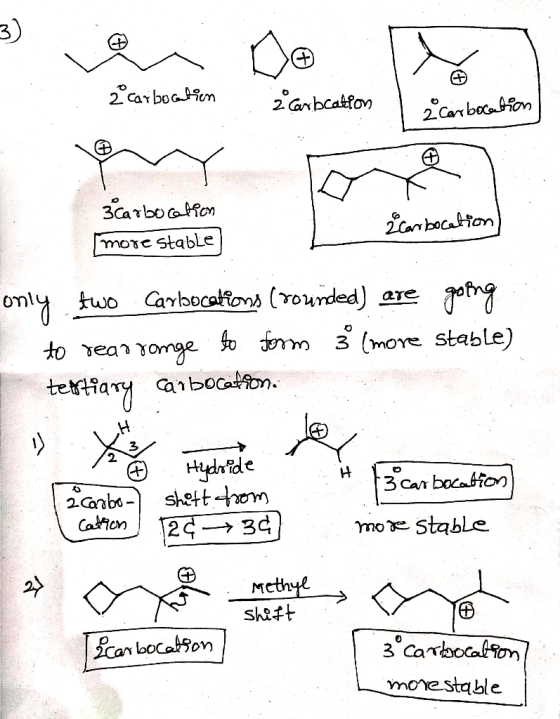
From the list of carbocations below, select the carbocation(s) that can rearrange via hydride shift to...
 From the list of carbocations below, select the carbocation(s) that can rearrange via hydride shift to a more stable carbocation. CH2
Predict whether the following carbocations will rearrange. For those that do show the mechanism of the...
 Predict whether the following carbocations will rearrange. For those that do show the mechanism of the rearrangement and the structure of the rearranged carbocation. Note that if a 'hydride transfer occurs, the hydrogens are not shown. For TWO of them, a rearrangement will occur that results in a more stable carbocation due to resonance. Show the two resonance forms that result YES NO YES NO YES NO YES NO YES NO YES NO YES NO
which of the following carbocations can undergo a hydride shift to be more stable than it...
 which of the following carbocations can undergo a hydride
shift to be more stable than it was?
Which of the following carbocation(s) can undergo a hydride shift to be more stable than it was? which of the follow do y como Select one: a. Carbocationc b. none of the carbocations c. Carbocation a O d. Carbocation d e. Carbocation b
which of the following carbocations can undergo a hydride
shift to be more stable than it was?
Which of the following carbocation(s) can undergo a hydride shift to be more stable than it was? which of the follow do y como Select one: a. Carbocationc b. none of the carbocations c. Carbocation a O d. Carbocation d e. Carbocation b
1. Rank the following carbocations in order from most stable (1) to least stable (4). o...
 1. Rank the following carbocations in order from most stable (1) to least stable (4). o ó no 8 2. Consider the following carbocation. Would this carbocation undergo a rearrangement? If so, show the mechanism (curved arrows) for the rearrangement (including the rearranged cation that is the product of your curved arrows) and explain why it happens. If not, explain why it would not rearrange.
Question 9 1 pts Which ane of the following carbocations, as drawn, is the mast stable?...
 Question 9 1 pts Which ane of the following carbocations, as drawn, is the mast stable? Me CH (methyl cation) Cна Me Me Question 10 1 pts With respect to the previous question, which carbocation (A, B, C, D, or E) is most likely to undergo a 1,2-hydride shift to generate a more stable carbocation? A
Which of the following carbocation(s) can undergo a methyl shift OR Hydride shift to be more...
 Which of the following carbocation(s) can undergo a methyl shift OR Hydride shift to be more stable than it was? o den 8 a Select one or more: a. Carbocation a b. Carbocation d B c. Carbocationc d. Carbocation b
O- CHE Br CH2 H3C Hac Electrophilic addition of HBr toalkenes yields a bromoalkane. The reaction...
 Electrophilic addition of HBr to alkenes yields a bromoalkane. The reaction begins with an attack on the hydrogen of the electrophilic HBr by the electrons of the double bond to give a carbocation. This step follows Markovnikov's rule with the electrophilic H atom adding to the sp2 carbon containing the most hydrogens, leading to the formation of the most stable carbocation (1° < 2° < 3°). If possible, a 1,2-shift of either a neighboring hydride or methyl group can occur...
Which of the following carbocation(s) can undergo a methyl shift and hydride shift to be more...
 Which of the following carbocation(s) can undergo a methyl shift and hydride shift to be more stable than it was? Oo ngoa Select one: O a. Non of the above O b. Carbocation a o c. Carbocation b O d. Carbocationc O e. Carbocation d
 answer all questions
1. For the following substrates, predict whether a carbocation rearrangement will take place in an SN1/E1 mechanism by first drawing the carbocation intermediate, then deciding if the carbocation will rearrange (can it form a more stable carbocation by hydride or methyl shift?): Carbocation: Sturcture Rearrange? If yes, draw the rearranged product. If no, write No н.с Br Н,с, Cн, 2. For each pair of nucle ophiles, circle which will react faster with CHsl in an Sx2 reaction....
answer all questions
1. For the following substrates, predict whether a carbocation rearrangement will take place in an SN1/E1 mechanism by first drawing the carbocation intermediate, then deciding if the carbocation will rearrange (can it form a more stable carbocation by hydride or methyl shift?): Carbocation: Sturcture Rearrange? If yes, draw the rearranged product. If no, write No н.с Br Н,с, Cн, 2. For each pair of nucle ophiles, circle which will react faster with CHsl in an Sx2 reaction....
 For each of the following pairs of organic molecules, circle the one that would react with a given nucleophile at a faster rate in the Sw1 reaction, and briefly explain your choice. нссн, vs. H₂C CH₂ CH Hoc tots vs. Ho C^ots 6. Each of the following carbocations can undergo a rearrangement to give a more stable carbocation. In each case, draw the structure of the rearranged carbocation, and show the mechanism of the 1,2 hydride shift or 1,2-alkyl shift...
 From the list of carbocations below, select the carbocation(s) that can rearrange via hydride shift to a more stable carbocation. CH2
 Predict whether the following carbocations will rearrange. For those that do show the mechanism of the rearrangement and the structure of the rearranged carbocation. Note that if a 'hydride transfer occurs, the hydrogens are not shown. For TWO of them, a rearrangement will occur that results in a more stable carbocation due to resonance. Show the two resonance forms that result YES NO YES NO YES NO YES NO YES NO YES NO YES NO
 which of the following carbocations can undergo a hydride
shift to be more stable than it was?
Which of the following carbocation(s) can undergo a hydride shift to be more stable than it was? which of the follow do y como Select one: a. Carbocationc b. none of the carbocations c. Carbocation a O d. Carbocation d e. Carbocation b
which of the following carbocations can undergo a hydride
shift to be more stable than it was?
Which of the following carbocation(s) can undergo a hydride shift to be more stable than it was? which of the follow do y como Select one: a. Carbocationc b. none of the carbocations c. Carbocation a O d. Carbocation d e. Carbocation b
 1. Rank the following carbocations in order from most stable (1) to least stable (4). o ó no 8 2. Consider the following carbocation. Would this carbocation undergo a rearrangement? If so, show the mechanism (curved arrows) for the rearrangement (including the rearranged cation that is the product of your curved arrows) and explain why it happens. If not, explain why it would not rearrange.
 Question 9 1 pts Which ane of the following carbocations, as drawn, is the mast stable? Me CH (methyl cation) Cна Me Me Question 10 1 pts With respect to the previous question, which carbocation (A, B, C, D, or E) is most likely to undergo a 1,2-hydride shift to generate a more stable carbocation? A
 Which of the following carbocation(s) can undergo a methyl shift OR Hydride shift to be more stable than it was? o den 8 a Select one or more: a. Carbocation a b. Carbocation d B c. Carbocationc d. Carbocation b
 Which of the following carbocation(s) can undergo a methyl shift and hydride shift to be more stable than it was? Oo ngoa Select one: O a. Non of the above O b. Carbocation a o c. Carbocation b O d. Carbocationc O e. Carbocation d
Most questions answered within 3 hours.
-
Where is the error in this code sequence?
String s1 = "Hello";
String s2 = "ello";...
asked 10 months ago -
Financial data for Joel de Paris, Inc., for last year
follow:
Joel de Paris, Inc.
Balance...
asked 10 months ago -
Consider this reaction:
Al2(SO4)3 (aq)+ BaCl3
(aq) Al2Cl6 (aq)- +
3BaSO4(s) . What is the...
asked 10 months ago -
Suppose that Savneet is considering increasing her
recent random sample from 20 car rentals to 40...
asked 10 months ago -
Trucks arrive at an unloading terminal at an average rate of 120
per hour.
Trucks arrive...
asked 10 months ago -
Why are methanol and ethanol completely soluble in water while
octanol is not very little soluble....
asked 10 months ago -
A facilities manager at a university reads in a research report
that the mean amount of...
asked 10 months ago -
When the CuSO4 is rehydrated by adding water to the anhydrous
compound, is this an endothermic...
asked 10 months ago -
A ray of sunlight is passing from diamond into crown glass; the
angle of incidence is...
asked 10 months ago -
A block of mass 0.249 kg is placed on top of a light, vertical
spring of...
asked 10 months ago -
how do the kidneys compensate in the presences of acidosis
a) trigger hyperventilate
b) reserve acid...
asked 10 months ago -
Question 501 pts
The rental rate of capital to the firm increases. Which of the
following...
asked 10 months ago