A classical gas of N particles is contained in a volume V. Show that the probability...
A classical gas of N particles is contained in a volume V. Show that the probability of n particles being in a small subvolume v of the gas is given by the Poisson distribution P(n)=nne-n/n!, where n=Np=N(v/V) is the mean number of particles in the subvolume v.
Homework Answers

Answer question
Add Answer to:
A classical gas of N particles is contained in a volume V. Show
that the probability...
An ideal gas enclosed in a volume V is composed of N identical particles in equilibrium...
An ideal gas enclosed in a volume V is composed of N identical particles in equilibrium at temperature T. (a) Write down the N-particle classical partition function Z in terms of the single-particle partition function ζ, and show that Z it can be written as ln(Z)=N(ln (V/N) + 3/2ln(T)+σ (1) where σ does not depend on either N, T or V . (b) From Equation 1 derive the mean energy E, the equation of state of the ideal gas and...
1.9 The probability W(n) that an event characterized by a probability p occurs n times in...
 1.9 The probability W(n) that an event characterized by a probability p occurs n times in N trials was shown to be given by the binomial distribution Consider a situation where the probability p is small (p « 1) and where one is interested in the case n < N. (Note that if N is large, W(n) becomes very small if n → N because of the smallness of the factor P" when p 《I. Hence W(n) is indeed only...
Problem One (10 points) An ideal Bose gas consists of particles in volume V at thermal...
 Problem One (10 points) An ideal Bose gas consists of particles in volume V at thermal equilibrium. 1. Evaluate the transition temperature of the gas in term of N. V. and mass m of the particles. 2. Show that the heat capacity, C, of the gas at low temperature ( 7 72) is proportional with T3, whereas it is constant at high temperature,
(80 pts) Entropy of the ideal gas: Consider a monatomic gas of identical non-interacting particles of...
 (80 pts) Entropy of the ideal gas: Consider a monatomic gas of identical non-interacting particles of mass m. The kinetic energy of each particle is given in terms of its momentum p by Ekinp2/(2m). For a given total energy U, volume V and total particle number N (with N » 1) calculate the entropy S(U, V,N)-klog Ω(U, V,N), where Ω(U, V,N) counts the number of different microscopic configurations for given N, U and V. To get a finite number for...
Problem 7: A cloud of particles and anti-particles suddenly appears and immediately all parti- cle/anti-particle pairs...
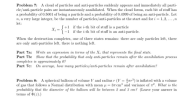 Problem 7: A cloud of particles and anti-particles suddenly appears and immediately all parti- cle/anti-particle pairs are instantaneously annihilated. When the cloud forms, each bit of stuff has a probability of 0.5001 of being a particle and a probability of 0.4999 of being an anti-particle. Let n, a very large integer, be the number of particles/anti-particles at the start and for i = 1,2,...,n let: 5+1 if the i-th bit of stuff is a particle 1-1 if the i-th bit...
Students must show work to receive full credit. 1. Differentiate “Empirical Probability” and “Classical Probability”. 2....
Students must show work to receive full credit. 1. Differentiate “Empirical Probability” and “Classical Probability”. 2. Define “Independent Events”, “Mutually Exclusive Events”, and “Collectively Exhaustive Events”. 3. Suppose there are 15 red marbles and 5 blue marbles in a box. (3.a) If an individual randomly selects two marbles without replacement, what is the probability that both marbles are red? (3.b) If an individual randomly selects two marbles with replacement, what is the probability that both marbles are red? 4. Solve...
Help me the part b please, if possible part c too The binomial distribution is B(n,pl-probability...
 Help me the part b please, if
possible part c too
The binomial distribution is B(n,pl-probability for variable X to be equal to K P(X-k) with m we define-np, which is the probability of success for n events each with probability p we take the limit when う00 (we consider a very large number of events M-1 2 Mass (Da) 2. Poisson distribution a. Show that the Poisson distribution,p(kl)arises from the binomial distribution in the limit that p 1 and...
Help me the part b please, if
possible part c too
The binomial distribution is B(n,pl-probability for variable X to be equal to K P(X-k) with m we define-np, which is the probability of success for n events each with probability p we take the limit when う00 (we consider a very large number of events M-1 2 Mass (Da) 2. Poisson distribution a. Show that the Poisson distribution,p(kl)arises from the binomial distribution in the limit that p 1 and...
B.2 The multiplicity of a monatomic ideal gas is given by 2 = f(N)VN U3N/2, where...
 B.2 The multiplicity of a monatomic ideal gas is given by 2 = f(N)VN U3N/2, where V is the volume occupied by the gas, U its internal energy, N the number of particles in the gas and f(N) a complicated function of N. [2] (i) Show that the entropy S of this system is given by 3 S = Nkg In V + ŽNkg In U + g(N), where g(N) is some function of N. (ii) Define the temperature T...
1. Show that for a classical ideal gas, Q1 alnQ1 NK Hint: Start with the partition function for t...
 1. Show that for a classical ideal gas, Q1 alnQ1 NK Hint: Start with the partition function for the classical ideal gas ( Q1) and use above equation to find the value of right-hand side and compare with the value of r we derive in the class. (Recall entropy you derived for classical gas) NK Making use of the fact that the Helmholtz free energy A (N, V, T) of a thermodynamic system is an extensive property of the system....
 1.9 The probability W(n) that an event characterized by a probability p occurs n times in N trials was shown to be given by the binomial distribution Consider a situation where the probability p is small (p « 1) and where one is interested in the case n < N. (Note that if N is large, W(n) becomes very small if n → N because of the smallness of the factor P" when p 《I. Hence W(n) is indeed only...
 Problem One (10 points) An ideal Bose gas consists of particles in volume V at thermal equilibrium. 1. Evaluate the transition temperature of the gas in term of N. V. and mass m of the particles. 2. Show that the heat capacity, C, of the gas at low temperature ( 7 72) is proportional with T3, whereas it is constant at high temperature,
 (80 pts) Entropy of the ideal gas: Consider a monatomic gas of identical non-interacting particles of mass m. The kinetic energy of each particle is given in terms of its momentum p by Ekinp2/(2m). For a given total energy U, volume V and total particle number N (with N » 1) calculate the entropy S(U, V,N)-klog Ω(U, V,N), where Ω(U, V,N) counts the number of different microscopic configurations for given N, U and V. To get a finite number for...
 Problem 7: A cloud of particles and anti-particles suddenly appears and immediately all parti- cle/anti-particle pairs are instantaneously annihilated. When the cloud forms, each bit of stuff has a probability of 0.5001 of being a particle and a probability of 0.4999 of being an anti-particle. Let n, a very large integer, be the number of particles/anti-particles at the start and for i = 1,2,...,n let: 5+1 if the i-th bit of stuff is a particle 1-1 if the i-th bit...
 Help me the part b please, if
possible part c too
The binomial distribution is B(n,pl-probability for variable X to be equal to K P(X-k) with m we define-np, which is the probability of success for n events each with probability p we take the limit when う00 (we consider a very large number of events M-1 2 Mass (Da) 2. Poisson distribution a. Show that the Poisson distribution,p(kl)arises from the binomial distribution in the limit that p 1 and...
Help me the part b please, if
possible part c too
The binomial distribution is B(n,pl-probability for variable X to be equal to K P(X-k) with m we define-np, which is the probability of success for n events each with probability p we take the limit when う00 (we consider a very large number of events M-1 2 Mass (Da) 2. Poisson distribution a. Show that the Poisson distribution,p(kl)arises from the binomial distribution in the limit that p 1 and...
 B.2 The multiplicity of a monatomic ideal gas is given by 2 = f(N)VN U3N/2, where V is the volume occupied by the gas, U its internal energy, N the number of particles in the gas and f(N) a complicated function of N. [2] (i) Show that the entropy S of this system is given by 3 S = Nkg In V + ŽNkg In U + g(N), where g(N) is some function of N. (ii) Define the temperature T...
 1. Show that for a classical ideal gas, Q1 alnQ1 NK Hint: Start with the partition function for the classical ideal gas ( Q1) and use above equation to find the value of right-hand side and compare with the value of r we derive in the class. (Recall entropy you derived for classical gas) NK Making use of the fact that the Helmholtz free energy A (N, V, T) of a thermodynamic system is an extensive property of the system....
Most questions answered within 3 hours.
-
Where is the error in this code sequence?
String s1 = "Hello";
String s2 = "ello";...
asked 11 months ago -
Financial data for Joel de Paris, Inc., for last year
follow:
Joel de Paris, Inc.
Balance...
asked 11 months ago -
Consider this reaction:
Al2(SO4)3 (aq)+ BaCl3
(aq) Al2Cl6 (aq)- +
3BaSO4(s) . What is the...
asked 11 months ago -
Suppose that Savneet is considering increasing her
recent random sample from 20 car rentals to 40...
asked 11 months ago -
Trucks arrive at an unloading terminal at an average rate of 120
per hour.
Trucks arrive...
asked 11 months ago -
Why are methanol and ethanol completely soluble in water while
octanol is not very little soluble....
asked 11 months ago -
A facilities manager at a university reads in a research report
that the mean amount of...
asked 11 months ago -
When the CuSO4 is rehydrated by adding water to the anhydrous
compound, is this an endothermic...
asked 11 months ago -
A ray of sunlight is passing from diamond into crown glass; the
angle of incidence is...
asked 11 months ago -
A block of mass 0.249 kg is placed on top of a light, vertical
spring of...
asked 11 months ago -
how do the kidneys compensate in the presences of acidosis
a) trigger hyperventilate
b) reserve acid...
asked 11 months ago -
Question 501 pts
The rental rate of capital to the firm increases. Which of the
following...
asked 11 months ago