Methanol is converted to formaldehyde by alcohol dehydrogenase. Would the alcohol dehydrogenase reaction be useful in...
Methanol is converted to formaldehyde by alcohol dehydrogenase. Would the alcohol dehydrogenase reaction be useful in determining whether wine had been adulterated with methanol? Explain. Please and thank you!
Homework Answers
Alcohol dehydrogenase enzymes facilitate the conversion of alcohols to aldehydes or ketones with the reduction of nicotinamide adenine dinucleotide (NAD+-----> NADH). If the wine sample contains methanol then this enzyme will convert methanol to formaldehyde but also convert ethanol (the main component of alcohol) to acetaldehyde. Unfortunately, there is no test to determine the presence of formaldehyde in presence of acetaldehyde while converse is true. Iodoform test identifies alpha hydrogen atoms or the CH3 groups directly attached to the carbonyl groups. The alpha hydrogen atoms are acidic and will react with a base to form anion. This anion will react with iodine to form alpha iodo product. The alpha iodo product is attacked by the base to give carboxylic acid and yellow coloured iodoform. Please find image for detailed mechanism of iodoform test. Thus acetaldehyde will show positive results while formaldehyde will show negative results with this test.

A way to test the presence of methanol through the enzyme route will be to further oxidise the aldehyde to corresponding acids using aldehyde hydrogenase enzyme. Since formic acid contains H-C=O group similar to aldehydes, it will give positive results for most aldehyde tests such as Fehling’s test, Tollen’s test and Benedict’s test.
Tollen’s test: The Tollen's reagent contains diamminesilver complex which oxidises aldehyde to carboxylate ion. The carboxylate ion reduces Ag(I) to Ag(0) thus coating the inside of the test tube with a mirror-like layer of elemental silver. Hence this test is also called silver mirror test. Acetic acid, on a contrary, does not have H-C=O group and hence it cannot reduce Tollen’s reagent and will show negative results with this tests.
2[Ag(NH3)2]+ + HOCHO + H2O ----> 2 Ag(s) + 4 NH3 +CO2 + 2H+ + H2O
Add Answer to:
Methanol is converted to formaldehyde by alcohol dehydrogenase.
Would the alcohol dehydrogenase reaction be useful in...
Methanol is highly toxic, not because of its own biological activity but because it is converted...
Methanol is highly toxic, not because of its own biological activity but because it is converted metabolically to formaldehyde, through action of alcohol dehydrogenase. Part of the medical treatment for methanol poisoning involves administration of large doses of ethanol. Explain why this treatment is effective. Please no handwritten or picture responses
Leader name 4. Methanol is a highly poisonous solvent, chemically similar to ethanol (alcohol) and similar...
 Leader name 4. Methanol is a highly poisonous solvent, chemically similar to ethanol (alcohol) and similar in appearance and scent. In the US, methanol poisoning is most likely to occur from Ingestion of windshield wiper fluid or other household or industrial products. Poisoning can also occur from drinking adulterated alcoholic beverages Methanol is broken down to formaldehyde by alcohol dehydrogenase (ADH), and then the formaldehyde is broken down to formic acid by aldehyde dehydrogenase (ALDH). Formic acid is highly toxic...
Problem 12.2 Methanol is highly toxic, not because of its own biological activity but because it...
Problem 12.2 Methanol is highly toxic, not because of its own biological activity but because it is converted metabolically to formaldehyde, through action of alcohol dehydrogenase. Part of the medical treatment for methanol poisoning involves administration of large doses of ethanol. Part A Explain why this treatment is effective. Match the words in the left column to the appropriate blanks in the sentences on the right. Make certain each sentence is complete before submitting your answer. Each word can only...
4.75. A catalytic reactor is used to produce formaldehyde from methanol in the reaction HCHO+ H2...
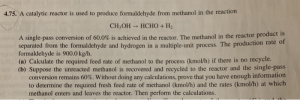 4.75. A catalytic reactor is used to produce formaldehyde from methanol in the reaction HCHO+ H2 CH-OН A single-pass conversion of 60.0% is achieved in the reactor. The methanol in the reactor product is separated from the formaldehyde and hydrogen in a multiple-unit process. The production rate of formaldehyde is 900.0 kg/h. (a) Calculate the required feed rate of methanol to the process (kmol/h) if there is no recycle. (b) Suppose the unreacted methanol is recovered and recycled to the...
Would HCl be just as effective as H2SO4 when catalyzing a methanol and carboxylic acid reaction?...
Would HCl be just as effective as H2SO4 when catalyzing a methanol and carboxylic acid reaction? Please explain. Thank you!
hi could you explain how to build formaldehyde production plant using catalytic oxidation of methanol way?...
hi could you explain how to build formaldehyde production plant using catalytic oxidation of methanol way? what is the reaction? whats raw materials needed?
Syngas can be burned directly or converted to methanol. Calculate AH for the reaction CO(g) +...
 Syngas can be burned directly or converted to methanol. Calculate AH for the reaction CO(g) + 2H2 (g) → CH3OH(1) You may need to use the following data: Substance and State AHf (kJ/mol) CO(g) H2(9) CH3OH(l) -110.5 239 △H = kJ
An alkene can be converted to an alcohol upon reaction with Hg(OAc)2 in H2O followed by...
 An alkene can be converted to an alcohol upon reaction with
Hg(OAc)2 in H2O followed by NaBH4.
In the boxes, draw the mechanism arrows for the reaction below. You
do not have to do the mechanism for the NaBH4 reaction.
Be sure to add lone pairs of electrons and nonzero formal charges
to all species.
NaBH4 O I
An alkene can be converted to an alcohol upon reaction with
Hg(OAc)2 in H2O followed by NaBH4.
In the boxes, draw the mechanism arrows for the reaction below. You
do not have to do the mechanism for the NaBH4 reaction.
Be sure to add lone pairs of electrons and nonzero formal charges
to all species.
NaBH4 O I
Please explain. I need both part a and b. thank you. 2. Alcohol Reaction Mechanism Fill...
 Please explain. I
need both part a and b. thank you.
2. Alcohol Reaction Mechanism Fill in the major organic product and draw a complete curved-arrow mechanism a. H-Br OH b. How would the above reaction change if sulfuric acid were used instead? Why?
Please explain. I
need both part a and b. thank you.
2. Alcohol Reaction Mechanism Fill in the major organic product and draw a complete curved-arrow mechanism a. H-Br OH b. How would the above reaction change if sulfuric acid were used instead? Why?
______________________________________________________________________ Methanol, CH, OH, formerly known as wood alcohol, is manufactured commercially by the following reaction:...
 ______________________________________________________________________
Methanol, CH, OH, formerly known as wood alcohol, is manufactured commercially by the following reaction: CO(g) + 2H2 (9) = CH2OH(9) A 1.500 L vessel was filled with 0.1560 mol CO and 0.3070 mol H. When this mixture came to equilibrium at 500 K, the vessel contained 0.1060 mol CO. How many moles of each substance were in the vessel at equilibrium? mol CO mol H2 mol CH3OH An experimenter places the following concentrations of gases in a closed...
______________________________________________________________________
Methanol, CH, OH, formerly known as wood alcohol, is manufactured commercially by the following reaction: CO(g) + 2H2 (9) = CH2OH(9) A 1.500 L vessel was filled with 0.1560 mol CO and 0.3070 mol H. When this mixture came to equilibrium at 500 K, the vessel contained 0.1060 mol CO. How many moles of each substance were in the vessel at equilibrium? mol CO mol H2 mol CH3OH An experimenter places the following concentrations of gases in a closed...
 Leader name 4. Methanol is a highly poisonous solvent, chemically similar to ethanol (alcohol) and similar in appearance and scent. In the US, methanol poisoning is most likely to occur from Ingestion of windshield wiper fluid or other household or industrial products. Poisoning can also occur from drinking adulterated alcoholic beverages Methanol is broken down to formaldehyde by alcohol dehydrogenase (ADH), and then the formaldehyde is broken down to formic acid by aldehyde dehydrogenase (ALDH). Formic acid is highly toxic...
 4.75. A catalytic reactor is used to produce formaldehyde from methanol in the reaction HCHO+ H2 CH-OН A single-pass conversion of 60.0% is achieved in the reactor. The methanol in the reactor product is separated from the formaldehyde and hydrogen in a multiple-unit process. The production rate of formaldehyde is 900.0 kg/h. (a) Calculate the required feed rate of methanol to the process (kmol/h) if there is no recycle. (b) Suppose the unreacted methanol is recovered and recycled to the...
 Syngas can be burned directly or converted to methanol. Calculate AH for the reaction CO(g) + 2H2 (g) → CH3OH(1) You may need to use the following data: Substance and State AHf (kJ/mol) CO(g) H2(9) CH3OH(l) -110.5 239 △H = kJ
 An alkene can be converted to an alcohol upon reaction with
Hg(OAc)2 in H2O followed by NaBH4.
In the boxes, draw the mechanism arrows for the reaction below. You
do not have to do the mechanism for the NaBH4 reaction.
Be sure to add lone pairs of electrons and nonzero formal charges
to all species.
NaBH4 O I
An alkene can be converted to an alcohol upon reaction with
Hg(OAc)2 in H2O followed by NaBH4.
In the boxes, draw the mechanism arrows for the reaction below. You
do not have to do the mechanism for the NaBH4 reaction.
Be sure to add lone pairs of electrons and nonzero formal charges
to all species.
NaBH4 O I
 Please explain. I
need both part a and b. thank you.
2. Alcohol Reaction Mechanism Fill in the major organic product and draw a complete curved-arrow mechanism a. H-Br OH b. How would the above reaction change if sulfuric acid were used instead? Why?
Please explain. I
need both part a and b. thank you.
2. Alcohol Reaction Mechanism Fill in the major organic product and draw a complete curved-arrow mechanism a. H-Br OH b. How would the above reaction change if sulfuric acid were used instead? Why?
 ______________________________________________________________________
Methanol, CH, OH, formerly known as wood alcohol, is manufactured commercially by the following reaction: CO(g) + 2H2 (9) = CH2OH(9) A 1.500 L vessel was filled with 0.1560 mol CO and 0.3070 mol H. When this mixture came to equilibrium at 500 K, the vessel contained 0.1060 mol CO. How many moles of each substance were in the vessel at equilibrium? mol CO mol H2 mol CH3OH An experimenter places the following concentrations of gases in a closed...
______________________________________________________________________
Methanol, CH, OH, formerly known as wood alcohol, is manufactured commercially by the following reaction: CO(g) + 2H2 (9) = CH2OH(9) A 1.500 L vessel was filled with 0.1560 mol CO and 0.3070 mol H. When this mixture came to equilibrium at 500 K, the vessel contained 0.1060 mol CO. How many moles of each substance were in the vessel at equilibrium? mol CO mol H2 mol CH3OH An experimenter places the following concentrations of gases in a closed...
Most questions answered within 3 hours.
-
Where is the error in this code sequence?
String s1 = "Hello";
String s2 = "ello";...
asked 10 months ago -
Financial data for Joel de Paris, Inc., for last year
follow:
Joel de Paris, Inc.
Balance...
asked 10 months ago -
Consider this reaction:
Al2(SO4)3 (aq)+ BaCl3
(aq) Al2Cl6 (aq)- +
3BaSO4(s) . What is the...
asked 10 months ago -
Suppose that Savneet is considering increasing her
recent random sample from 20 car rentals to 40...
asked 10 months ago -
Trucks arrive at an unloading terminal at an average rate of 120
per hour.
Trucks arrive...
asked 10 months ago -
Why are methanol and ethanol completely soluble in water while
octanol is not very little soluble....
asked 10 months ago -
A facilities manager at a university reads in a research report
that the mean amount of...
asked 10 months ago -
When the CuSO4 is rehydrated by adding water to the anhydrous
compound, is this an endothermic...
asked 10 months ago -
A ray of sunlight is passing from diamond into crown glass; the
angle of incidence is...
asked 10 months ago -
A block of mass 0.249 kg is placed on top of a light, vertical
spring of...
asked 10 months ago -
how do the kidneys compensate in the presences of acidosis
a) trigger hyperventilate
b) reserve acid...
asked 10 months ago -
Question 501 pts
The rental rate of capital to the firm increases. Which of the
following...
asked 10 months ago