
Homework Answers
The solution is given below
If any doubts post in comment section
Add Answer to:
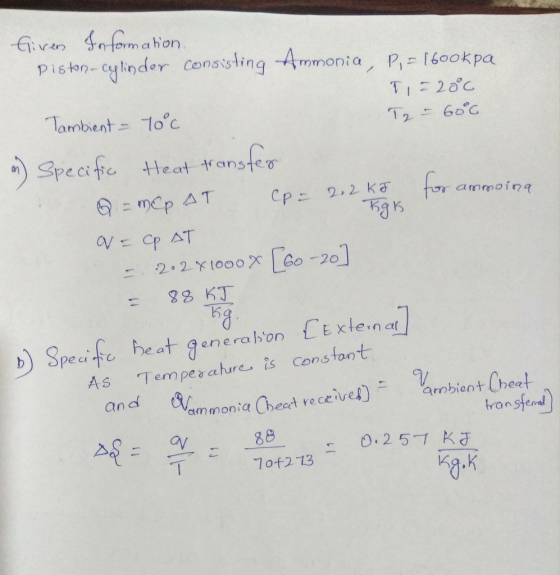
An internally reversible, externally irreversible process Ammonia in a piston-cylinder that maintains constant P is at...
Ammonia is contained in a piston-cylinder assembly. The ammonia undergoes a reversible, isobaric process from an...
Ammonia is contained in a piston-cylinder assembly. The ammonia undergoes a reversible, isobaric process from an initial pressure of 30 lbf/in2 and volume of 4 ft3/lb to a final temperature of 70° F. The mass of ammonia is 0.35 lb. Determine the amount of work done on the ammonia in Btu, the amount of heat transfer to the ammonia in Btu, and the temperature at which the heat transfer occurs in °F. Assume that the heat transfer occurs at a...
4. Nitrogen in a piston/cylinder assembly undergoes an internally reversible compression between specified states through a...
 4. Nitrogen in a piston/cylinder assembly undergoes an internally reversible compression between specified states through a polytropic process with n=1.30. Determine P, the work and heat transfer and entropy change during the process. The volume at state 1 is 0.5 m', the pressure at state 1 is 1. bar, and the temperature at state 1 is 20°C. The temperature at state 2 is 200°C. P2 - bar W = Q= AS _ kJ/K
A piston-cylinder assembly contains ammonia, initially at a temperature of -20°C and a quality of 70%....
 A piston-cylinder assembly contains ammonia, initially at a temperature of -20°C and a quality of 70%. The ammonia is slowly heated to a final state where the pressure is 6 bar and the temperature is 160°C. While the ammonia is heated, its pressure varies linearly with specific volume. For the ammonia, determine the work and heat transfer, each in kJ/kg.
Nitrogen in a piston cylinder device occupies 0.5 m3 at 100 kPa and 20 °C. It undergoes a compres...
 Nitrogen in a piston cylinder device occupies 0.5 m3 at 100 kPa and 20 °C. It undergoes a compression process (during which PV1.30-constant) to a final state where the temperature is 200 °C. The specific heats are assumed to be constant while Tsur - 15 C a) Prove that the gas, at state 1, can be treated as an ideal gas. b) Find the pressure and volume at state 2 c) Find the heat transfer, in kJ. d) Find the...
Problem 7-173- A piston–cylinder device contains air that undergoes a reversible thermodynamic cycle. Initially, air is...
Problem 7-173- A piston–cylinder device contains air that undergoes a reversible thermodynamic cycle. Initially, air is at 400 kPa and 300 K with a volume of 0.3 m3. Air is first expanded isothermally to 150 kPa, then compressed adiabatically to the initial pressure, and finally compressed at the constant pressure to the initial state. Accounting for the variation of specific heats with temperature, determine the work and heat transfer for each process.
A frictionless-piston-cylinder device contains a liquid-vapor mixture of water at 200°C. During a constant- pressure process,...
 A frictionless-piston-cylinder device contains a liquid-vapor mixture of water at 200°C. During a constant- pressure process, 500 kJ of heat is transferred to the surrounding air at 20°C. As a result, part of the water vapor contained in the cylinder condenses. a) Draw a schematic of your system including the boundary and all relevant energy transfer. (2 pts) b) Determine the entropy change of the water, in kJ/K. (3 pts) c) For the extended system (system + surroundings), write an...
Ulston cylinder device contains a liquid-vapor xture at 300K. During a constant pressure added to water....
 Ulston cylinder device contains a liquid-vapor xture at 300K. During a constant pressure added to water. As a result some of the liquid vaporizes. the entropy change? ure process. 750 kJ of heat is What is b.4 kJ/K c. 2.5 kJ/k d. 0.4 kJ/K 14. In which of the following processes does entropy change? a. Reversible adiabatic b. Isentropic Process procesS c. Internally reversible d. Constant-pressure expansion process process through a real turbine 15. A piston cylinder device contains superheated...
A piston–cylinder assembly contains ammonia, initially at a temperature of -20°C and a quality of 40%....
A piston–cylinder assembly contains ammonia, initially at a temperature of -20°C and a quality of 40%. The ammonia is slowly heated to a final state where the pressure is 6 bar and the temperature is 100°C. While the ammonia is heated, its pressure varies linearly with specific volume. For the ammonia, determine the work and heat transfer, each in kJ/kg.
Thermodynamics 5. 0.5kg of ammonia is contained in a piston-cylinder assembly, initially at Ti-20°C and a...
 Thermodynamics
5. 0.5kg of ammonia is contained in a piston-cylinder assembly, initially at Ti-20°C and a quality of 25%. As the ammonia is slowly heated to a final state, where T2 20°C, P2 = 0.6MPa, its pressure varies linearly with specific volume. For the ammonia, (a) show the process on a P o diagram and (b) evaluate the work and heat transfer, each in kJ.
Thermodynamics
5. 0.5kg of ammonia is contained in a piston-cylinder assembly, initially at Ti-20°C and a quality of 25%. As the ammonia is slowly heated to a final state, where T2 20°C, P2 = 0.6MPa, its pressure varies linearly with specific volume. For the ammonia, (a) show the process on a P o diagram and (b) evaluate the work and heat transfer, each in kJ.
2. (5 Points) 3-kg of air (an ideal gas) is heated in a piston-cylinder device from...
 2. (5 Points) 3-kg of air (an ideal gas) is heated in a piston-cylinder device from 17°C to 117°C at a constant pressure of 100 kPa. Determine the entropy change in kJ/K, assuming: a. Constant specific heat. b. Variable specific heat.
 4. Nitrogen in a piston/cylinder assembly undergoes an internally reversible compression between specified states through a polytropic process with n=1.30. Determine P, the work and heat transfer and entropy change during the process. The volume at state 1 is 0.5 m', the pressure at state 1 is 1. bar, and the temperature at state 1 is 20°C. The temperature at state 2 is 200°C. P2 - bar W = Q= AS _ kJ/K
 A piston-cylinder assembly contains ammonia, initially at a temperature of -20°C and a quality of 70%. The ammonia is slowly heated to a final state where the pressure is 6 bar and the temperature is 160°C. While the ammonia is heated, its pressure varies linearly with specific volume. For the ammonia, determine the work and heat transfer, each in kJ/kg.
 Nitrogen in a piston cylinder device occupies 0.5 m3 at 100 kPa and 20 °C. It undergoes a compression process (during which PV1.30-constant) to a final state where the temperature is 200 °C. The specific heats are assumed to be constant while Tsur - 15 C a) Prove that the gas, at state 1, can be treated as an ideal gas. b) Find the pressure and volume at state 2 c) Find the heat transfer, in kJ. d) Find the...
 A frictionless-piston-cylinder device contains a liquid-vapor mixture of water at 200°C. During a constant- pressure process, 500 kJ of heat is transferred to the surrounding air at 20°C. As a result, part of the water vapor contained in the cylinder condenses. a) Draw a schematic of your system including the boundary and all relevant energy transfer. (2 pts) b) Determine the entropy change of the water, in kJ/K. (3 pts) c) For the extended system (system + surroundings), write an...
 Ulston cylinder device contains a liquid-vapor xture at 300K. During a constant pressure added to water. As a result some of the liquid vaporizes. the entropy change? ure process. 750 kJ of heat is What is b.4 kJ/K c. 2.5 kJ/k d. 0.4 kJ/K 14. In which of the following processes does entropy change? a. Reversible adiabatic b. Isentropic Process procesS c. Internally reversible d. Constant-pressure expansion process process through a real turbine 15. A piston cylinder device contains superheated...
 Thermodynamics
5. 0.5kg of ammonia is contained in a piston-cylinder assembly, initially at Ti-20°C and a quality of 25%. As the ammonia is slowly heated to a final state, where T2 20°C, P2 = 0.6MPa, its pressure varies linearly with specific volume. For the ammonia, (a) show the process on a P o diagram and (b) evaluate the work and heat transfer, each in kJ.
Thermodynamics
5. 0.5kg of ammonia is contained in a piston-cylinder assembly, initially at Ti-20°C and a quality of 25%. As the ammonia is slowly heated to a final state, where T2 20°C, P2 = 0.6MPa, its pressure varies linearly with specific volume. For the ammonia, (a) show the process on a P o diagram and (b) evaluate the work and heat transfer, each in kJ.
 2. (5 Points) 3-kg of air (an ideal gas) is heated in a piston-cylinder device from 17°C to 117°C at a constant pressure of 100 kPa. Determine the entropy change in kJ/K, assuming: a. Constant specific heat. b. Variable specific heat.
Most questions answered within 3 hours.
-
Where is the error in this code sequence?
String s1 = "Hello";
String s2 = "ello";...
asked 10 months ago -
Financial data for Joel de Paris, Inc., for last year
follow:
Joel de Paris, Inc.
Balance...
asked 10 months ago -
Consider this reaction:
Al2(SO4)3 (aq)+ BaCl3
(aq) Al2Cl6 (aq)- +
3BaSO4(s) . What is the...
asked 10 months ago -
Suppose that Savneet is considering increasing her
recent random sample from 20 car rentals to 40...
asked 10 months ago -
Trucks arrive at an unloading terminal at an average rate of 120
per hour.
Trucks arrive...
asked 10 months ago -
Why are methanol and ethanol completely soluble in water while
octanol is not very little soluble....
asked 10 months ago -
A facilities manager at a university reads in a research report
that the mean amount of...
asked 10 months ago -
When the CuSO4 is rehydrated by adding water to the anhydrous
compound, is this an endothermic...
asked 10 months ago -
A ray of sunlight is passing from diamond into crown glass; the
angle of incidence is...
asked 10 months ago -
A block of mass 0.249 kg is placed on top of a light, vertical
spring of...
asked 10 months ago -
how do the kidneys compensate in the presences of acidosis
a) trigger hyperventilate
b) reserve acid...
asked 10 months ago -
Question 501 pts
The rental rate of capital to the firm increases. Which of the
following...
asked 10 months ago