Find the phase angle of the sinusoid that results from the division below. All angles are...
Find the phase angle of the sinusoid that results from the division below. All angles are given in radians. 10sin(wt + 1.16)/(7 + j5) = ?
Homework Answers

Add Answer to:
Find the phase angle of the sinusoid that results from the
division below. All angles are...
Write a C++ program to analyze a variety of triangles. The program should determine all angles...
Write a C++ program to analyze a variety of triangles. The program should determine all angles and all sides for a triangle for three different options (give the user a menu of choices): 1) Given two sides and the angle between 2) Given two angles and one side 3) Given three sides More details for each option is provided below. Option 1: Given two sides and the angle between First check to be sure that the three values entered are...
Write a C++ program to analyze a variety of triangles. The program should determine all angles...
Write a C++ program to analyze a variety of triangles. The program should determine all angles and all sides for a triangle for three different options (give the user a menu of choices): Given two angles and one side First check to be sure that the three values entered are valid. In particular, the following conditions must be met: Side > 0 For each angle: 0 < angle < 180 (if angle is in radians, convert it to degrees first...
Convert the following angles from degrees to radians, or from radians to degrees. Sketch the angle...
 Convert the following angles from degrees to radians, or from radians to degrees. Sketch the angle on the coordinate plane with the origin as the vertex and the positive x-axis as the initial side. 2) 210 18 3) - 135 13 6 5) -340 Problem B: A bike traveling 22 feet per second has wheels with a 27 inch diameter. Find out how fast the wheels are turning (rounded to the nearest 100th rpm). Problem C: A sprinkler system on...
2. For the ideal transformer in the figure below, find the amplitudes and phase angles of...
 2. For the ideal transformer in the figure below, find the amplitudes and phase angles of V1, V2, 11, and 12. 10 k12 0.5 H 10:1 330 10.cos(100t) V 5000 uF
Part E - Use phasors to subtract one sinusoid from another sinusoid Suppose you want to...
 Part E - Use phasors to subtract one sinusoid from another sinusoid Suppose you want to find the difference of two sinusoidal currents, given as follows: ¿1(t) = 1; cos(wt+$1) and iz(t) = 12 cos(wt+$2). If you stay in the time domain, you will have to use trigonometric identities to perform the subtraction. But if you transform to the frequency domain, you can simply subtract the phasors I1 and 12 as complex numbers using y calculator. Make sure that all...
Mesh Analysis in AC Circuits Show all work for your calculations. Include all phase angles, where...
 Mesh Analysis in AC Circuits Show all work for your calculations. Include all phase angles, where applicable. 1. Construct the circuit shown below R1 R2 160 220Ω 1500 V1 C1 0.1uF L1 56mH 1.5kHz 2. U sing mesh analysis, calculate the mesh currents and using your solution determine currents through each component. Record your results in Table 1. Show your work the space provided for calculations. Include all phase angles. Using the values of the currents and Ohm's Law, determine...
Find general equations for the magnitude and phase angle of the transfer function below: (2+ jw)...
 Find general equations for the magnitude and phase angle of the transfer function below: (2+ jw) H(jw) = (1+j ) (7 +jw)
Use the cosine of the sum of two angles formula to find the exact value of...
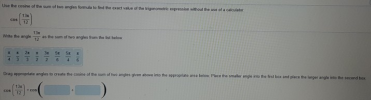 Use the cosine of the sum of two angles formula to find the exact value of the trigonometric expression without the use of a calculator Write the angle as the sum of two angles from the list below. Drag appropriate angles to create the cosine of the sum of two angles given above into the appropriate area below. Place the smaller angle into the first box and place the larger angle into the second box
7.(15 pts.) Use trigonometry to find all sides and angles in the triangle below. 28 in...
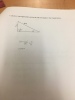 7.(15 pts.) Use trigonometry to find all sides and angles in the triangle below. 28 in 30 in5 28n
Two sides and an angle are given below. Determine whether the given information results in one triangle, two triangles, or no triangle at all. Solve any triangle(s) that results.
Two sides and an angle are given below. Determine whether the given information results in one triangle, two triangles, or no triangle at all. Solve any triangle(s) that results. a = 7, c=5, C = 40° Select the correct choice below and, if necessary, fill in the answer boxes to complete your choice. (Type an integer or decimal rounded to two decimal places as needed.) A. A single triangle is produced, where B≈_______ , A≈_______ , and b ≈ _______ B. Two triangles are produced,...
 Convert the following angles from degrees to radians, or from radians to degrees. Sketch the angle on the coordinate plane with the origin as the vertex and the positive x-axis as the initial side. 2) 210 18 3) - 135 13 6 5) -340 Problem B: A bike traveling 22 feet per second has wheels with a 27 inch diameter. Find out how fast the wheels are turning (rounded to the nearest 100th rpm). Problem C: A sprinkler system on...
 2. For the ideal transformer in the figure below, find the amplitudes and phase angles of V1, V2, 11, and 12. 10 k12 0.5 H 10:1 330 10.cos(100t) V 5000 uF
 Part E - Use phasors to subtract one sinusoid from another sinusoid Suppose you want to find the difference of two sinusoidal currents, given as follows: ¿1(t) = 1; cos(wt+$1) and iz(t) = 12 cos(wt+$2). If you stay in the time domain, you will have to use trigonometric identities to perform the subtraction. But if you transform to the frequency domain, you can simply subtract the phasors I1 and 12 as complex numbers using y calculator. Make sure that all...
 Mesh Analysis in AC Circuits Show all work for your calculations. Include all phase angles, where applicable. 1. Construct the circuit shown below R1 R2 160 220Ω 1500 V1 C1 0.1uF L1 56mH 1.5kHz 2. U sing mesh analysis, calculate the mesh currents and using your solution determine currents through each component. Record your results in Table 1. Show your work the space provided for calculations. Include all phase angles. Using the values of the currents and Ohm's Law, determine...
 Find general equations for the magnitude and phase angle of the transfer function below: (2+ jw) H(jw) = (1+j ) (7 +jw)
 Use the cosine of the sum of two angles formula to find the exact value of the trigonometric expression without the use of a calculator Write the angle as the sum of two angles from the list below. Drag appropriate angles to create the cosine of the sum of two angles given above into the appropriate area below. Place the smaller angle into the first box and place the larger angle into the second box
 7.(15 pts.) Use trigonometry to find all sides and angles in the triangle below. 28 in 30 in5 28n
Most questions answered within 3 hours.
-
Where is the error in this code sequence?
String s1 = "Hello";
String s2 = "ello";...
asked 11 months ago -
Financial data for Joel de Paris, Inc., for last year
follow:
Joel de Paris, Inc.
Balance...
asked 11 months ago -
Consider this reaction:
Al2(SO4)3 (aq)+ BaCl3
(aq) Al2Cl6 (aq)- +
3BaSO4(s) . What is the...
asked 11 months ago -
Suppose that Savneet is considering increasing her
recent random sample from 20 car rentals to 40...
asked 11 months ago -
Trucks arrive at an unloading terminal at an average rate of 120
per hour.
Trucks arrive...
asked 11 months ago -
Why are methanol and ethanol completely soluble in water while
octanol is not very little soluble....
asked 11 months ago -
A facilities manager at a university reads in a research report
that the mean amount of...
asked 11 months ago -
When the CuSO4 is rehydrated by adding water to the anhydrous
compound, is this an endothermic...
asked 11 months ago -
A ray of sunlight is passing from diamond into crown glass; the
angle of incidence is...
asked 11 months ago -
A block of mass 0.249 kg is placed on top of a light, vertical
spring of...
asked 11 months ago -
how do the kidneys compensate in the presences of acidosis
a) trigger hyperventilate
b) reserve acid...
asked 11 months ago -
Question 501 pts
The rental rate of capital to the firm increases. Which of the
following...
asked 11 months ago