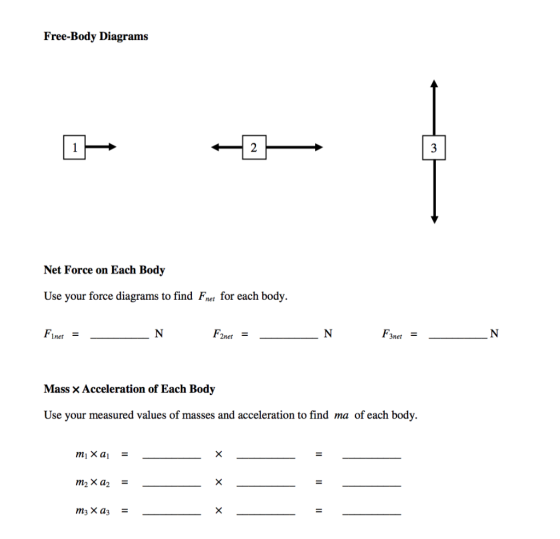
Force probe 1=0.47, force probe 2= 0.93, Gravitational force body 3=0.98
m1=0.66kg, m2=0.65kg, m3=0.1kg
a=0.7
Homework Answers
Here,
Force probe 1 
Force probe 2
Gravitational force 
Mass of block 1 
Mass of block 2 
Mass of block 3 
Acceleration 
Net force in each block 
Since, block is accelerating in positive x direction, net
force  in block 1 in horizontal direction by applying Newton's laws of
motion:
in block 1 in horizontal direction by applying Newton's laws of
motion:



Therefore, the net force on block 1 is 0.462 N.
Since, block 2 is accelerating in positive x direction, net
force  in block 2 in horizontal direction by applying Newton's laws of
motion:
in block 2 in horizontal direction by applying Newton's laws of
motion:



Therefore, the net force on block 2 is 0.46 N.
Since, block 3 is accelerating in negative y direction, net
force  in block 3 in vertical direction by applying Newton's laws of
motion:
in block 3 in vertical direction by applying Newton's laws of
motion:



Therefore, the net force on block 3 is -0.05 N.
Here, negative sign indicates the downward net force direction.
Add Answer to:
Force probe 1=0.47, force probe 2= 0.93, Gravitational force
body 3=0.98
m1=0.66kg, m2=0.65kg, m3=0.1kg
a=0.7
Free-Body...
Hi i need help with the question. Could you draw the free body diagram of m1,m2...
 Hi i need help with the question. Could you draw the free body
diagram of m1,m2 and m3 and an explaination for the problem.
Thanks
FB-diagram a-calculation m1 m2 7. (20 points) Consider a block of mass M on a ramp of angle e. The block is attached by massless strings over massless, frictionless pulleys to two objects, mi and m2, both of mass m where m < M. Assume there is no friction between the block of mass M...
Hi i need help with the question. Could you draw the free body
diagram of m1,m2 and m3 and an explaination for the problem.
Thanks
FB-diagram a-calculation m1 m2 7. (20 points) Consider a block of mass M on a ramp of angle e. The block is attached by massless strings over massless, frictionless pulleys to two objects, mi and m2, both of mass m where m < M. Assume there is no friction between the block of mass M...
Below is a schematic of a double Atwood machine: 1. 2T T m1 T/2 m2 m3 (a) For each of the masses, draw a free body diag...
 Below is a schematic of a double Atwood machine: 1. 2T T m1 T/2 m2 m3 (a) For each of the masses, draw a free body diagram (0.5 mark) (b) Write all 4 coupled equations describing the systems (HINT: 3 equations of motion for the 3 masses and 1 equation relating the accelerations) (1.5 marks) (c) Write the coupled equations from above into a matrix (HINT: look at Week 3 Physics content lecture slides) (1 mark) (d) Row reduce your...
b)set up the net force equations for m1 and m2 for both x and y directions....
 b)set up the net force equations for m1 and m2 for both x and
y directions.
C) calculate the magnitude of acceleration of the
blocks.
please explain clearly, really trying to understand.
4. [22 points) Two blocks A and B of masses mi and m2 are connected by a string as shown in the figure below. Assume that frictional force is negligible. Block A has a mass of 6.00 kg and block B has a mass of 4.00 kg. B...
b)set up the net force equations for m1 and m2 for both x and
y directions.
C) calculate the magnitude of acceleration of the
blocks.
please explain clearly, really trying to understand.
4. [22 points) Two blocks A and B of masses mi and m2 are connected by a string as shown in the figure below. Assume that frictional force is negligible. Block A has a mass of 6.00 kg and block B has a mass of 4.00 kg. B...
Answer: 2.93 x 10A(3) Question 4 Three point masses, m1 150 kg, m2 185 kg and...
 Answer: 2.93 x 10A(3) Question 4 Three point masses, m1 150 kg, m2 185 kg and m3 278 kg are located in the x-y plane. The coordinates of the masses are the following: m1 (-3.0 m, -6,0 m), m2 (+4.0 m, +8.0 m) and m3 (+5.0 m, -3.0 m). Determine the magnitude of the net gravitational force on m3 due to the other two masses. Give your answer in the form "a.bcx 10Ak)" N. Not yet answered Marked out of...
2. Atwood's Table with Two Hanging Masses You have table of width L, masses m1, m2,...
2. Atwood's Table with Two Hanging Masses You have table of width L, masses m1, m2, and m3, two frictionless pulleys, and ideal string. Placing m2 on the table, you attach a bit of string to mass m1 the left pulley, to the left side of m2. Similarly, you hang mass m3 from the right side of m2 using the pulley on the right side of the table. The coefficient of friction of the table is mu. The acceleration of...
A force of magnitude 7.50 N pushes three boxes with masses m1= 1.30 kg,m2= 3.20 kg, and m3= 4.90 kg
 A force of magnitude 7.50 N pushes three boxes with masses m1= 1.30 kg,m2= 3.20 kg, and m3= 4.90 kg, as shown in the figure. (Ignore friction.)Find the magnitude of the contact force between boxes 1 and 2Find the magnitude of the contact force between boxes 2 and 3.
As shown in (Figure 1), five balls (masses m1 = 2.20kg, m2 = 2.15kg, m3 =...
As shown in (Figure 1), five balls (masses m1 = 2.20kg, m2 = 2.15kg, m3 = 2.11 kg , m4 = 2.05 kg , m5 = 2.00kg) hang from a crossbar. Each mass is supported by "5-lb test" fishing line which will break when its tension force exceeds 22.2 N ( = 5.00 lb). When this device is placed in an elevator, which accelerates upward, only the lines attached to the 2.05 kg and 2.00kg masses do not break. Within...
Laboratory Unversal Gravitational Law please answer all 3 cases. thank you Laboratory universal gravitational law Answer...
 Laboratory Unversal Gravitational Law
please answer all 3 cases. thank you
Laboratory universal gravitational law Answer all cases please. (Equation 11 Where: - mass of one object in ks - mass of the other object in kg G-Newton's Universal Gravitational Constant r - distance between the two masses in meters Case 1: Glven two masses. - 100 kg = 400 kg, and the attractive force between the two masses is Newtons Case 2: Glven two masses... 230 kg. - 280...
Laboratory Unversal Gravitational Law
please answer all 3 cases. thank you
Laboratory universal gravitational law Answer all cases please. (Equation 11 Where: - mass of one object in ks - mass of the other object in kg G-Newton's Universal Gravitational Constant r - distance between the two masses in meters Case 1: Glven two masses. - 100 kg = 400 kg, and the attractive force between the two masses is Newtons Case 2: Glven two masses... 230 kg. - 280...
Please help. Block 1 (m1 = 5kg) and block 2 (m2 = 6 kg) are adjacent....
 Please help. Block 1 (m1 = 5kg) and block 2 (m2 = 6 kg) are
adjacent.
Block 1 (m1 5 kg) and block 2 (m2 6 kg) are adjacent to each other on the surface of a table. Block 2 is to the LEFT of block 1. A rope pulls on block 2 up and to the right with a vertical tension of 30 N upward, and both blocks move right with an acceleration of magnitude 3 m/s2. The coefficient...
Please help. Block 1 (m1 = 5kg) and block 2 (m2 = 6 kg) are
adjacent.
Block 1 (m1 5 kg) and block 2 (m2 6 kg) are adjacent to each other on the surface of a table. Block 2 is to the LEFT of block 1. A rope pulls on block 2 up and to the right with a vertical tension of 30 N upward, and both blocks move right with an acceleration of magnitude 3 m/s2. The coefficient...
Block 1 (m1 = 5 kg) and block 2 (m2 = 7 kg) are adjacent to...
Block 1 (m1 = 5 kg) and block 2 (m2 = 7 kg) are adjacent to each other on the surface of a table. Block 2 is to the LEFT of block 1. A hand pushes horizontally on block 2 and causes both blocks to move to the right with an acceleration of magnitude 8 m/s2. The coefficient of kinetic friction between the block and the surface equals 0.2. On a sheet of paper, draw the free body diagrams for...
 Hi i need help with the question. Could you draw the free body
diagram of m1,m2 and m3 and an explaination for the problem.
Thanks
FB-diagram a-calculation m1 m2 7. (20 points) Consider a block of mass M on a ramp of angle e. The block is attached by massless strings over massless, frictionless pulleys to two objects, mi and m2, both of mass m where m < M. Assume there is no friction between the block of mass M...
Hi i need help with the question. Could you draw the free body
diagram of m1,m2 and m3 and an explaination for the problem.
Thanks
FB-diagram a-calculation m1 m2 7. (20 points) Consider a block of mass M on a ramp of angle e. The block is attached by massless strings over massless, frictionless pulleys to two objects, mi and m2, both of mass m where m < M. Assume there is no friction between the block of mass M...
 Below is a schematic of a double Atwood machine: 1. 2T T m1 T/2 m2 m3 (a) For each of the masses, draw a free body diagram (0.5 mark) (b) Write all 4 coupled equations describing the systems (HINT: 3 equations of motion for the 3 masses and 1 equation relating the accelerations) (1.5 marks) (c) Write the coupled equations from above into a matrix (HINT: look at Week 3 Physics content lecture slides) (1 mark) (d) Row reduce your...
 b)set up the net force equations for m1 and m2 for both x and
y directions.
C) calculate the magnitude of acceleration of the
blocks.
please explain clearly, really trying to understand.
4. [22 points) Two blocks A and B of masses mi and m2 are connected by a string as shown in the figure below. Assume that frictional force is negligible. Block A has a mass of 6.00 kg and block B has a mass of 4.00 kg. B...
b)set up the net force equations for m1 and m2 for both x and
y directions.
C) calculate the magnitude of acceleration of the
blocks.
please explain clearly, really trying to understand.
4. [22 points) Two blocks A and B of masses mi and m2 are connected by a string as shown in the figure below. Assume that frictional force is negligible. Block A has a mass of 6.00 kg and block B has a mass of 4.00 kg. B...
 Answer: 2.93 x 10A(3) Question 4 Three point masses, m1 150 kg, m2 185 kg and m3 278 kg are located in the x-y plane. The coordinates of the masses are the following: m1 (-3.0 m, -6,0 m), m2 (+4.0 m, +8.0 m) and m3 (+5.0 m, -3.0 m). Determine the magnitude of the net gravitational force on m3 due to the other two masses. Give your answer in the form "a.bcx 10Ak)" N. Not yet answered Marked out of...
 Laboratory Unversal Gravitational Law
please answer all 3 cases. thank you
Laboratory universal gravitational law Answer all cases please. (Equation 11 Where: - mass of one object in ks - mass of the other object in kg G-Newton's Universal Gravitational Constant r - distance between the two masses in meters Case 1: Glven two masses. - 100 kg = 400 kg, and the attractive force between the two masses is Newtons Case 2: Glven two masses... 230 kg. - 280...
Laboratory Unversal Gravitational Law
please answer all 3 cases. thank you
Laboratory universal gravitational law Answer all cases please. (Equation 11 Where: - mass of one object in ks - mass of the other object in kg G-Newton's Universal Gravitational Constant r - distance between the two masses in meters Case 1: Glven two masses. - 100 kg = 400 kg, and the attractive force between the two masses is Newtons Case 2: Glven two masses... 230 kg. - 280...
 Please help. Block 1 (m1 = 5kg) and block 2 (m2 = 6 kg) are
adjacent.
Block 1 (m1 5 kg) and block 2 (m2 6 kg) are adjacent to each other on the surface of a table. Block 2 is to the LEFT of block 1. A rope pulls on block 2 up and to the right with a vertical tension of 30 N upward, and both blocks move right with an acceleration of magnitude 3 m/s2. The coefficient...
Please help. Block 1 (m1 = 5kg) and block 2 (m2 = 6 kg) are
adjacent.
Block 1 (m1 5 kg) and block 2 (m2 6 kg) are adjacent to each other on the surface of a table. Block 2 is to the LEFT of block 1. A rope pulls on block 2 up and to the right with a vertical tension of 30 N upward, and both blocks move right with an acceleration of magnitude 3 m/s2. The coefficient...
Most questions answered within 3 hours.
-
Where is the error in this code sequence?
String s1 = "Hello";
String s2 = "ello";...
asked 10 months ago -
Financial data for Joel de Paris, Inc., for last year
follow:
Joel de Paris, Inc.
Balance...
asked 10 months ago -
Consider this reaction:
Al2(SO4)3 (aq)+ BaCl3
(aq) Al2Cl6 (aq)- +
3BaSO4(s) . What is the...
asked 10 months ago -
Suppose that Savneet is considering increasing her
recent random sample from 20 car rentals to 40...
asked 10 months ago -
Trucks arrive at an unloading terminal at an average rate of 120
per hour.
Trucks arrive...
asked 10 months ago -
Why are methanol and ethanol completely soluble in water while
octanol is not very little soluble....
asked 10 months ago -
A facilities manager at a university reads in a research report
that the mean amount of...
asked 10 months ago -
When the CuSO4 is rehydrated by adding water to the anhydrous
compound, is this an endothermic...
asked 10 months ago -
A ray of sunlight is passing from diamond into crown glass; the
angle of incidence is...
asked 10 months ago -
A block of mass 0.249 kg is placed on top of a light, vertical
spring of...
asked 10 months ago -
how do the kidneys compensate in the presences of acidosis
a) trigger hyperventilate
b) reserve acid...
asked 10 months ago -
Question 501 pts
The rental rate of capital to the firm increases. Which of the
following...
asked 10 months ago