Assume L is an array, length(L) returns the number of records in the array, and qsort(L, i, j) sorts the records of L from i to j (leaving the records sorted in L) using the Quicksort algorithm. What is the averagecase time complexity for each of the foll
a) For (i=0;i<length(L);i++)
q sort(L,0,i)

b) for (i=0;i<length(L);i++)
qsort(L,0,length(L)-1);
Homework Answers
Request Answer!
We need at least 10 more requests to produce the answer.
0 / 10 have requested this problem solution
The more requests, the faster the answer.
Add Answer to:
Assume L is an array, length(L) returns the number of records in the array, and qsort(L, i, j) sorts the records of L from i to j (leaving the records sorted in L) using the Quicksort algorithm. What is the averagecase time complexity for each of the foll
Assume L is an array, length(L) returns the number of records in the array, and qsort(L, i, j) sorts the records of L from i to j (leaving the records sorted in L) using the Quicksort algorithm. What is the averagecase time complexity for each of the foll
Assume L is an array, length (L) returns the number of records in the array, and qsort \((L, \quad i, j)\) sorts the records of \(L\) from \(i\) to \(j\) (leaving the records sorted in L) using the Quicksort algorithm. What is the average-case complexity for the following code fragment?$$ \begin{array}{c} \text { for }(\mathrm{i}=0 ; \text { i<length }(\mathrm{L}) ; \mathrm{i}++) \\ \text { qsort }(\mathrm{L}, 0, \mathrm{i}) ; \end{array} $$You should provide a formula for computing the total...
Assume L is an array, length(L) returns the number of records in the array, and qsort(L,i,j)...
 Assume L is an array, length(L) returns the number of records in the array, and qsort(L,i,j) sorts the records of L from i toj (leaving the records sorted in L) using the Quicksort algorithm. What is the average-case complexity for the following code fragment? for (i = @; i<length(L); i++) asort(1, 0, 1); Consider the time for each pass of the for loop, and sum them all together. Prove the upper and lower bound, then argue for an average case....
vas Х Assume Lis an array, length(L) returns the number of records in the array, and...
 vas Х Assume Lis an array, length(L) returns the number of records in the array, and qsort(L. 1.j) sorts the records of Lfrom itoj (leaving the records sorted in L) using the Quicksort algorithm. What is the average-case complexity for the following code fragment? for (i = 0; i<length(); i++) asort(1, 0, 1); Consider the time for each pass of the for loop, and sum them all together. Prove the upper and lower bound, then argue for an average case....
C++ Question 14 10 Assume Lis an array, length(L) returns the number of records in the...
 C++
Question 14 10 Assume Lis an array, length(L) returns the number of records in the array, and qsort(L, 1. j) sorts the records of L from i toj (leaving the records sorted in L) using the Quicksort algorithm. What is the average-case complexity for the following code fragment? for (i = 0; i<length(); i++) asort(L, 0, 1); Consider the time for each pass of the for loop, and sum them all together. Prove the upper and lower bound, then...
C++
Question 14 10 Assume Lis an array, length(L) returns the number of records in the array, and qsort(L, 1. j) sorts the records of L from i toj (leaving the records sorted in L) using the Quicksort algorithm. What is the average-case complexity for the following code fragment? for (i = 0; i<length(); i++) asort(L, 0, 1); Consider the time for each pass of the for loop, and sum them all together. Prove the upper and lower bound, then...
7. (20 points) Assume L is a list, and assume that int n=L length() returns the number of element...
 7. (20 points) Assume L is a list, and assume that int n=L length() returns the number of elements in the list, and Bubblsort(L, 0,i) sorts the list from 0 to i usin the g the Bubble sort algorithm. Determine asymtotic running time as function of n, e(T(n), for the average case time for the following code fragments a) for( int i = 1;i < n; i* 2) Bubblsort (L,0,i); for( int i=0;i
7. (20 points) Assume L is a...
7. (20 points) Assume L is a list, and assume that int n=L length() returns the number of elements in the list, and Bubblsort(L, 0,i) sorts the list from 0 to i usin the g the Bubble sort algorithm. Determine asymtotic running time as function of n, e(T(n), for the average case time for the following code fragments a) for( int i = 1;i < n; i* 2) Bubblsort (L,0,i); for( int i=0;i
7. (20 points) Assume L is a...
What is the purpose of the following pseudocode: i = 0 j = length / 2...
What is the purpose of the following pseudocode: i = 0 j = length / 2 While i < length / 2 # Swap elements at positions i and j temp = a[i] a[i] = a[j] a[j] = temp i = i + 1 j = j + 1 Group of answer choices flip the first half of a list with the second half sort the list from smallest to largest sort the list from largest to smallest reverse the...
Algorithm Analysis: Study the following sorting algorithm. SORT( A[1...n]) bound <- Length(A) -1 for i...
Algorithm Analysis: Study the following sorting algorithm. SORT( A[1...n]) bound <- Length(A) -1 for i <- 1 to Length(A) newbound <- 0 for j <- 0 to bound if A[j] > A[j + 1] swap( A[j], A[j + 1] ) newbound = j -1 bound <- newbound (a) Use the longer approach described in lecture 3 week 1 that we used in analyzing Insertion-Sort to compute the running time T(n) of the above SORT algorithm. You may...
A. What is the time complexity of Merge Sort? B. Explain why Merge Sort has the...
 A. What is the time complexity of Merge Sort? B. Explain why Merge Sort has the time complexity you listed above in Part A. Algorithm Quicksort (A, left, right) if (left < right) pivot Point = [(left+right)/2] 11 note central pivot i left - 1 ja right + 1 do do it i +1 while (i < A.size) and (A[i] SA[pivot Point]) do jj-1 while (j > i) and (A[il > A[pivot Point]) if (i <j) then swap (A[i], Aljl)...
2. A straight section of wire of length L carries a current i. (a) Show that...
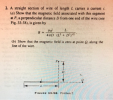 2. A straight section of wire of length L carries a current i. (a) Show that the magnetic field associated with this segmert at P, a perpendicular distance D from one end of the wire (see Fig. 33-58), is given by (b) Show that the magnetic field is zero at point Q, along the line of the wire. Pt 0 FIGURE 33-58. Problem 2
4) [15 points total (5 points each)] Assume you are given a sorted array A of n numbers, where A is indexed from 1 up t...
 4) [15 points total (5 points each)] Assume you are given a sorted array A of n numbers, where A is indexed from 1 up to n, anda number num which we wish to insert into A, in the proper sorted position. The function Search finds the minimum index i such that num should be inserted into Ali]. It searches the array sequentially until it finds the location i. Another function MakeRoom moves A[i], .., AIn] to Ali+1]...AIn+1] same sort...
 Assume L is an array, length(L) returns the number of records in the array, and qsort(L,i,j) sorts the records of L from i toj (leaving the records sorted in L) using the Quicksort algorithm. What is the average-case complexity for the following code fragment? for (i = @; i<length(L); i++) asort(1, 0, 1); Consider the time for each pass of the for loop, and sum them all together. Prove the upper and lower bound, then argue for an average case....
 vas Х Assume Lis an array, length(L) returns the number of records in the array, and qsort(L. 1.j) sorts the records of Lfrom itoj (leaving the records sorted in L) using the Quicksort algorithm. What is the average-case complexity for the following code fragment? for (i = 0; i<length(); i++) asort(1, 0, 1); Consider the time for each pass of the for loop, and sum them all together. Prove the upper and lower bound, then argue for an average case....
 C++
Question 14 10 Assume Lis an array, length(L) returns the number of records in the array, and qsort(L, 1. j) sorts the records of L from i toj (leaving the records sorted in L) using the Quicksort algorithm. What is the average-case complexity for the following code fragment? for (i = 0; i<length(); i++) asort(L, 0, 1); Consider the time for each pass of the for loop, and sum them all together. Prove the upper and lower bound, then...
C++
Question 14 10 Assume Lis an array, length(L) returns the number of records in the array, and qsort(L, 1. j) sorts the records of L from i toj (leaving the records sorted in L) using the Quicksort algorithm. What is the average-case complexity for the following code fragment? for (i = 0; i<length(); i++) asort(L, 0, 1); Consider the time for each pass of the for loop, and sum them all together. Prove the upper and lower bound, then...
 7. (20 points) Assume L is a list, and assume that int n=L length() returns the number of elements in the list, and Bubblsort(L, 0,i) sorts the list from 0 to i usin the g the Bubble sort algorithm. Determine asymtotic running time as function of n, e(T(n), for the average case time for the following code fragments a) for( int i = 1;i < n; i* 2) Bubblsort (L,0,i); for( int i=0;i
7. (20 points) Assume L is a...
7. (20 points) Assume L is a list, and assume that int n=L length() returns the number of elements in the list, and Bubblsort(L, 0,i) sorts the list from 0 to i usin the g the Bubble sort algorithm. Determine asymtotic running time as function of n, e(T(n), for the average case time for the following code fragments a) for( int i = 1;i < n; i* 2) Bubblsort (L,0,i); for( int i=0;i
7. (20 points) Assume L is a...
 A. What is the time complexity of Merge Sort? B. Explain why Merge Sort has the time complexity you listed above in Part A. Algorithm Quicksort (A, left, right) if (left < right) pivot Point = [(left+right)/2] 11 note central pivot i left - 1 ja right + 1 do do it i +1 while (i < A.size) and (A[i] SA[pivot Point]) do jj-1 while (j > i) and (A[il > A[pivot Point]) if (i <j) then swap (A[i], Aljl)...
 2. A straight section of wire of length L carries a current i. (a) Show that the magnetic field associated with this segmert at P, a perpendicular distance D from one end of the wire (see Fig. 33-58), is given by (b) Show that the magnetic field is zero at point Q, along the line of the wire. Pt 0 FIGURE 33-58. Problem 2
 4) [15 points total (5 points each)] Assume you are given a sorted array A of n numbers, where A is indexed from 1 up to n, anda number num which we wish to insert into A, in the proper sorted position. The function Search finds the minimum index i such that num should be inserted into Ali]. It searches the array sequentially until it finds the location i. Another function MakeRoom moves A[i], .., AIn] to Ali+1]...AIn+1] same sort...
Most questions answered within 3 hours.
-
Where is the error in this code sequence?
String s1 = "Hello";
String s2 = "ello";...
asked 11 months ago -
Financial data for Joel de Paris, Inc., for last year
follow:
Joel de Paris, Inc.
Balance...
asked 11 months ago -
Consider this reaction:
Al2(SO4)3 (aq)+ BaCl3
(aq) Al2Cl6 (aq)- +
3BaSO4(s) . What is the...
asked 11 months ago -
Suppose that Savneet is considering increasing her
recent random sample from 20 car rentals to 40...
asked 11 months ago -
Trucks arrive at an unloading terminal at an average rate of 120
per hour.
Trucks arrive...
asked 11 months ago -
Why are methanol and ethanol completely soluble in water while
octanol is not very little soluble....
asked 11 months ago -
A facilities manager at a university reads in a research report
that the mean amount of...
asked 11 months ago -
When the CuSO4 is rehydrated by adding water to the anhydrous
compound, is this an endothermic...
asked 11 months ago -
A ray of sunlight is passing from diamond into crown glass; the
angle of incidence is...
asked 11 months ago -
A block of mass 0.249 kg is placed on top of a light, vertical
spring of...
asked 11 months ago -
how do the kidneys compensate in the presences of acidosis
a) trigger hyperventilate
b) reserve acid...
asked 11 months ago -
Question 501 pts
The rental rate of capital to the firm increases. Which of the
following...
asked 11 months ago