![Figure 2.11 Two-bar truss. -14 3 0 3-1 [A]=1 4 2.21 The potential energy of the two-bar truss shown in Fig. 2.11 is given by s (2s where E is Youngs modulus, A the cross-sectional area of each member, I the span or the tru s the length of each member, h the height of the truss the applied load, θ the angle at which the load is applied, and x and x are, respectively, the horizontal and vertical displacements of the free node. Find the values of xi and x that minimize the potential energy when E 207 x 10, Pa. A=10-5 m?. / = 1.5 m, h 4.0 m, P=10° N, and θ = 30°.](http://img.homeworklib.com/questions/96a44590-6575-11eb-a4cf-478877a1c255.png?x-oss-process=image/resize,w_560)
Homework Answers


Add Answer to:
Figure 2.11 Two-bar truss. -14 3 0 3-1 [A]=1 4 2.21 The potential energy of the...
3. A two bar truss structure is shown in Figure 1. The coordinates of Points A, C and B are given...
 3. A two bar truss structure is shown in Figure 1. The coordinates of Points A, C and B are given by (0,0), (0, 10") and (10",0), respectively, in which the x-axis is from A to B and the y-axis is from A to C. Points A and C are fixed. The cross-sectional area of all members in inch?. A vertical point load, P, is applied at the tip of the structure, Point B. Based upon either the Principle of...
2. For the pin-jointed truss shown in Figure Q2.1 applied at node 4. The Young's modulus E(GPa) is the same for...
 2. For the pin-jointed truss shown in Figure Q2.1 applied at node 4. The Young's modulus E(GPa) is the same for the three truss vertical downward force P(kN) is a members. The cross sectional area of each of the truss members is indicated below and expressed in terms of a constant A. By using the stiffness method: (a) Compute the reduced stiffness matrix Kg [5 marks [10 marks (b) Calculate the global displacements of node 4 in terms of P,...
Determine the nodal displacements and reaction forces using the finite element direct method for the 1-D bar elements connected as shown below.
 Determine the nodal displacements and reaction forces using the finite element direct method for the 1-D bar elements connected as shown below. Do not rename the nodes or elements when solving. Assume that the bars can only undergo translation in x (1 DOF at each node). Nodes 1 and 3 are fixed Element 1 has Young's Modulus of 300 Pa, length of 1 m and cross-sectional area of 1 m2. Element 2 has Young's Modulus of 200 Pa, length of 2...
The three-bar truss ABC shown in the figure has a span L = 3 m and...
 The three-bar truss ABC shown in the figure has a span L = 3 m and is constructed of steel pipes having cross-sectional area A = 3900 mm and modulus of elasticity E = 200 GPa. A load P acts horizontally to the right at joint C. (a) If P= 500 kN, what is the horizontal displacement of joint B? (b) What is the maximum permissible load Pox if the displacement of joint B is limited to 2.5mm? 45 45°...
1. The following is a one-layer truss structure fabricated from aluminum tubing with outside diameter and...
 1. The following is a one-layer truss structure fabricated from aluminum tubing with outside diameter and wall thickness as 0.4 inch and 0.05 inch, respectively. The Young's modulus and Poisson's ratio for aluminum are E= 10 x 10°psi, v=0.33, respectively. The applied load P is 60 Ib. = 60° B Ra UR The internal force for member AC is: -30 lb 34.6 lb 30 lb -34.6 lb Question 2 1 points Save Answer 1. The following is a one-layer truss...
For the 3-D indeterminate (4-member) TRUSS structure shown in Figure 2A. Given that Px 10K (in...
 For the 3-D indeterminate (4-member) TRUSS structure shown in Figure 2A. Given that Px 10K (in X-direction); Py none (in Y-direction); E 30,000 ksi; A 0.2 square inches. The nodal coordinates, the earth-quake displacement/settlement, and members' connectivity information are given aS Applied Load! Earth-Quake MEMBER #1 NODE # X node-i node-j 120.00" 160.00"| 80.00"| Px=-10 Kips none Py- none 120.00" 160.00"0.00"none 120.00"0.00" 0.00" none 0.00" 0.00"0.00" none 0.00" 0.00" 80.00" none none 2 none 4 4 none 4 +2.00" (in...
1. The following is a one-layer truss structure fabricated from aluminum tubing with outside diameter and...
 1. The following is a one-layer truss structure fabricated from aluminum tubing with outside diameter and wall thickness as 0.4 inch and 0.05 inch, respectively. The Young's modulus and Poisson's ratio for aluminum are E = 10 x 10Ⓡpsi, v=0.33, respectively. The applied load P is 60 lb. °60 - 8ܢ Bܢ Ra Rb The internal force for member AC is: 34.6 lb -34.6 lb -30 lb O 30 lb The cross-sectional area of the tube is: O 0.045in2 O...
Question 1 (10 marks) Consider the bar element shown in Figure 1. Cross sectional area A...
 Question 1 (10 marks) Consider the bar element shown in Figure 1. Cross sectional area A = 200 mm and Young's modulus E = 200 x 107 kPa. If u = 3 mm and u2 = 2 mm, determine: (a) the displacement at point P, (b) the strain, (c) the stress, and (d) the strain energy in the element. U] U2 x = 400 mm xi = 200 mm x2 = 700 mm Figure 1 EAL 2 Note: the strain...
2. A 1-D mechanical bar (see Figure) consisting of two materials is clamped at x-0 while subjected to a displacement (u...
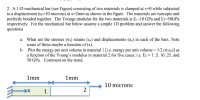 2. A 1-D mechanical bar (see Figure) consisting of two materials is clamped at x-0 while subjected to a displacement (u 10 microns) at x-2mm as shown in the figure. The materials are isotropic and perfectly bonded together. The Youngs modulus for the two materials is E1 -10 GPa and E-50GPa respectively. For the mechanical bar below assume a simple 1D problem and answer the following questions What are the stresses (o) strains (Ex) and displacements (u) in each of...
Problem 1 The truss (all joints are pinned) structure in figure 1 is made of members with cross s...
 We were unable to transcribe this imageProblem 1 The truss (all joints are pinned) structure in figure 1 is made of members with cross sectional area A = 1 in, with a linear elastic, homogeneous, isotropic material with an elastic modulus. E-10E6 psi and a coefficient of thermal expansion, α-6E-6 °F-ι. The structure starts out at a uniform temperature of 65°F and is raised to a final temperature of 120°F while being subjected to a concentrated load Po- 5,000 lbs...
 3. A two bar truss structure is shown in Figure 1. The coordinates of Points A, C and B are given by (0,0), (0, 10") and (10",0), respectively, in which the x-axis is from A to B and the y-axis is from A to C. Points A and C are fixed. The cross-sectional area of all members in inch?. A vertical point load, P, is applied at the tip of the structure, Point B. Based upon either the Principle of...
 2. For the pin-jointed truss shown in Figure Q2.1 applied at node 4. The Young's modulus E(GPa) is the same for the three truss vertical downward force P(kN) is a members. The cross sectional area of each of the truss members is indicated below and expressed in terms of a constant A. By using the stiffness method: (a) Compute the reduced stiffness matrix Kg [5 marks [10 marks (b) Calculate the global displacements of node 4 in terms of P,...
 Determine the nodal displacements and reaction forces using the finite element direct method for the 1-D bar elements connected as shown below. Do not rename the nodes or elements when solving. Assume that the bars can only undergo translation in x (1 DOF at each node). Nodes 1 and 3 are fixed Element 1 has Young's Modulus of 300 Pa, length of 1 m and cross-sectional area of 1 m2. Element 2 has Young's Modulus of 200 Pa, length of 2...
 The three-bar truss ABC shown in the figure has a span L = 3 m and is constructed of steel pipes having cross-sectional area A = 3900 mm and modulus of elasticity E = 200 GPa. A load P acts horizontally to the right at joint C. (a) If P= 500 kN, what is the horizontal displacement of joint B? (b) What is the maximum permissible load Pox if the displacement of joint B is limited to 2.5mm? 45 45°...
 1. The following is a one-layer truss structure fabricated from aluminum tubing with outside diameter and wall thickness as 0.4 inch and 0.05 inch, respectively. The Young's modulus and Poisson's ratio for aluminum are E= 10 x 10°psi, v=0.33, respectively. The applied load P is 60 Ib. = 60° B Ra UR The internal force for member AC is: -30 lb 34.6 lb 30 lb -34.6 lb Question 2 1 points Save Answer 1. The following is a one-layer truss...
 For the 3-D indeterminate (4-member) TRUSS structure shown in Figure 2A. Given that Px 10K (in X-direction); Py none (in Y-direction); E 30,000 ksi; A 0.2 square inches. The nodal coordinates, the earth-quake displacement/settlement, and members' connectivity information are given aS Applied Load! Earth-Quake MEMBER #1 NODE # X node-i node-j 120.00" 160.00"| 80.00"| Px=-10 Kips none Py- none 120.00" 160.00"0.00"none 120.00"0.00" 0.00" none 0.00" 0.00"0.00" none 0.00" 0.00" 80.00" none none 2 none 4 4 none 4 +2.00" (in...
 1. The following is a one-layer truss structure fabricated from aluminum tubing with outside diameter and wall thickness as 0.4 inch and 0.05 inch, respectively. The Young's modulus and Poisson's ratio for aluminum are E = 10 x 10Ⓡpsi, v=0.33, respectively. The applied load P is 60 lb. °60 - 8ܢ Bܢ Ra Rb The internal force for member AC is: 34.6 lb -34.6 lb -30 lb O 30 lb The cross-sectional area of the tube is: O 0.045in2 O...
 Question 1 (10 marks) Consider the bar element shown in Figure 1. Cross sectional area A = 200 mm and Young's modulus E = 200 x 107 kPa. If u = 3 mm and u2 = 2 mm, determine: (a) the displacement at point P, (b) the strain, (c) the stress, and (d) the strain energy in the element. U] U2 x = 400 mm xi = 200 mm x2 = 700 mm Figure 1 EAL 2 Note: the strain...
 2. A 1-D mechanical bar (see Figure) consisting of two materials is clamped at x-0 while subjected to a displacement (u 10 microns) at x-2mm as shown in the figure. The materials are isotropic and perfectly bonded together. The Youngs modulus for the two materials is E1 -10 GPa and E-50GPa respectively. For the mechanical bar below assume a simple 1D problem and answer the following questions What are the stresses (o) strains (Ex) and displacements (u) in each of...
 We were unable to transcribe this imageProblem 1 The truss (all joints are pinned) structure in figure 1 is made of members with cross sectional area A = 1 in, with a linear elastic, homogeneous, isotropic material with an elastic modulus. E-10E6 psi and a coefficient of thermal expansion, α-6E-6 °F-ι. The structure starts out at a uniform temperature of 65°F and is raised to a final temperature of 120°F while being subjected to a concentrated load Po- 5,000 lbs...
Most questions answered within 3 hours.
-
Where is the error in this code sequence?
String s1 = "Hello";
String s2 = "ello";...
asked 11 months ago -
Financial data for Joel de Paris, Inc., for last year
follow:
Joel de Paris, Inc.
Balance...
asked 11 months ago -
Consider this reaction:
Al2(SO4)3 (aq)+ BaCl3
(aq) Al2Cl6 (aq)- +
3BaSO4(s) . What is the...
asked 11 months ago -
Suppose that Savneet is considering increasing her
recent random sample from 20 car rentals to 40...
asked 11 months ago -
Trucks arrive at an unloading terminal at an average rate of 120
per hour.
Trucks arrive...
asked 11 months ago -
Why are methanol and ethanol completely soluble in water while
octanol is not very little soluble....
asked 11 months ago -
A facilities manager at a university reads in a research report
that the mean amount of...
asked 11 months ago -
When the CuSO4 is rehydrated by adding water to the anhydrous
compound, is this an endothermic...
asked 11 months ago -
A ray of sunlight is passing from diamond into crown glass; the
angle of incidence is...
asked 11 months ago -
A block of mass 0.249 kg is placed on top of a light, vertical
spring of...
asked 11 months ago -
how do the kidneys compensate in the presences of acidosis
a) trigger hyperventilate
b) reserve acid...
asked 11 months ago -
Question 501 pts
The rental rate of capital to the firm increases. Which of the
following...
asked 11 months ago