
Homework Answers
I have used the Euler's method to calculate the approximate
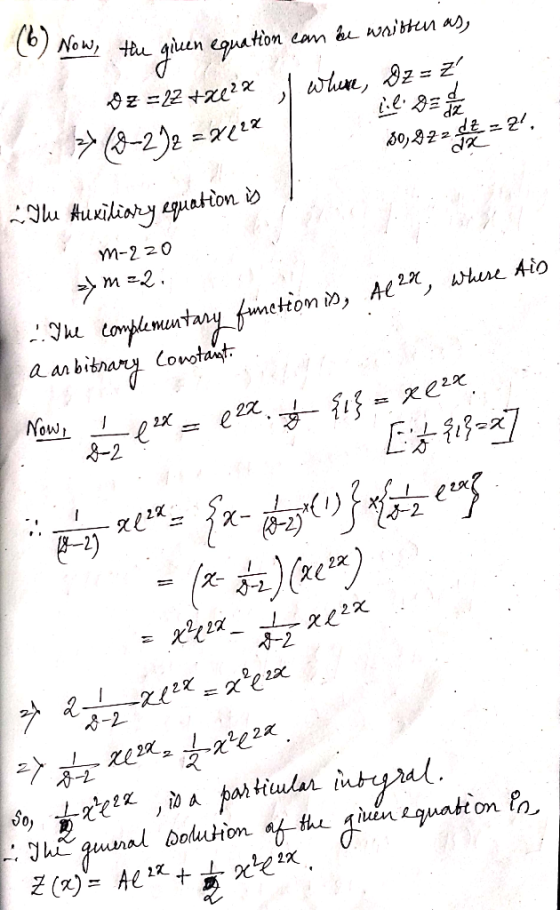
value of z(1) and then analitically , using complementary function
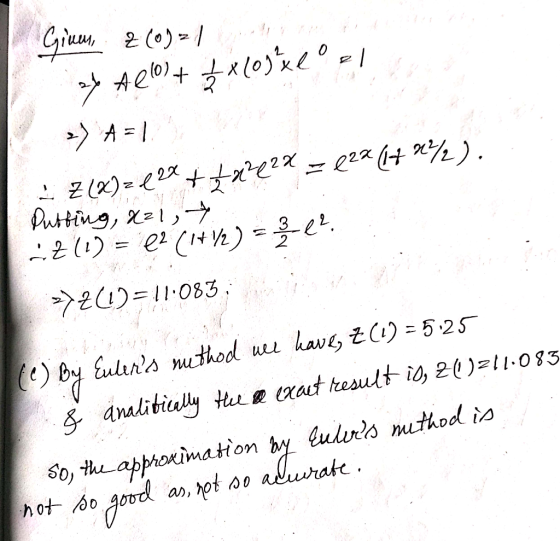
and a particular integral, caculated z(1) and we see that the
approximation is not accurate.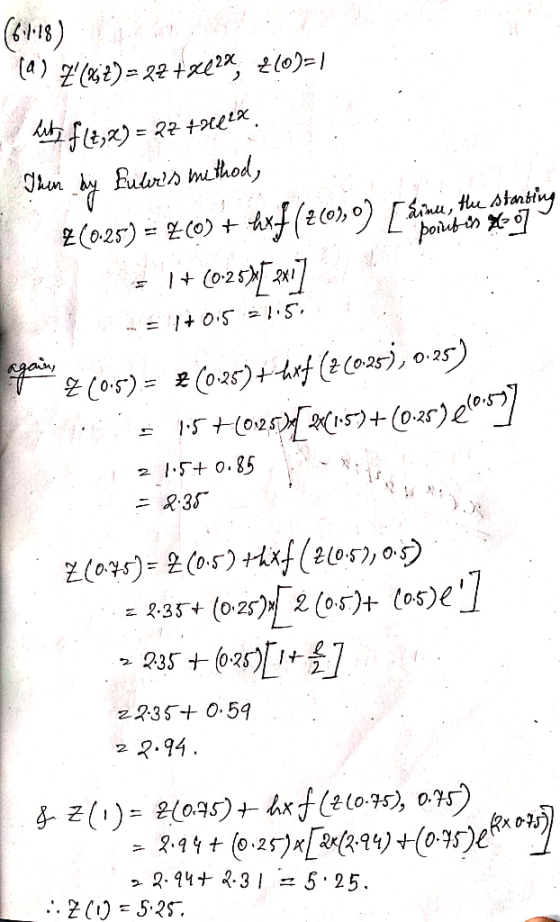
Add Answer to:
PROBLEM 1: (6.1.8) Consider the ODE :'(x, 2) = 2: + rear with 2(0) = 1....
# Q(1) SOLVE A SIMPLE ODE # the ODE, dy/dx + y = x, y(0) =...
# Q(1) SOLVE A SIMPLE ODE # the ODE, dy/dx + y = x, y(0) = 1 can be analytically solved to get # the equation y(x) = x + 2*exp(-x) - 1. # Show that you can use ODEINT to match that performance using pyplot This is in python
2. Consider the following first-order ODE from x = 0 to x = 2.4 with y(0)...
 2. Consider the following first-order ODE from x = 0 to x = 2.4 with y(0) = 2. (a) solving with Euler's explicit method using h=0.6 (b) solving with midpoint method using h= 0.6 (c) solving with classical fourth-order Runge-Kutta method using h = 0.6. Plot the x-y curve according to your solution for both (a) and (b).
I want Matlab code. 22.2 Solve the following problem over the interval from x = 0 to 1 using a step size of 0.25 whe...
 I want Matlab code.
22.2 Solve the following problem over the interval from x = 0 to 1 using a step size of 0.25 where y(0)-1. Display all your results on the same graph. r dV = (1 + 4x) (a) Analytically. (b) Using Euler's method. (c) Using Heun's method without iteration. (d) Using Ralston's method. (e) Using the fourth-order RK method.
22.2 Solve the following problem over the interval from x = 0 to 1 using a step size...
I want Matlab code.
22.2 Solve the following problem over the interval from x = 0 to 1 using a step size of 0.25 where y(0)-1. Display all your results on the same graph. r dV = (1 + 4x) (a) Analytically. (b) Using Euler's method. (c) Using Heun's method without iteration. (d) Using Ralston's method. (e) Using the fourth-order RK method.
22.2 Solve the following problem over the interval from x = 0 to 1 using a step size...
3.) (1 point) Revisit our example from class and estimate y(O) for the ODE: y'= y...
 3.) (1 point) Revisit our example from class and estimate y(O) for the ODE: y'= y + x2 y(-1) = -1, using Euler's Method and an h = 0.25 (4 steps) Also plot the direction field for this ODE from -2<x<2 and -2<y<2, only use integer values of x and y for this plot. Draw a line of the particular solution based on your estimate of y(0)
dy: 2 Consider the following Ordinary Differential Equation (ODE) for function yı(z) on interval [0, 1]...
 dy: 2 Consider the following Ordinary Differential Equation (ODE) for function yı(z) on interval [0, 1] +(-10,3) dayi dy + 28.06 + (-16.368) + y(x) = 1.272.0.52 with the following initial conditions at point a = 0; dy 91 = 4.572 = 30.6248 = 185.2223 dar Introducting notations dyi dy2 dy dar dar dir? convert the ODE to the system of three first-order ODEs for functions y1, y2, y3 in the form: dy dar fi (1, y1, ya, y) dy2...
O Solve the following initial value problems with your VBA code over the interval from t 0 to 2 w...
 I need the visual basic code that is supposed to be typed
through excel
o Solve the following initial value problems with your VBA code over the interval from t 0 to 2 where y(0)1. o Graph the results from each solution method on the same graph. Analytically Euler's method with h 0.5 and h 0.25 Huen's method with h 0.5 and h 0.25 Fourth-order RK with h 0.5
o Solve the following initial value problems with your VBA code...
I need the visual basic code that is supposed to be typed
through excel
o Solve the following initial value problems with your VBA code over the interval from t 0 to 2 where y(0)1. o Graph the results from each solution method on the same graph. Analytically Euler's method with h 0.5 and h 0.25 Huen's method with h 0.5 and h 0.25 Fourth-order RK with h 0.5
o Solve the following initial value problems with your VBA code...
Solve using MATLAB code 22.2 Solve the following problem over the interval from 0 to 1...
 Solve using MATLAB code
22.2 Solve the following problem over the interval from 0 to 1 using a step size of 0.25 where y(0) 1. Display all your results on the same graph. dy dx (a) Analytically (b) Using Euler's method. (c) Using Heun's method without iteration. (d) Using Ralston's method. (e) Using the fourth-order RK method. Note that using the midpoint method instead of Ralston's method in d). You can use my codes as reference.
Solve using MATLAB code
22.2 Solve the following problem over the interval from 0 to 1 using a step size of 0.25 where y(0) 1. Display all your results on the same graph. dy dx (a) Analytically (b) Using Euler's method. (c) Using Heun's method without iteration. (d) Using Ralston's method. (e) Using the fourth-order RK method. Note that using the midpoint method instead of Ralston's method in d). You can use my codes as reference.
using matlab thank you 3 MARKS QUESTION 3 Background The van der Pol equation is a 2nd-order ODE that describes self-sustaining oscillations in which energy is withdrawn from large oscillations and fe...
 using matlab thank you
3 MARKS QUESTION 3 Background The van der Pol equation is a 2nd-order ODE that describes self-sustaining oscillations in which energy is withdrawn from large oscillations and fed into the small oscillations. This equation typically models electronic circuits containing vacuum tubes. The van der Pol equation is: dt2 dt where y represents the position coordinate, t is time, and u is a damping coefficient The 2nd-order ODE can be solved as a set of 1st-order ODEs,...
using matlab thank you
3 MARKS QUESTION 3 Background The van der Pol equation is a 2nd-order ODE that describes self-sustaining oscillations in which energy is withdrawn from large oscillations and fed into the small oscillations. This equation typically models electronic circuits containing vacuum tubes. The van der Pol equation is: dt2 dt where y represents the position coordinate, t is time, and u is a damping coefficient The 2nd-order ODE can be solved as a set of 1st-order ODEs,...
HW12_1 Problem 22.1. (a,b,c). Find y(2). Do the plotting in MATLAB. (which means you are coding...
 HW12_1 Problem 22.1. (a,b,c). Find y(2). Do the plotting in
MATLAB. (which means you are coding each of these methods as well
as doing the work by hand on paper). Just the coding
portion of the question please.
dy dt (a) Analytically (b) Using Euler's method with h-0.5 and 0.25. (c) Using the midpoint method with h-0.5.
HW12_1 Problem 22.1. (a,b,c). Find y(2). Do the plotting in
MATLAB. (which means you are coding each of these methods as well
as doing the work by hand on paper). Just the coding
portion of the question please.
dy dt (a) Analytically (b) Using Euler's method with h-0.5 and 0.25. (c) Using the midpoint method with h-0.5.
ODE Numerical Solution a) The concen function of time by At the initial time, 1-0, the salt concentration in tration of salt x in a homemade soap maker is given as a a) The x 37.5-3.5r the tank is...
 ODE Numerical Solution a) The concen function of time by At the initial time, 1-0, the salt concentration in tration of salt x in a homemade soap maker is given as a a) The x 37.5-3.5r the tank is 50 g/L. Usi concentration after 3 minutes? gL. Using Euler's method and a step size of h O 1.5 min, what is the salt
ODE Numerical Solution a) The concen function of time by At the initial time, 1-0, the salt...
ODE Numerical Solution a) The concen function of time by At the initial time, 1-0, the salt concentration in tration of salt x in a homemade soap maker is given as a a) The x 37.5-3.5r the tank is 50 g/L. Usi concentration after 3 minutes? gL. Using Euler's method and a step size of h O 1.5 min, what is the salt
ODE Numerical Solution a) The concen function of time by At the initial time, 1-0, the salt...
 2. Consider the following first-order ODE from x = 0 to x = 2.4 with y(0) = 2. (a) solving with Euler's explicit method using h=0.6 (b) solving with midpoint method using h= 0.6 (c) solving with classical fourth-order Runge-Kutta method using h = 0.6. Plot the x-y curve according to your solution for both (a) and (b).
 I want Matlab code.
22.2 Solve the following problem over the interval from x = 0 to 1 using a step size of 0.25 where y(0)-1. Display all your results on the same graph. r dV = (1 + 4x) (a) Analytically. (b) Using Euler's method. (c) Using Heun's method without iteration. (d) Using Ralston's method. (e) Using the fourth-order RK method.
22.2 Solve the following problem over the interval from x = 0 to 1 using a step size...
I want Matlab code.
22.2 Solve the following problem over the interval from x = 0 to 1 using a step size of 0.25 where y(0)-1. Display all your results on the same graph. r dV = (1 + 4x) (a) Analytically. (b) Using Euler's method. (c) Using Heun's method without iteration. (d) Using Ralston's method. (e) Using the fourth-order RK method.
22.2 Solve the following problem over the interval from x = 0 to 1 using a step size...
 3.) (1 point) Revisit our example from class and estimate y(O) for the ODE: y'= y + x2 y(-1) = -1, using Euler's Method and an h = 0.25 (4 steps) Also plot the direction field for this ODE from -2<x<2 and -2<y<2, only use integer values of x and y for this plot. Draw a line of the particular solution based on your estimate of y(0)
 dy: 2 Consider the following Ordinary Differential Equation (ODE) for function yı(z) on interval [0, 1] +(-10,3) dayi dy + 28.06 + (-16.368) + y(x) = 1.272.0.52 with the following initial conditions at point a = 0; dy 91 = 4.572 = 30.6248 = 185.2223 dar Introducting notations dyi dy2 dy dar dar dir? convert the ODE to the system of three first-order ODEs for functions y1, y2, y3 in the form: dy dar fi (1, y1, ya, y) dy2...
 I need the visual basic code that is supposed to be typed
through excel
o Solve the following initial value problems with your VBA code over the interval from t 0 to 2 where y(0)1. o Graph the results from each solution method on the same graph. Analytically Euler's method with h 0.5 and h 0.25 Huen's method with h 0.5 and h 0.25 Fourth-order RK with h 0.5
o Solve the following initial value problems with your VBA code...
I need the visual basic code that is supposed to be typed
through excel
o Solve the following initial value problems with your VBA code over the interval from t 0 to 2 where y(0)1. o Graph the results from each solution method on the same graph. Analytically Euler's method with h 0.5 and h 0.25 Huen's method with h 0.5 and h 0.25 Fourth-order RK with h 0.5
o Solve the following initial value problems with your VBA code...
 Solve using MATLAB code
22.2 Solve the following problem over the interval from 0 to 1 using a step size of 0.25 where y(0) 1. Display all your results on the same graph. dy dx (a) Analytically (b) Using Euler's method. (c) Using Heun's method without iteration. (d) Using Ralston's method. (e) Using the fourth-order RK method. Note that using the midpoint method instead of Ralston's method in d). You can use my codes as reference.
Solve using MATLAB code
22.2 Solve the following problem over the interval from 0 to 1 using a step size of 0.25 where y(0) 1. Display all your results on the same graph. dy dx (a) Analytically (b) Using Euler's method. (c) Using Heun's method without iteration. (d) Using Ralston's method. (e) Using the fourth-order RK method. Note that using the midpoint method instead of Ralston's method in d). You can use my codes as reference.
 using matlab thank you
3 MARKS QUESTION 3 Background The van der Pol equation is a 2nd-order ODE that describes self-sustaining oscillations in which energy is withdrawn from large oscillations and fed into the small oscillations. This equation typically models electronic circuits containing vacuum tubes. The van der Pol equation is: dt2 dt where y represents the position coordinate, t is time, and u is a damping coefficient The 2nd-order ODE can be solved as a set of 1st-order ODEs,...
using matlab thank you
3 MARKS QUESTION 3 Background The van der Pol equation is a 2nd-order ODE that describes self-sustaining oscillations in which energy is withdrawn from large oscillations and fed into the small oscillations. This equation typically models electronic circuits containing vacuum tubes. The van der Pol equation is: dt2 dt where y represents the position coordinate, t is time, and u is a damping coefficient The 2nd-order ODE can be solved as a set of 1st-order ODEs,...
 HW12_1 Problem 22.1. (a,b,c). Find y(2). Do the plotting in
MATLAB. (which means you are coding each of these methods as well
as doing the work by hand on paper). Just the coding
portion of the question please.
dy dt (a) Analytically (b) Using Euler's method with h-0.5 and 0.25. (c) Using the midpoint method with h-0.5.
HW12_1 Problem 22.1. (a,b,c). Find y(2). Do the plotting in
MATLAB. (which means you are coding each of these methods as well
as doing the work by hand on paper). Just the coding
portion of the question please.
dy dt (a) Analytically (b) Using Euler's method with h-0.5 and 0.25. (c) Using the midpoint method with h-0.5.
 ODE Numerical Solution a) The concen function of time by At the initial time, 1-0, the salt concentration in tration of salt x in a homemade soap maker is given as a a) The x 37.5-3.5r the tank is 50 g/L. Usi concentration after 3 minutes? gL. Using Euler's method and a step size of h O 1.5 min, what is the salt
ODE Numerical Solution a) The concen function of time by At the initial time, 1-0, the salt...
ODE Numerical Solution a) The concen function of time by At the initial time, 1-0, the salt concentration in tration of salt x in a homemade soap maker is given as a a) The x 37.5-3.5r the tank is 50 g/L. Usi concentration after 3 minutes? gL. Using Euler's method and a step size of h O 1.5 min, what is the salt
ODE Numerical Solution a) The concen function of time by At the initial time, 1-0, the salt...
Most questions answered within 3 hours.
-
Where is the error in this code sequence?
String s1 = "Hello";
String s2 = "ello";...
asked 10 months ago -
Financial data for Joel de Paris, Inc., for last year
follow:
Joel de Paris, Inc.
Balance...
asked 10 months ago -
Consider this reaction:
Al2(SO4)3 (aq)+ BaCl3
(aq) Al2Cl6 (aq)- +
3BaSO4(s) . What is the...
asked 10 months ago -
Suppose that Savneet is considering increasing her
recent random sample from 20 car rentals to 40...
asked 10 months ago -
Trucks arrive at an unloading terminal at an average rate of 120
per hour.
Trucks arrive...
asked 10 months ago -
Why are methanol and ethanol completely soluble in water while
octanol is not very little soluble....
asked 10 months ago -
A facilities manager at a university reads in a research report
that the mean amount of...
asked 10 months ago -
When the CuSO4 is rehydrated by adding water to the anhydrous
compound, is this an endothermic...
asked 10 months ago -
A ray of sunlight is passing from diamond into crown glass; the
angle of incidence is...
asked 10 months ago -
A block of mass 0.249 kg is placed on top of a light, vertical
spring of...
asked 10 months ago -
how do the kidneys compensate in the presences of acidosis
a) trigger hyperventilate
b) reserve acid...
asked 10 months ago -
Question 501 pts
The rental rate of capital to the firm increases. Which of the
following...
asked 10 months ago