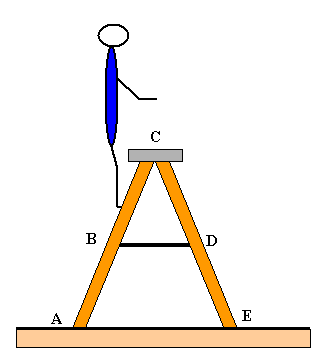
A student is standing on a ladder as shown in the figure to the right. Each leg of the ladder is 2.6 m long and is hidged at point C. The tie-rod (BD) attached halfway up and is 0.7 m long. The student is standing at a spot 1.95 m along the leg and her weight is 541 N. (You may ignore the weight of the ladder and any minor friction between the floor and the legs.)
1)
What is the tension in the tie-rod?
N
2)
What is the vertical component of the force of the ground on the ladder leg at point A?
N
3)
What is the horizontal component of the force of the ground on the ladder leg at point A?
N
4)
What is the vertical component of the force of the ground on the ladder leg at point E?
N
Homework Answers
If the tie-rod is "halfway up and is 0.7 m long," then A is
2*0.70m = 1.4 m from E.
The angle each leg makes with horizontal is
Θ = arccos(0.7/2.6) = 74.4º
4) Sum the moments about A:
ΣM = 0 = E*1.4m - 541N * 1.95m * cos74.4º
E = 283.7N·m / 1.4m = 202.6 N
3) If we "may ignore ... any minor friction," then the horizontal
component of the force at A (and E) is "minor." If friction is
zero, then that component is zero.
2) Sum the vertical forces:
ΣF = 0 = A + E - 541N
A = 541N - E = 338.4 N
1) Cut the ladder in half vertically and sum the moments about C
(using the left half):
ΣM = 0 = 541N * (2.6 - 1.95)m * cos74.4º + T * ½ * 2.6m * sin74.4º
- 338.4 * 0.7m
T = 113.7 N
Add Answer to:
A student is standing on a ladder as shown in the figure to the
right. Each...
For the stepladder shown in the figure, sides AC and CE are each 2.60 m long...
 For the stepladder shown in the figure, sides AC and
CE are each 2.60 m long and hinged at C. Bar
BD is a tie-rod 0.778 m long, halfway up. A man weighing
823 N climbs 1.95 m along the ladder. Assuming that the floor is
frictionless and neglecting the mass of the ladder, find
(a) the tension in the tie-rod and the magnitudes
of the forces on the ladder from the floor at (b)
A and (c) E. (Hint:...
For the stepladder shown in the figure, sides AC and
CE are each 2.60 m long and hinged at C. Bar
BD is a tie-rod 0.778 m long, halfway up. A man weighing
823 N climbs 1.95 m along the ladder. Assuming that the floor is
frictionless and neglecting the mass of the ladder, find
(a) the tension in the tie-rod and the magnitudes
of the forces on the ladder from the floor at (b)
A and (c) E. (Hint:...
For the stepladder shown in the figure, sides AC and CE are each 2.89 m long...
 For the stepladder shown in the figure, sides AC and
CE are each 2.89 m long and hinged at C. Bar
BD is a tie-rod 0.555 m long, halfway up. A man weighing
663 N climbs 2.17 m along the ladder. Assuming that the floor is
frictionless and neglecting the mass of the ladder, find
(a) the tension in the tie-rod and the magnitudes
of the forces on the ladder from the floor at (b)
A and (c) E. (Hint:...
For the stepladder shown in the figure, sides AC and
CE are each 2.89 m long and hinged at C. Bar
BD is a tie-rod 0.555 m long, halfway up. A man weighing
663 N climbs 2.17 m along the ladder. Assuming that the floor is
frictionless and neglecting the mass of the ladder, find
(a) the tension in the tie-rod and the magnitudes
of the forces on the ladder from the floor at (b)
A and (c) E. (Hint:...
Consider a person standing on a ladder. The ladder is 4 m long, has a mass...
 Consider a person standing on a ladder. The ladder is 4 m long, has a mass mı 25 kg, and is leaning against the wall at an angle θ = 70°. The person has a mass m,-75 kg, and their center of mass is located 2.5 m above the ground. a) Draw a free-body diagram, modeling the ladder and person together as one object (i.e. the person will exist in the diagram only as a weight pressing on the ladder)....
A uniform ladder is 14 m long and weighs 210 N. In the figure, the ladder...
 A uniform ladder is 14 m long and weighs 210 N. In the figure, the ladder leans against a vertical, frictionless wall at height h = 7.0 m above the ground. A horizontal force r is applied to the ladder at distance d = 1.2 m from its base (measured along the ladder). If force magnitude F = 40 N, what are (a)-, (b)y-components of the force of the ground on the ladder? If F 130 N, what are (c)x-,...
A uniform ladder is 14 m long and weighs 190 N. In the figure, the ladder...
 A uniform ladder is 14 m long and weighs 190 N. In the figure, the ladder leans against a vertical, frictionless wall at height h 8.0 m above the ground. A horizontal force F is applied to the ladder at distance d 2.0 m from its base (measured along the ladder). If force magnitude F 64 N, what are (a)x-, (b)y-components of are (c)x-, (d)y-components of the force of the ground on the ladder? (e) Suppose the coefficient of static...
A uniform 7.7 m long ladder of mass 18 kg leans against a smooth all (so...
A uniform 7.7 m long ladder of mass 18 kg leans against a smooth all (so that the force exerted by the wall on the ladder is perpendular to the wall). The ladder makes an angle of 18 degrees with the vertical wall and the ground is rough. (a) Calculate the force exerted by the wall on the ladder. N (b) Calculate the x-component of the force exerted by the ground on the ladder at its base. N (c) Calculate...
A uniform ladder stands on a rough floor and rests against a frictionless wall as shown...
 A uniform ladder stands on a rough floor and rests against a frictionless wall as shown in the figure. Since the floor is rough, it exerts both a normal force N, and a frictional force f on the ladder. However, since the wall is frictionless, it exerts only a normal force N, on the ladder. The ladder has a length of L = 4.65 m, a weight of W = 50.5 N, and rests against the wall a distance d...
Tom is climbing a 3.0-m-long ladder that leans against a vertical wall, contacting the wall 2.2...
Tom is climbing a 3.0-m-long ladder that leans against a vertical wall, contacting the wall 2.2 mabove the ground. His weight of 680 N is a vector pointing vertically downward. (Weight is measured in newtons, abbreviated N.) What is the magnitude of the component of Tom's weight perpendicular to the ladder?
A uniform ladder stands on a rough floor and rests against a frictionless wall as shown...
 A uniform ladder stands on a rough floor and rests against a
frictionless wall as shown in the figure.
Since the floor is rough, it exerts both a normal force
N1
and a frictional force
f1
on the ladder. However, since the wall is frictionless, it
exerts only a normal force
N2
on the ladder. The ladder has a length of
L = 4.85 m,
a weight of
WL = 62.5 N,
and rests against the wall a distance
d...
A uniform ladder stands on a rough floor and rests against a
frictionless wall as shown in the figure.
Since the floor is rough, it exerts both a normal force
N1
and a frictional force
f1
on the ladder. However, since the wall is frictionless, it
exerts only a normal force
N2
on the ladder. The ladder has a length of
L = 4.85 m,
a weight of
WL = 62.5 N,
and rests against the wall a distance
d...
 For the stepladder shown in the figure, sides AC and
CE are each 2.60 m long and hinged at C. Bar
BD is a tie-rod 0.778 m long, halfway up. A man weighing
823 N climbs 1.95 m along the ladder. Assuming that the floor is
frictionless and neglecting the mass of the ladder, find
(a) the tension in the tie-rod and the magnitudes
of the forces on the ladder from the floor at (b)
A and (c) E. (Hint:...
For the stepladder shown in the figure, sides AC and
CE are each 2.60 m long and hinged at C. Bar
BD is a tie-rod 0.778 m long, halfway up. A man weighing
823 N climbs 1.95 m along the ladder. Assuming that the floor is
frictionless and neglecting the mass of the ladder, find
(a) the tension in the tie-rod and the magnitudes
of the forces on the ladder from the floor at (b)
A and (c) E. (Hint:...
 For the stepladder shown in the figure, sides AC and
CE are each 2.89 m long and hinged at C. Bar
BD is a tie-rod 0.555 m long, halfway up. A man weighing
663 N climbs 2.17 m along the ladder. Assuming that the floor is
frictionless and neglecting the mass of the ladder, find
(a) the tension in the tie-rod and the magnitudes
of the forces on the ladder from the floor at (b)
A and (c) E. (Hint:...
For the stepladder shown in the figure, sides AC and
CE are each 2.89 m long and hinged at C. Bar
BD is a tie-rod 0.555 m long, halfway up. A man weighing
663 N climbs 2.17 m along the ladder. Assuming that the floor is
frictionless and neglecting the mass of the ladder, find
(a) the tension in the tie-rod and the magnitudes
of the forces on the ladder from the floor at (b)
A and (c) E. (Hint:...
 Consider a person standing on a ladder. The ladder is 4 m long, has a mass mı 25 kg, and is leaning against the wall at an angle θ = 70°. The person has a mass m,-75 kg, and their center of mass is located 2.5 m above the ground. a) Draw a free-body diagram, modeling the ladder and person together as one object (i.e. the person will exist in the diagram only as a weight pressing on the ladder)....
 A uniform ladder is 14 m long and weighs 210 N. In the figure, the ladder leans against a vertical, frictionless wall at height h = 7.0 m above the ground. A horizontal force r is applied to the ladder at distance d = 1.2 m from its base (measured along the ladder). If force magnitude F = 40 N, what are (a)-, (b)y-components of the force of the ground on the ladder? If F 130 N, what are (c)x-,...
 A uniform ladder is 14 m long and weighs 190 N. In the figure, the ladder leans against a vertical, frictionless wall at height h 8.0 m above the ground. A horizontal force F is applied to the ladder at distance d 2.0 m from its base (measured along the ladder). If force magnitude F 64 N, what are (a)x-, (b)y-components of are (c)x-, (d)y-components of the force of the ground on the ladder? (e) Suppose the coefficient of static...
 A uniform ladder stands on a rough floor and rests against a frictionless wall as shown in the figure. Since the floor is rough, it exerts both a normal force N, and a frictional force f on the ladder. However, since the wall is frictionless, it exerts only a normal force N, on the ladder. The ladder has a length of L = 4.65 m, a weight of W = 50.5 N, and rests against the wall a distance d...
 A uniform ladder stands on a rough floor and rests against a
frictionless wall as shown in the figure.
Since the floor is rough, it exerts both a normal force
N1
and a frictional force
f1
on the ladder. However, since the wall is frictionless, it
exerts only a normal force
N2
on the ladder. The ladder has a length of
L = 4.85 m,
a weight of
WL = 62.5 N,
and rests against the wall a distance
d...
A uniform ladder stands on a rough floor and rests against a
frictionless wall as shown in the figure.
Since the floor is rough, it exerts both a normal force
N1
and a frictional force
f1
on the ladder. However, since the wall is frictionless, it
exerts only a normal force
N2
on the ladder. The ladder has a length of
L = 4.85 m,
a weight of
WL = 62.5 N,
and rests against the wall a distance
d...
Most questions answered within 3 hours.
-
Where is the error in this code sequence?
String s1 = "Hello";
String s2 = "ello";...
asked 11 months ago -
Financial data for Joel de Paris, Inc., for last year
follow:
Joel de Paris, Inc.
Balance...
asked 11 months ago -
Consider this reaction:
Al2(SO4)3 (aq)+ BaCl3
(aq) Al2Cl6 (aq)- +
3BaSO4(s) . What is the...
asked 11 months ago -
Suppose that Savneet is considering increasing her
recent random sample from 20 car rentals to 40...
asked 11 months ago -
Trucks arrive at an unloading terminal at an average rate of 120
per hour.
Trucks arrive...
asked 11 months ago -
Why are methanol and ethanol completely soluble in water while
octanol is not very little soluble....
asked 11 months ago -
A facilities manager at a university reads in a research report
that the mean amount of...
asked 11 months ago -
When the CuSO4 is rehydrated by adding water to the anhydrous
compound, is this an endothermic...
asked 11 months ago -
A ray of sunlight is passing from diamond into crown glass; the
angle of incidence is...
asked 11 months ago -
A block of mass 0.249 kg is placed on top of a light, vertical
spring of...
asked 11 months ago -
how do the kidneys compensate in the presences of acidosis
a) trigger hyperventilate
b) reserve acid...
asked 11 months ago -
Question 501 pts
The rental rate of capital to the firm increases. Which of the
following...
asked 11 months ago